Many ASEAN countries are keen to join the BRICS, the economic bloc seen as a counterweight to the dominance of the West over the global economy. Most are interested in leveraging trade and investment through membership while also retaining harmonious ties with the US and other Western countries.
Boosting trade and investment
Back in 2001, when Goldman Sachs coined the acronym BRIC for Brazil, Russia, India and China, it was thought these four powerhouses would shape the future of the global economy. The economic fortunes of most of these countries, excluding India, looks less bright today. But the BRICS has now morphed into a formal grouping of emerging economies that includes Egypt, Ethiopia, Iran, South Africa and the United Arab Emirates.
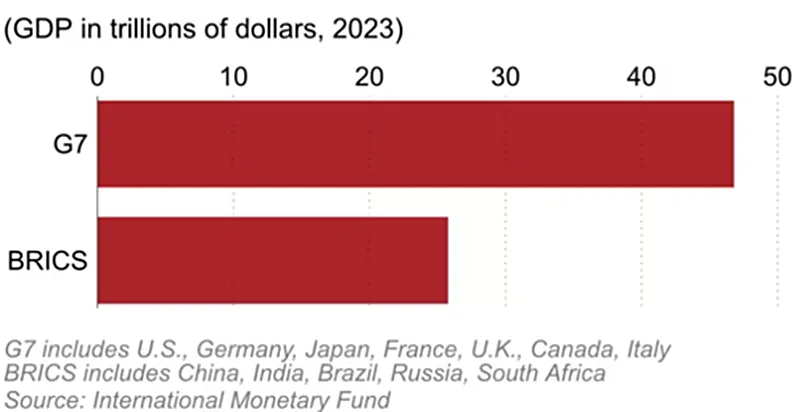
Together, the BRICS economies are home to around 3.5 billion people (or 45% of the global population) and account for around a quarter of global GDP. That represents a vast market for potential exporters and investors, so it is little wonder that many Southeast Asian countries are eager to join.
Moreover, the BRICS have agreed to pool US$100 billion of foreign-currency reserves, which they can lend to each other during emergencies. The group has also created the New Development Bank – a World Bank-modelled institution that has approved almost US$33 billion of loans, mainly for water, transport and other infrastructure projects, since it began operations in 2015, according to Bloomberg. 1
The news agency believes the pool “would be useful in Southeast Asia, where official development finance dwindled to a low of $26 billion in 2022”, according to a recent report by the Sydney-based Lowy Institute.
Indonesia takes a different direction
Indonesia kicked off the ASEAN race to enter the BRICS in late 2023, but that ended in a false start. Jakarta had tracked the organisation since 2011 but ultimately decided against applying for membership. President Jokowi said the government needed more time to study the benefits and drawbacks of BRICS membership, especially in the economic domain, and wanted to consult with its ASEAN partners.
It seems more likely that Jakarta’s long tradition of non-alignment meant it did not want to join a bloc so heavily influenced by China and Russia. So, it has instead applied to join the Paris-based Organisation for Economic Co-operation and Development (OECD), which has 38 mostly Western members. If it is successful in its bid, Indonesia will be the third Asian member, after Japan and South Korea.
The Jakarta Post says that, having regained upper-middle-income economic status this year, the country has ambitions to make it to the world’s top-five largest economies before the middle of the century – and it believes the OECD, rather than the BRICS, provides the best route to get there. 2
Thailand and Malaysia leading the charge
However, Jakarta’s decision has not deterred Laos, Cambodia, Myanmar, Vietnam, Malaysia and Thailand, which are all believed to be interested in applying for BRICS membership.
Malaysian Premier Anwar Ibrahim says the decision to join has already been made. The government believes that membership would boost trade and investment with the grouping. Rahul Mishra, associate professor at the Centre for Indo-Pacific Studies at Jawaharlal Nehru University in New Delhi, recently told Deutsche Welle that joining the bloc would help Malaysia’s digital economy grow faster by allowing it to integrate with countries that have strong digital markets. Membership would also allow it to take advantage of best practices from other members.
A Thai application is imminent for the same reasons as Malaysia; the BRICS already account for nearly a quarter of Thailand’s trade. Mishra believes:
“Thailand would also be able to draw investments in important industries including services, manufacturing, and agriculture.” 3
Apart from boosting trade and investment, Malaysia and other ASEAN members view the BRICS as a way of mitigating the economic risks of increasingly strained ties between the US and China. Many Southeast Asian nations depend economically on trade with China while simultaneously welcoming the security presence and investment that Washington provides.
According to Bloomberg, BRICS membership “is also a way of signalling increasing frustration with the US-led international order and key institutions that remain firmly in the control of Western powers, like the World Bank and International Monetary Fund”. 4
Figure 1: The G7 versus the BRICS
The Philippines and Vietnam ambivalent
The Philippines and Vietnam are proceeding more cautiously. Both fear that accession would lead to excessive dependence on the interests of the major partners – and, in particular, China. Both countries have clashed with China’s aggressively expansionistic ambitions in the South China Sea.
They may also be worried that applying to join the BRICS could endanger relations with the US and its allies, as the BRICS is viewed in Washington and other capitals as being hostile to Western interests and values.
However, countries like Thailand argue that they can act as a bridge between the West and the BRICS. Bangkok is striving to show its even-handed approach by also applying to join the OECD.
Meanwhile, the likes of Myanmar, Cambodia and Laos, which have good relations with China and Russia, are likely to apply for BRICS membership.
If joining the BRICS can boost investment and trade as well as open up access to new forms of financing in the form of loans from the New Development Bank, that can only be positive for the region. But only time will tell whether Indonesia, by applying to join the OECD rather than the BRICS, has taken a more direct route to prosperity. The BRICS certainly faces significant challenges.
Key economies like Russia, China and South Africa face significant long-term challenges, while maintaining the cohesion of such a diverse and expanding group will prove very difficult.
3. https://www.dw.com/en/why-are-southeast-asian-countries-looking-to-join-brics/a-69547127
Source: Worldbox Press Release
About Worldbox Business Intelligence
Worldbox Business Intelligence, headquartered in Switzerland, is a Global API data solution provider of business intelligence and used in data analytics.
With the Global API solution Worldbox Business Intelligence enables clients and partners also a frictionless real time onboarding, KYC and compliance verification while rapid global investigations are provided, if needed.
Worldbox Business Intelligence provides global data in a standardised structure to more than 200 Million companies worldwide. The global network of subsidiaries, branches and desks allows to precisely and efficiently collect data and target key territories for clients and partners.”
“Worldbox Business Intelligence – Bringing Swiss Precision To Data”
Copyright (C) 2024 Worldbox Business Intelligence. All rights reserved.
Our mailing address is:
Worldbox Business Intelligence
Breitackerstrasse 1
Zollikon
Zurich 8702
Switzerland