Green light for Southeast Asian economies in 2025

It’s that time of the year when economic forecasters dust off their crystal ball and peer ahead at likely developments for the New Year. This time round, the outlook seems particularly bullish for Southeast Asia as global borrowing costs fall, says Adrian Ashurst, CEO of Worldbox Business Intelligence.
The economic prospects for Southeast Asia in 2025 appear unusually bright. Nearly every country in the region is expected to see stronger growth than in 2024 as inflation and interest rates decline worldwide. The World Bank, for example, believes that Vietnam will lead the pack, with a growth rate of 6.5%, up from 6.1% in 2024, followed by the Philippines at 6%, up from 5.8%.
Meanwhile, the financial-services company Citi expects the Malaysian economy to expand by 5.2%, up from 4.8%, and Worldbox Business Intelligence anticipates that Indonesia will accelerate slightly to a robust 5.1%, from 5% this year. We also expect Singapore to register growth of more than 3% in 2024 and 2025 – a very healthy pace of expansion for an advanced economy. Cambodia will hum along at 6%, up from 5.8%, while Thailand’s growth rate should improve from 2.6% to 2.8%.
Myanmar and Laos are likely to prove the two main laggards. The civil war will continue to cripple Myanmar’s economy, to the cost of its long-suffering people, while the International Monetary Fund (IMF) anticipates that Laotian growth will fall from 4.1% to 3.5% – a very low level for such an underdeveloped economy.
These projections could increase significantly should global growth accelerate. The IMF’s latest economic outlook, published in October 2024, projects that the world economy will expand by a relatively modest 3.2% in both 2024 and 2025. But while issuing the normal warnings about potential threats to growth, the IMF observes that the “global battle against inflation has largely been won”, which should allow central banks to ease monetary policy significantly in 2025.
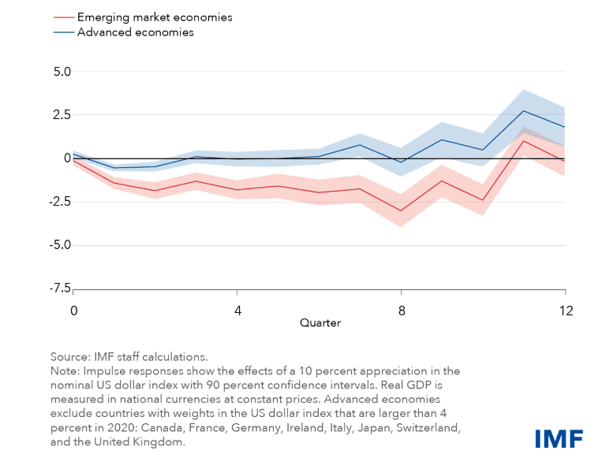
Falling US interest rates, in particular, should prove a boon for Southeast Asia. That’s because easier monetary policy in the US should cause the dollar to weaken as returns on the currency decline. Emerging-market economies, such as those in Southeast Asia, typically feel pressure to raise interest rates to defend their currencies when the US dollar strengthens. The reverse is true when the dollar weakens, so the Southeast Asian central banks will have plenty of scope to ease monetary conditions, providing a further fillip to local economies.
Figure 1: A US dollar appreciation affects emerging economies more than their advanced counterparts
Moreover, as the Federal Reserve cuts American borrowing costs, the tailwind behind the US economy – a critical engine of global growth and demand for Southeast Asian exports – will gather strength.
Trump fears exaggerated?
There are, of course, concerns that a Trump presidency could heighten global tensions and that he could impose tariffs on the likes of China, so destabilising global trade and growth. Perhaps the best means of finding out what might happen to the global economy and Southeast Asia during the next four years is to look at what Trump actually did during his first term.
Trump’s foreign-policy doctrine of “Peace through Strength” certainly worked well in his initial term, when he became one of the few presidents not to embroil the US in a major foreign conflict. And while Trump has a penchant for making bellicose, sometimes absurd statements, he remains at heart a real-estate developer and is always looking to cut the next deal.
Responsible Statecraft cites the example of Iran. In November, it reported that Trump donor and adviser Elon Musk has reportedly held a meeting with Iranian officials with the aim of defusing tensions. That, the publication argues, “could be a sign that the once and future president may truly buck the neocons and interventionists who have dogged Republican and Democratic efforts to engage Iran and kept the US bogged down in conflicts in the Middle East for a generation”. 1
Similarly, while Trump pledged on the campaign trail to raise tariffs on all Chinese imports to 60%, such a move is unlikely and is more probably an opening gambit designed to pressure the Chinese to negotiate a trade deal that lowers the US’s $400 billion-plus annual deficit in trade with China. The Wall Street Journal, for example, recently argued that:
“Many economists say they doubt Trump will succeed in imposing the full 60%. Many U.S. companies oppose such high levies and Trump could back down, especially if he is able to use threats of higher tariffs to secure concessions from China.” 2
Sino–US tensions could boost Southeast Asia
There is even an argument that heightened trade tensions between the US and China could benefit Southeast Asia. Certainly, Southeast Asia has seen massive inflows of foreign direct investment (FDI) over the past 10 years or so as Western and Chinese companies look to relocate capacity from China to the region. The New York Times cites the example of Malaysia, which “aggressively courted American and Chinese companies with tax breaks and other goodies” during Trump’s first term as president.
The strategy worked, says the publication, with Malaysia attracting multi-billion-dollar investments from companies such as Texas Instruments and Lam Research of the US and Alibaba and Geely of China.
With Trump headed back to the White House, and threatening to disrupt global trade again, says The New York Times, Malaysia is hoping it can build on that approach with a plan to turn its southern tip into a hub for multinational companies looking for a safe haven.
A key part of this strategy involves an economic agreement with Singapore, which would see the establishment of a special Malaysian economic zone where companies will be given financial incentives to build factories. That would give “multinational companies based in Singapore, an island city-state on Malaysia’s southern border, the room and workers they need to expand their operations”. 3
In conclusion, then, there are grounds for considerable optimism that Southeast Asia’s economic advance will continue apace in 2025. The region should continue to attract huge sums of FDI as manufacturers shift production from China, local consumers will continue to spend heavily as living standards rise, and exports should expand robustly as global borrowing costs fall.
1 https://responsiblestatecraft.org/trump-iran/
3 https://www.nytimes.com/2024/11/15/business/malaysia-singapore-china-trade.html
Source: Worldbox Press Release
About Worldbox Business Intelligence
Worldbox Business Intelligence, headquartered in Switzerland, is a Global API data solution provider of business intelligence and used in data analytics.
With the Global API solution Worldbox Business Intelligence enables clients and partners a frictionless real time onboarding, KYC and compliance verification, while rapid global investigations are provided, if needed.
Worldbox Business Intelligence provides global data in a standardised structure on more than 300 Million companies worldwide. It’s global network of subsidiaries, branches and desks allows the precise and efficient collection of data on key target territories for clients and partners.”
“Worldbox Business Intelligence – Bringing Swiss Precision To Data”
Copyright (C) 2024 Worldbox Business Intelligence. All rights reserved.
Our mailing address is:
Worldbox Business Intelligence
Breitackerstrasse 1
Zollikon
Zurich 8702
Switzerland