Worldbox Country Risk Climate – September 2024
Vietnam
Summary
| Overall Risk Score 22 (Stable)
Political risk: Stable 7/10 Economic risk: Stable 8/10 Commercial risk: Stable 7/10 The risk assessment of a country is made up of 3 components, being Political, Economic and Commercial. Each component is scored out of 10 with 1 being the highest risk and 10 the lowest. |
ESG Risk: 6/10 (Stable)*
*Environmental, social and governance (ESG) issues are becoming increasingly important to companies, investors and consumers in Southeast Asia. That is why we are now preparing a separate ESG score and section with our quarterly country risk reports. We explain how each country rates, looking at the E, S and G individually, and outline recent developments. |
Political Risk – Stable at 7
Vietnam is a one-party state ruled by the Communist Party of Vietnam (CPV). The CPV provides strategic direction and decides all major policy issues which the government then implements. The four most important positions in the country are CPV General Secretary, the most powerful position in Vietnam, State President, Prime Minister and National Assembly Chair.
General Party Secretary Nguyen Phu Trong was the most powerful man in the country, until he passed away in July 2024. He was re-elected to the position of general secretary of the Communist Party in January 2021, at the age of 76, for a rare third five-year term. After taking office in 2011, Trong built up a strong power base in the Communist Party.
In 2016, Trong launched an anti-corruption campaign known as “blazing furnace”, which resulted in unprecedented political turmoil. Since December 2022, seven of the 18 members (39%) of the elite CPV Politburo have been forced to resign. They include two presidents, a deputy prime minister and the head of the National Assembly.
Trong’s departure will leave a considerable political vacuum. Trong saw the need to open up Vietnam’s economy. During his period in power, GDP per capita more than doubled and Vietnam signed free-trade agreements with the West and Asian neighbours. Trong was seen as keener to engage with the rest of the world than his predecessors, building relationships with US leaders as well as Russian leader Vladimir Putin and Chinese President Xi Jinping.
Trong’s anti-corruption drive does appear to have had some success, according to international corruption rankings by the likes of Transparency International – see Commercial Risk. However, it may also have tarnished the reputation of the CPV, given that so many officials have been caught and prosecuted. It has also destabilised the CPV, with very few leaders left as possible successors. At present there are just two likely successors, President To Lam and Prime Minister Pham Minh Chinh. To Lam has taken over as general secretary on an interim basis.
Economic Risk – Stable at 8
Vietnam’s shift from a centrally planned to a market economy has transformed the country from one of the poorest in the world into one of its most dynamic. Between 2002 and 2022, GDP per capita increased 3.6 times, reaching almost US$3,700, according to the World Bank. It adds that poverty rates (US$3.65/day, 2017 PPP) declined from 14% in 2010 to 3.8% in 2020.
The country’s economic model has been built on attracting foreign investment to drive the transformation from agriculture to a modern economy based on manufacturing. Strong foreign investment and current-account surpluses have strengthened the external position.
Vietnam is benefiting from the shift of production out of China due to geopolitical tensions. In addition, Vietnam offers lower manufacturing wage costs relative to coastal Chinese provinces, where manufacturing wages have been rising rapidly over the past decade. The country’s relatively large, well-educated and disciplined labour force is another attraction.
Domestic infrastructure spending is also supporting growth. The government estimates that US$133 billion of new power infrastructure spending alone will be required by 2030. The country has already been affected by severe power shortages as supply struggles to cope with surging demand.
The country is also benefiting from the signature of several trade agreements that are making it easier to attract FDI by providing better access to markets for Vietnamese exports. The EU–Vietnam Free Trade Agreement entered into force on 1 August 2020, while the UK–Vietnam Free Trade Agreement came into force on 1 May 2021. The Regional Comprehensive Economic Partnership entered into force on 1 January 2022 for 10 countries, including Vietnam. These agreements may benefit foreign companies operating in Vietnam by reducing barriers to inputs from and exports to participating countries.
According to the Ministry of Planning and Investment (MPI), which oversees investment activities, Vietnam’s FDI stock stood at US$297 billion at the end of 2023. Vietnam attracted US$8.25 billion of FDI in the first five months of 2024, the highest level seen in five years, and nearly 8% higher than the same period in 2023. The processing and manufacturing sector accounted for nearly 80% of the total FDI. Much of the money is flowing into industrial zones in the north.
China is a major source of FDI. Hong Kong and mainland China accounted for 23.4% of new FDI in 2023 alone. More Chinese companies are relocating due to the China Plus One strategy, which involves diversifying production out of China.
Commercial Risk – Stable at 7
Businesses operating in Vietnam faces some significant challenges according to the US State Department’s 2024 Investment Climate report. These include widespread corruption, the entrenched position of state-owned enterprises (SOEs) in certain sectors, regulatory uncertainty in key sectors, a weak and opaque legal regime, poor enforcement of intellectual property rights, a shortage of skilled labour, restrictive labour practices, and slow government decision-making processes.
The report adds that due to a high reliance on inputs from China, Vietnamese manufacturing is vulnerable to forced labour risks in supply chains, though the government and industry are actively working to address these concerns.
Corruption is a significant challenge. However, progress does seem to be being made. Vietnam ranked in 83rd place out of 180 countries in Transparency International’s 2023 Corruption Perceptions Index, up from joint 104th in 2021.
The country ranks as the 59th freest in the 2024 Index of Economic Freedom from the Heritage Foundation. Its rating has increased by one point from last year, and Vietnam is ranked 11th out of 39 countries in the Asia-Pacific region.
The lack of adequate infrastructure provides significant challenges to operating in Vietnam. The country is making a huge investment in infrastructure: approximately 6% of GDP, compared with an ASEAN average of 2.3%, highlighting its commitment to growth. However, a significant gap remains between the current infrastructure and the requirements for sustained economic development. In March 2024, Prime Minister Pham Minh Chinh reassured foreign investors that there would be no repeat of last year’s power shortages for their factories, as Vietnam increases coal imports.
September Bulletin
Political Risk – Stable at 7
President To Lam, who has taken over the leadership of the country on an interim basis from General Party Secretary Nguyen Phu Trong, who died in July 2024, is likely to try and cement his position as quickly as possible. The 67-year-old is in a strong position to do so, given he was head of public security, the political police, before becoming president in May.
It remains unclear whether Lam will hold the presidency and the party leadership until the next CPV National Congress in early 2026, or whether an alternative president will be chosen in the coming months. Reuters reports that all of Vietnam’s top jobs will be up for grabs again in 2026, when the country’s parliament ends its five-year term, “with many analysts and diplomats seeing Lam as currently the best placed to keep the leadership of the party”.
There is unlikely to be any change in the political climate should To Lam establish his leadership of the country. During his rule, Trong, a close friend of To Lam, continued to tighten Vietnam’s control on human rights and freedom of speech.
The other potential contender for Communist Party leadership is Prime Minister Pham Minh Chinh. He also spent decades in the security ministry, including as deputy minister. Nikkei Asia reports that:
“Investors were pleasantly surprised when Chinh, upon being elevated to the premiership, embraced business despite lacking an economic background, hobnobbing with Silicon Valley CEOs from Apple’s Tim Cook to Nvidia’s Jensen Huang. Executives hope Lam will follow suit.”
However, Worldbox Business Intelligence does not foresee any major changes to the economic policies that have served Vietnam well over the past decade or so. Nikkei Asia quoted VinUniversity lecturer Hai Hong Nguyen as predicting that, under Lam’s leadership, “we will see regime security tightened more on the one hand, [while] economic liberalisation and foreign relations are enhanced on the other”.
Economic Risk – Stable at 8
The economy grew by a higher-than-forecast 6.93% in the second quarter, buoyed by a recovery in trade and increased business activity aided by foreign investment. The industrial sector remained strong in the first half of the year, with manufacturing output growth – the driver of the country’s economic expansion – at 8.67%, the statistics office said in a statement.
The International Monetary Fund expects Vietnam’s GDP to expand by 6% this year, up from 5% in 2023 – a rate that will place it among Asia’s fastest-growing economies.
Inflation remains relatively contained, with consumer prices increasing by 4.34% in June from a year earlier. The central bank targets an inflation rate of 4.0% to 4.5%. Higher food prices, mainly reflecting supply issues, have contributed to the increase in prices. However, booming domestic demand is also an issue: retail sales accelerated by 9.5% on an annual basis in May. Worldbox Business Intelligence expects interest rates to rise from the current 4.5% over the remainder of the year.
Commercial Risk – Stable at 7
In a setback for Vietnam’s exports to the US, the Biden administration announced in August that it would not lift Vietnam’s “Non-Market Economy” (NME) status. The US Department of Commerce said this was because the Vietnamese government still heavily intervenes in the economy despite recent economic reforms.
The US is Vietnam’s most important export market, with two-way trade totalling more than US$125 billion in 2023. But according to the VoA, Washington has initiated more trade defence investigations – mainly anti-dumping investigations – with Vietnam than with any other country. Vietnam recorded 58 cases subject to US trade remedies as of August 2023, in which 26 were anti-dumping, according to the Vietnam Trade Office in the US.
However, last September, the two countries formally upgraded their diplomatic ties to a “comprehensive strategic partnership”, a symbolic yet highly important move that positions Vietnam as a destination for more US investment, including for critical technologies such as semiconductor chips.
Environmental, Social and Governance (ESG) – Stable at 6
The United Nations’ Sustainable Development Goals (SDGs) are recognised as a beneficial framework for responsible investment. The Sustainable Development Report from Cambridge University Press assesses the progress of all UN Member States on the SDGs. It provides a useful means of ranking Southeast Asian countries on their ESG progress.
Vietnam is ranked 54 out of 166 in the 2024 report, with a score of 73.3.
Environment – According to the Intergovernmental Panel on Climate change, Vietnam is one of several countries most vulnerable to climate change. With 3,260 km of coastline, 2,860 rivers and 4,000 islands, Vietnam is dangerously exposed to flooding, typhoons, tsunamis and tropical storms. A recent catastrophe, ‘The 2020 Central Vietnam floods’ saw a death toll of 189 people and damage worth $1.57 billion. The floods were the result of seasonal monsoons and tropical cyclones.
Attempting to combat climate change, the Vietnamese Government has released plans to reach a net-zero emissions target by 2050. It hopes to increase the country’s renewable energy usage by 67.5%, and pledges to build no new coal-fired power stations post 2030. English-language newspaper, Viêt Nam News claims ‘Coal and gas thermal powers reach 42.7 per cent of energy provided, while turbines are 11.2 per cent and hydroelectric 27.4 per cent’, as of February 2023.
Social – The US State Department Human Rights report for 2022 outlines a number of human rights abuses. The Vietnamese government responded by saying the report contained “unobjective comments based on inaccurate information about the actual situation in Vietnam.”
In terms of worker’ rights, Vietnam adopted an amended Labour Code in January 2021. It is aimed at aligning labour rules with international labour standards assessed by the International Labour Organization.
Governance – Corporate governance is a relatively new concept in Vietnam. The government has taken important measures to improve its ownership and corporate governance frameworks for state-owned enterprises (SOEs), according to an OECD report published in 2022. SOEs account for one-third of GDP and dominate many of the sectors such as energy, transport, telecommunications and finance. The country’s SEC launched the Vietnam Corporate Governance Code of Best Practices in 2019 for the private sector. It draws upon the G20/OECD Principles of Corporate Governance, the 2017 ASEAN Corporate Governance Scorecard, as well as the most recent corporate governance codes of countries around the world.
September Bulletin
Environmental, Social and Governance (ESG) – Stable at 6
The country’s regulators, banks and international aid agencies are promoting the adoption of ESG factors by private-sector enterprises by easing access to funding sources, Vietnam Briefing reported in late May.
Vietnam Brief said that Prime Minister Pham Minh Chinh has reiterated that green growth is one of the two core elements of economic restructuring and growth-model transformation. This shift aims to improve productivity, quality, efficiency and competitiveness, and achieve rapid, sustainable development in the country. However, the publication added that regulatory and policy reforms, including the establishment of a green taxonomy, are needed to encourage banks to provide green credit.
Latest economic data
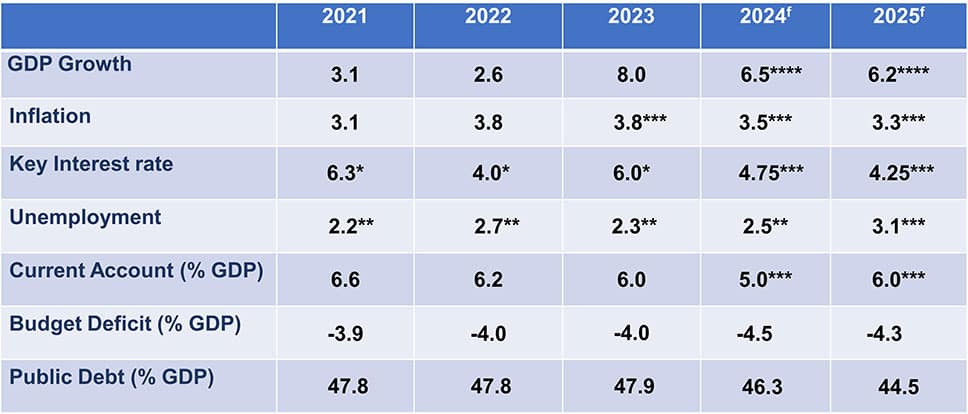
f – forecasts
* State Bank of Vietnam
** Statista
*** Worldbox Intelligence
**** Asian Development Bank
Source: International Monetary Fund, except where stated
Useful Links
https://www.transparency.org/en
https://www.imf.org/en/Countries/VNM
About Worldbox Business Intelligence
Worldbox Business Intelligence, headquartered in Switzerland, is a Global API data solution provider of business intelligence and used in data analytics.
With the Global API solution Worldbox Business Intelligence enables clients and partners also a frictionless real time onboarding, KYC and compliance verification while rapid global investigations are provided, if needed.
Worldbox Business Intelligence provides global data in a standardised structure to more than 200 Million companies worldwide. The global network of subsidiaries, branches and desks allows to precisely and efficiently collect data and target key territories for clients and partners.”
“Worldbox Business Intelligence – Bringing Swiss Precision To Data”
Copyright (C) 2024 Worldbox Business Intelligence. All rights reserved.
Our mailing address is:
Worldbox Business Intelligence
Breitackerstrasse 1
Zollikon
Zurich 8702
Switzerland