Worldbox Country Risk Climate – May 2025
Vietnam
Summary
NEW – Technology is an increasingly important driver of economic success, and we are now including a separate Technology sector in our quarterly country risk reports and integrating the core into our overall score.
| Overall Risk Score 29/40 (Stable)
Political risk: Stable 7/10 Economic risk: Stable 8/10 Commercial risk: Stable 7/10 Technology risk: Stable 7/10 The risk assessment of a country is made up of four components, being Political, Economic, Commercial and Technological. Each component is scored out of 10 with 1 being the highest risk and 10 the lowest. |
ESG Risk: 6/10 (Stable)*
*Environmental, social and governance (ESG) issues are becoming increasingly important to companies, investors and consumers in Southeast Asia. That is why we are now preparing a separate ESG score and section with our quarterly country risk reports. We explain how each country rates, looking at the E, S and G individually, and outline recent developments. |
Political Risk – Stable at 7
Vietnam is a one-party state ruled by the Communist Party of Vietnam (CPV). The CPV provides strategic direction and decides all major policy issues, which the government then implements. The four most important positions in the country are CPV General Secretary (the most powerful position in Vietnam), State President, Prime Minister and National Assembly Chair.
General Party Secretary Nguyen Phu Trong was the most powerful man in the country until he passed away in July 2024. He had been re-elected to the position of general secretary of the Communist Party in January 2021, at the age of 76, for a rare third five-year term. After taking office in 2011, Trong built up a strong power base in the Communist Party.
In October 2024, General Luong Cuong became the country’s new president, making the military general the fourth official to fill the largely ceremonial role in 18 months. Cuong, 67, replaced To Lam, who had remained president even after he was formally appointed as the general secretary of the ruling Communist Party in August.
In December, To Lam announced a sweeping set of proposals to streamline the government, legislature and ruling-party apparatus. At the government level, five of 21 ministries will be eliminated through mergers and closures. The reforms aim to improve national government efficiency by eliminating layers of cumbersome bureaucracy, helping drive the country onto a higher economic plane.
A welter of overlapping functions and authorities currently impede decision-making and create inconsistencies in policies and policy implementation between the CPV and state agencies. According to The Diplomat:
“The previous institutional framework was seen as a ‘bottleneck’ that hinders further economic development. When compared to other Asian economic ‘tigers’ like South Korea, Singapore, Taiwan, and Malaysia – or even China, the giant northern country with many similarities in political regime and shared communist ideology – Vietnam is considered to have developed more slowly within the same timeframe.”
Worldbox Business Intelligence believes the reforms could indeed have a dramatic impact on the country’s appeal to foreign investors and could thus have the desired effect of significantly raising Vietnam’s long-term growth potential.
Economic Risk – Stable at 8
Since the early 1980s when the economy was on the verge of collapse, Vietnam has been transformed into a middle-income country with one of the most dynamic economies in the world. Bold economic reforms, political stability, and a hard-working, well-educated and disciplined workforce has attracted vast amounts of FDI that have helped the country become an export powerhouse.
More recently, Vietnam has successfully positioned itself as a low-cost alternative manufacturing base to China. The pandemic, which exposed the Western economies reliance on China, helped drive FDI away from China and into Vietnam
However, the new Trump administration’s tariff policies pose a clear threat to Vietnam’s economic model. Exports to the US contribute around 30% of Vietnam’s GDP. However, even prior to Trump’s inauguration, Vietnam was in the process of changing its economic model.
Under the leadership of To Lam, Vietnam aims to build an upper-income, knowledge-and-tech-based economy by the year 2045. It has been aiming for annual growth rates in excess of 8%. Exporting more to the US, already its biggest market, was central to that plan.
The country is aiming to achieve double-digit growth rates during the 2026–2030 economic period to push the country to high-income status by 2045 by focusing on tech and sustainable development. It wants to replace the focus on low-value added sectors, which is challenged by rising wage, and now, Trump’s tariffs.
The government aims to drive this growth by invest in infrastructure including a North-South high-speed railway project, constructing Vietnam’s first nuclear power plant and finding partners to build new deep-water ports.
The country has also embarked on substantial reforms aimed at strengthening the independent rule of law and institutions, and cutting bureaucracy. In February, the government approved a reduction in the number of ministries from 18 to 14, and cuts to one in five public sector jobs over the next five years.
Vietnam may also be able to mitigate the impact by striking a deal with the US, especially if it agrees to increase imports of American goods or ease market access for US businesses. (see political risk May 2025 update).
Commercial Risk – Stable at 7
Businesses operating in Vietnam face some significant challenges, according to the US State Department’s 2024 Investment Climate report. These include widespread corruption, the entrenched position of state-owned enterprises (SOEs) in certain sectors, regulatory uncertainty in key sectors, a weak and opaque legal regime, poor enforcement of intellectual property rights, a shortage of skilled labour, restrictive labour practices, and slow government decision-making processes.
The report adds that due to a high reliance on inputs from China, Vietnamese manufacturing is vulnerable to forced-labour risks in supply chains, though the government and industry are actively working to address these concerns.
Corruption is a significant challenge. However, progress does seem to be being made. Vietnam ranked in 88th place out of 180 countries in Transparency International’s 2024 Corruption Perceptions Index, up from joint 83rd in 2023.
The country ranks as the 61st freest in the 2025 Index of Economic Freedom from the Heritage Foundation. Its rating has fallen by two places from last year. The country’s economic freedom score is higher than the world and regional averages.The lack of adequate infrastructure provides significant challenges to operating in Vietnam. The country is making a huge investment in infrastructure: approximately 6% of GDP, compared with an ASEAN average of 2.3%, highlighting its commitment to growth. A number of new projects will come onstream in the coming years. These include 3,000km of expressways by the end of 2025, including the North-South Expressway and connections to the eastern and western regions. A new international airport serving Ho Chi Minh City is also due to open at the end of 2025.
NEW
Technology Risk – Stable at 7
The Global Innovation Index (GII), from the World Intellectual Property Organization, is an important index used by countries and multinational companies to assess innovation ecosystems and aid in policymaking and investment decisions.
Vietnam ranked 44th out of 133 countries in the 2024 GII – moving up from 62nd place in 2020. It ranked 10th among the 17 economies in South East Asia, East Asia, and Oceania.
Government policies
The government has implemented a “National Strategy for the Development of Digital Economy and Digital Society by 2025”, which aims to accelerate the adoption of digital technologies across various sectors. Vietnam is also committed to a “green” transition, with the government seeking to transform the economy by applying circular economic principles and exploiting digital technologies to reduce environmental impacts. Many businesses in the country have begun the process of data digitization and standardization of their operations. However, many small and medium-sized enterprises lack the funds to invest in clean technologies and digital infrastructure.
The government is keen to attract foreign investors in semiconductor manufacturing, artificial intelligence (AI) and green energy, as it seeks to take the next step in economic development away from low-added-value manufacturing. A shortage of skilled labour and concerns about stable power supply have stymied the authorities’ attempts to attract high-tech investment. Hanoi is reportedly considering offering special deals on land leases, corporate taxes, and import and export duties to attract high-tech investments from the likes of Apple. The government is also reportedly considering partnering with universities and multinationals to upgrade its labour force and facilitate licensing and registration.
Infrastructure
Vietnam’s 4G mobile network currently covers 99% of the population. The government aims to ensure that every city, province, industrial facility and household nationwide can access fibre-optic internet by 2030, with a goal for all internet users to benefit from speeds of at least 1 Gbps. At least two new international submarine cable routes are due to be launched, and the authorities want to achieve 99% coverage of the 5G broadband network by the end of 2025. Each citizen will have access to one Internet of Things connection and will have a digital identity, with over 70% of adults expected to possess a digital or electronic signature by 2030. Vietnam is investing heavily in data centres that meet international standards and is focusing on attracting domestic and international investments in digital infrastructure.
Education and skilled staff
The number of students studying STEM subjects has increased in recent years but remains low compared with some countries in the region and with Europe – particularly in the proportion of female students. For example, in 2021, the latest year for which figures are available, around 28% of university students studied STEM subjects, compared with 46% in Singapore, 50% in Malaysia, 35% in South Korea, 36% in Finland, and 39% in Germany.
May Bulletin
Political Risk – Stable at 7
In April 2025, Vietnam faced arguably its most serious challenge in decades when President Trump imposed tariffs of 46% on the country, which are due to come into effect in July. To Lam was among the first world leaders to call Trump on April 4, offering to reduce tariffs to zero if the US did the same.
The two countries agreed to start talks shortly after Trump’s announcement. Vietnam is hoping to get the duties reduced to a range of 22% to 28%, if not lower, according to Reuters. US officials have indicated that tariffs in this range are possible. That would still threaten Vietnam’s economic growth although even tougher tariffs on China may still make Vietnam relatively attractive.
With the aim of lowering the tariffs, Hanoi is offering to crack down on Chinese goods being shipped to the United States via its territory and will tighten controls on sensitive exports to China. Vietnam has little leverage given Vietnam’s exports to the U.S. were valued at nearly 10 times more than US exports to Vietnam in 2024.
Vietnam will benefit from one key exemption to the tariffs. Electronics imported to the US will not face the sweeping tariffs. That is important because Apple has shifted its production of iPads, MacBooks, and AirPods to Vietnam. In 2025, Vietnam will be responsible for producing 20% of all iPads and Apple Watches, 5% of MacBooks, and 65% of AirPods.
Vietnam may also be able to diversify its trade with the EU, in particular keen to develop relations. In 2024, the total trade flows between the EU and Vietnam amounted to €68 billion., while the EU is a major source of FDI. Various senior EU leaders, including president von der Leyen and President Macron of France visited Vietnam in April.
Economic Risk – Stable at 8
The economy grew by 7.1% in 2024, supported by continued strong external demand, resilient foreign direct investment, and accommodative policies. Economic growth slowed in the first quarter of the year, ahead of Trump’s trade tariffs, to 6.93% from 7.55% in the quarter ending in December.
The government has set a goal for GDP growth of 6.5% to 7% in 2025, and is determined to achieve a double-digit growth rate in the long term. However, Trump’s tariff policies are bound to have an impact on both global growth and Vietnam’s export-dependent economy. Apart from the hit to exports, the tariffs could also weigh on FDI as well as employment and consumer spending. Worldbox Business Intelligence believes a range of 4% to 6% growth is more likely this year.
Inflation remains relatively contained, with consumer prices increasing by 3.6% in 2024 from a year earlier. The central bank targets an inflation rate of 4.0% to 4.5%. Higher food prices, mainly reflecting supply issues, have contributed to the increase in prices. However, booming domestic demand is also an issue: retail sales accelerated by 9.3% on an annual basis in 2024.
Commercial Risk – Stable at 7
Allianz reported in January 2025 that Vietnam’s short-term financing risk is medium, with monitoring needed when it comes to elevated credit growth, the banking sector, foreign exchange reserves and external debt.
Technology Risk – Stable at 7
Elon Musk’s SpaceX, which last year pledged to invest US$1.5 billion in Vietnam, is readying a ground station in Vietnam for Starlink satellites and plans many more, Reuters reported in March 2025. The investment follows Vietnam’s decision, to allow Starlink to operate under a five-year pilot programme by which owner Elon Musk can retain full control of SpaceX’s local subsidiary, circumventing Vietnam’s normally strict limits on foreign ownership.
Environmental, Social and Governance (ESG) – Stable at 6
The United Nations’ Sustainable Development Goals (SDGs) are recognised as a beneficial framework for responsible investment. The Sustainable Development Report from Cambridge University Press assesses the progress of all UN Member States on the SDGs. It provides a useful means of ranking Southeast Asian countries on their ESG progress.
Vietnam is ranked 54 out of 166 in the 2024 report, with a score of 73.3.
Environment – According to the Intergovernmental Panel on Climate change, Vietnam is one of several countries most vulnerable to climate change. With 3260 km of coastline, 2860 rivers and 4000 islands, Vietnam is dangerously exposed to flooding, typhoons, tsunamis and tropical storms. In September 2024, a super typhoon known as Yagi killed more than 250 people and caused damage estimated at over US$3 billion.
Attempting to combat climate change, the Vietnamese Government has released plans to reach a net-zero emissions target by 2050. It hopes to increase the country’s renewable energy usage by 67.5%, and has pledged to build no new coal-fired power stations post-2030. The English-language newspaper Viêt Nam News claims “Coal and gas thermal powers reach 42.7 per cent of energy provided, while turbines are 11.2 per cent and hydroelectric 27.4 per cent”, as of February 2023.
Social – In June 2024, the US State Department removed Vietnam from a human-trafficking watch list, citing “overall increased efforts” on trafficking, including the submission of an antitrafficking law to the legislature for review, a rise in prosecutions and an increase in the number of victims assisted.
In terms of worker’ rights, Vietnam adopted an amended Labour Code in January 2021. This aims to align labour rules with international standards set out by the International Labour Organization.
Governance – Corporate governance is a relatively new concept in Vietnam. The government has taken important measures to improve its ownership and corporate governance frameworks for state-owned enterprises (SOEs), according to an OECD report published in 2022. SOEs account for one-third of GDP and dominate many sectors, such as energy, transport, telecommunications and finance. In 2019, the country’s SEC launched the Vietnam Corporate Governance Code of Best Practices for the private sector. This draws upon the G20/OECD Principles of Corporate Governance and the 2017 ASEAN Corporate Governance Scorecard, as well as the most recent corporate governance codes of countries around the world.
May Bulletin
Environmental, Social and Governance (ESG) – Stable at 6
In April 2025, Lego unveiled a new sustainable manufacturing facility in Vietnam involving US$1 billion of investment. The facility features 12,000 rooftop solar panels and a battery energy storage system and will be the first factory in the country to run entirely on clean energy.
Latest economic data
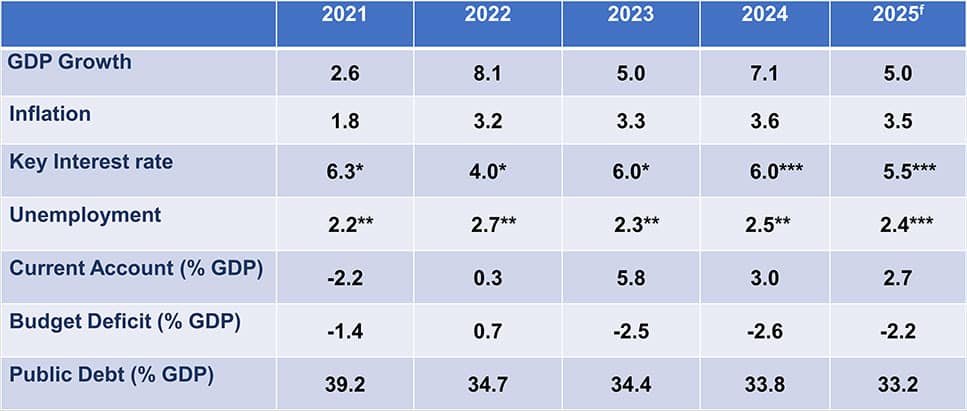
f – forecasts
* State Bank of Vietnam
** Statista
*** Worldbox Intelligence
Source: International Monetary Fund, except where stated
Useful Links
https://www.transparency.org/en
https://www.imf.org/en/Countries/VNM
About Worldbox Business Intelligence
Worldbox Business Intelligence, headquartered in Switzerland, is a Global API data solution provider of business intelligence and used in data analytics.
With the Global API solution Worldbox Business Intelligence enables clients and partners a frictionless real time onboarding, KYC and compliance verification, while rapid global investigations are provided, if needed.
Worldbox Business Intelligence provides global data in a standardised structure on more than 320 Million companies worldwide. It’s global network of subsidiaries, branches and desks allows the precise and efficient collection of data on key target territories for clients and partners.”
“Worldbox Business Intelligence – Bringing Swiss Precision To Data”
Copyright (C) 2025 Worldbox Business Intelligence. All rights reserved.
Our mailing address is:
Worldbox Business Intelligence
Breitackerstrasse 1
Zollikon
Zurich 8702
Switzerland