![[Aggregator] Downloaded image for imported item #9661](https://asiagategroup.com/wp-content/uploads/worldbox-vietnam-slider-2-25-26.jpg "[Aggregator] Downloaded image for imported item #9661")
Worldbox Country Risk Climate – February 2026
Vietnam
Summary
| Overall Risk Score 29/40 (Stable)
Political risk: Stable 7/10 Economic risk: Stable 8/10 Commercial risk: Stable 7/10 Technology risk: Stable 7/10 The risk assessment of a country is made up of four components, being Political, Economic, Commercial and Technological. Each component is scored out of 10 with 1 being the highest risk and 10 the lowest. |
ESG Risk: 6/10 (Stable)*
*Environmental, social and governance (ESG) issues are becoming increasingly important to companies, investors and consumers in Southeast Asia. That is why we are now preparing a separate ESG score and section with our quarterly country risk reports. We explain how each country rates, looking at the E, S and G individually, and outline recent developments. |
Political Risk – Stable at 7
Vietnam is a one-party state ruled by the Communist Party of Vietnam (CPV). The CPV provides strategic direction and decides all major policy issues, which the government then implements. The four most important positions in the country are CPV General Secretary (the most powerful position in Vietnam), State President, Prime Minister and National Assembly Chair.
General Party Secretary Nguyen Phu Trong was the most powerful man in the country until he passed away in July 2024. He had been re-elected to the position of general secretary of the Communist Party in January 2021, at the age of 76, for a rare third five-year term. After taking office in 2011, Trong built up a strong power base in the Communist Party.
In October 2024, General Luong Cuong became the country’s new president, making the military general the fourth official to fill the largely ceremonial role in 18 months. Cuong, 67, replaced To Lam, who had remained president even after he was formally appointed as the general secretary of the ruling Communist Party in August.
In December, To Lam announced a sweeping set of proposals to streamline the government, legislature and ruling-party apparatus. At the government level, five of 21 ministries will be eliminated through mergers and closures. The reforms aim to improve national government efficiency by eliminating layers of cumbersome bureaucracy, helping drive the country onto a higher economic plane.
These are the most sweeping and ambitious programme of political and governance reforms since the CPV launched the ‘renovation’ (doi moi) economic reforms nearly 40 years ago, which began the transition from a centrally planned economy to a ‘socialist-oriented market economy’. The ambition is to complete the reforms before the 14th National Party Congress, scheduled for the first quarter of 2026.
Worldbox Business Intelligence believes the reforms could have a dramatic impact on the country’s appeal to foreign investors and could thus have the desired effect of significantly raising Vietnam’s long-term growth potential.
In late December 2025, the Communist Party endorsed General Secretary To Lam to remain in the top job for the next five years, cementing his authority.
Economic Risk – Stable at 8
Since the early 1980s when the economy was on the verge of collapse, Vietnam has been transformed into a middle-income country with one of the most dynamic economies in the world. Bold economic reforms, political stability, and a hard-working, well-educated and disciplined workforce has attracted vast amounts of FDI that have helped the country become an export powerhouse.
More recently, Vietnam has successfully positioned itself as a low-cost alternative manufacturing base to China. The pandemic, which exposed the Western economies reliance on China, helped drive FDI away from China and into Vietnam
Under the leadership of To Lam, Vietnam aims to build an upper-income, knowledge-and-tech-based economy by the year 2045. It has been aiming for annual growth rates in excess of 8%. Exporting more to the US, already its biggest market, was central to that plan.
An article in the East Asia Forum sheds light on why Vietnam is enacting the comprehensive range of reforms announced in 2025. The article by a retired Vietnamese economist argues that Vietnam’s current model is running “out of road”. It contends that Vietnam’s credit, public investment and export-led growth are hitting structural limits. Environmental strain, shallow capital markets, a ‘missing middle’ of domestic firms under state-owned enterprise dominance and foreign-led exports undermine resilience. The author argues that to avoid a development trap, Vietnam must shift to a private-sector industrial base, reform state-owned enterprises and deepen markets and levels of household consumption.
The article, while accepting that the country’s economic rise has been extraordinary, adds that the growth model, fuelled by bank credit, public investment and exports, is showing signs of fatigue. It points out that aggressive bank credit expansion has long fuelled Vietnam’s growth. Between 2007–2010, bank lending surged by up to 36% annually, and in 2007 reached 53.8%. Credit growth remains a concern today – see Commercial Risk Outlook in the previous bulletin.
The article also says that the lack of a robust private sector provides a major constraint on Vietnam’s economic transformation. Sustained high growth and transitioning to high-income status require a dynamic and robust private sector. Yet the Author contends that approximately 97% of nearly 1 million registered firms are micro or small enterprises. There are very few private medium-sized corporations, resulting in a structural gap, referred to as the ‘missing middle’. The informal sector is expanding but suffers from low productivity and limited social protection.
The author adds that private firms and the informal sector face regulatory barriers, inadequate research and development capacity, and restricted access to finance, land and skilled labour, alongside the dominance of state-owned enterprises. It welcomes the government’s move to prioritise private sector development. But it adds that state-owned enterprises, a key obstacle to private sector competitiveness, are not included in the current reforms.
The article also focuses on Vietnam’s dependence on foreign investment and exports pointing out that foreign-invested enterprises account for approximately 72% of Vietnam’s total export turnover. The author says that the dependence on external capital and imported inputs expose Vietnam to global supply chain disruptions and geopolitical risks, adding that the scarcity of medium-sized domestic firms limits the potential for technology transfer, innovation and inclusive growth.
In conclusion, the author argues that:
“Vietnam must recalibrate its growth model and adopt a new paradigm that prioritises sustainability over speed. Achieving high-income status should not come at the cost of macroeconomic stability and the environment. In the increasingly volatile global landscape, Vietnam must complement its investment- and export-led strategy with the development of a resilient domestic economy — one capable of generating robust demand and supply from within. At the heart of this transformation lies a dynamic private sector, which can catalyse multiplier effects across critical segments of the economy.”
Commercial Risk – Stable at 7
Businesses operating in Vietnam face some significant challenges, according to the US State Department’s 2025 Investment Climate report. These include inconsistent regulatory interpretation, irregular enforcement, and an unclear legal framework. The report says that US companies have consistently voiced concerns that Vietnam lacks a fair legal system for investment, which affects US companies’ ability to do business in Vietnam.
Vietnam does not have a strong record on protecting and enforcing intellectual property rights. Fractured authority and a lack of coordination among ministries and agencies responsible for enforcement are the primary obstacles, and capacity constraints related to enforcement persist, in part, due to a lack of resources and IP expertise.
Corruption is a significant challenge. However, progress does seem to be being made. Vietnam ranked in 88th place out of 180 countries in Transparency International’s 2024 Corruption Perceptions Index, up from joint 83rd in 2023.
The country ranks as the 61st freest in the 2025 Index of Economic Freedom from the Heritage Foundation. Its rating has fallen by two places from last year. The country’s economic freedom score is higher than the world and regional averages.
The lack of adequate infrastructure provides significant challenges to operating in Vietnam. The country is making a huge investment in infrastructure: approximately 6% of GDP, compared with an ASEAN average of 2.3%, highlighting its commitment to growth. A number of new projects will come onstream in the coming years. These include 3,000km of expressways, including the North-South Expressway, completed in 2025, and connections to the eastern and western regions. A new international airport serving Ho Chi Minh City (HCMC) opened in December 2025. International flights will transfer from Tan Son Nhat International Airport to the new Long Thanh International Airport in 2026. Attention is now focusing on a US$67bn North-South high-speed rail project linking Hanoi and Ho Chi Minh City with investment raising plans likely to get underway in 2026.
Technology Risk – Stable at 7
The Global Innovation Index (GII), from the World Intellectual Property Organization, is an important index used by countries and multinational companies to assess innovation ecosystems and aid in policymaking and investment decisions.
Vietnam ranked 44th out of 139 countries in the 2025 GII – moving up from 62nd place in 2020. It ranked 9th among the 17 economies in Southeast Asia, East Asia, and Oceania, and 2nd among the 37 Lower middle-income group economies.
Government policies
The government has implemented a “National Strategy for the Development of Digital Economy and Digital Society by 2025”, which aims to accelerate the adoption of digital technologies across various sectors. Vietnam is also committed to a “green” transition, with the government seeking to transform the economy by applying circular economic principles and exploiting digital technologies to reduce environmental impacts. Many businesses in the country have begun the process of data digitization and standardization of their operations. However, many small and medium-sized enterprises lack the funds to invest in clean technologies and digital infrastructure.
The government is keen to attract foreign investors in semiconductor manufacturing, artificial intelligence (AI) and green energy, as it seeks to take the next step in economic development away from low-added-value manufacturing.
In December 2025, the country introduced one of the world’s first comprehensive AI regulatory frameworks, outlining risk-based classifications, compliance requirements, innovation incentives, and strategic opportunities for businesses investing in AI technologies. The law will come into effect in March 2026. According to Vietnam Briefing, the law explicitly bans AI applications that pose systemic threats. These include real-time biometric surveillance in public spaces (without special approval), large-scale facial recognition databases built through unauthorized data scraping, and AI systems designed to manipulate public opinion or behaviour in deceptive ways.
Infrastructure
Vietnam’s 4G mobile network currently covers 99% of the population. The government aims to ensure that every city, province, industrial facility and household nationwide can access fibre-optic internet by 2030, with a goal for all internet users to benefit from speeds of at least 1 Gbps. At least two new international submarine cable routes are due to be launched, and the authorities want to achieve 99% coverage of the 5G broadband network by the end of 2025. Each citizen will have access to one Internet of Things connection and will have a digital identity, with over 70% of adults expected to possess a digital or electronic signature by 2030. Vietnam is investing heavily in data centres that meet international standards and is focusing on attracting domestic and international investments in digital infrastructure.
Education and skilled staff
The number of students studying STEM subjects has increased in recent years but remains low compared with some countries in the region and with Europe – particularly in the proportion of female students. For example, in 2021, the latest year for which figures are available, around 28% of university students studied STEM subjects, compared with 46% in Singapore, 50% in Malaysia, 35% in South Korea, 36% in Finland, and 39% in Germany.
February Bulletin
Political Risk – Stable at 7
Vietnam remains one of the most politically-stable countries in the region. The robust economy, which is generating strong real wage growth and low unemployment, is helping to quell dissent. Recent policy amendments suggest the government is highly capable and is laying the foundations for future strong growth.
The country also appears to be entering a new era under Communist Party chief To Lam, who, according to Reuters, has earned a reputation as an ambitious risk-taker whose brief initial tenure was defined by rapid, sweeping reforms and a commanding leadership style.
In a December 2025 article, Reuters says that Vietnam has long relied on collective decision-making and multiple checks on individual leaders. However, Lam has strengthened the role of the party chief, following the path set by his late predecessor Nguyen Phu Trong, a shift that could push Vietnam to more centralised rule.
The news agency adds that despite not holding the title of head of state, Lam has embarked on a whirlwind tour on the world stage, making international visits to historical communist partners and new capitalist friends alike.
He has continued his predecessor’s “bamboo diplomacy”, balancing among major powers. However, under pressure from US tariffs, Hanoi has moved closer to Beijing. Under Lam, the security apparatus has vastly expanded, adds Reuters, with the police gaining powers in lawmaking, project approvals and in the corporate world.
Reuters says that the pace of Reform set by Lam has impressed many foreign investors and that supporters see a chance to speed up growth. However, the news agency says that critics argue the benefits of Lam’s reforms are accruing to a narrow group of well-connected firms. Reuters quotes a foreign diplomat as saying, “when he promotes the ‘private sector’, he means the private companies that are nicely tied up to the party.”
Economic Risk – Stable at 8
The economy grew by 7.1% in 2024, supported by continued strong external demand, resilient foreign direct investment, and accommodative policies. Officials expect the economy to have expanded by 8% in 2025. The economy grew by 8.23% in the third quarter, an acceleration from the 7.96% pace seen in the April-June period. Industrial output, particularly manufacturing and processing, remained the primary growth driver.
The outlook for 2026 also appears favourable. United Overseas Bank has upgraded its 2025 estimate for Vietnam to 7.7%, citing a sustained recovery in manufacturing and exports as key growth drivers.
This could be achievable if the government’s reforms work given that Hanoi has successfully negotiated down the President Trump’s tariffs on Vietnamese exports to the US to 20% from an initial 46%. The impact of the tariffs on the economy is as yet unclear. Vietnam is the second-most trade-dependent country in ASEAN, and 30% of Vietnam’s exports in 2024 went to the United States.
FLASH – With the US Supreme Court ruling on tariffs, issued on 19th February 2026 the developments todate with Tariffs on many countries will be impacted. The Trump Administration issued a proclamation to impose a 10% Global Tariff – using an alternative law, Section 122 of the 1974 Trade Act. This was subsequently increased to 15%. This will only hold up for 150 days since the regulations require ratification by Congress.
The present tariff rates in SE Asia will be overall reduced.
Worldbox Business Intelligence is of the opinion that the turmoil will continue.
Vietnam appears to be trying to engineer a depreciation of the currency to gain a competitive advantage over other ASEAN countries Other Asean nations have negotiated slightly lower tariffs with the US: Indonesia, Malaysia, the Philippines and Thailand all have 19% tariff rates. Bloomberg reports that the State Bank of Vietnam has been steadily guiding the dong weaker this year with the dong hitting record lows against the dollar.
Vietnam attracted US$31.52bn in foreign direct investment (FDI) during the first 10 months of 2025, marking a 15.6% year-on-year increase. FDI disbursements reached US$21.3bn in the first 10 months, an 8.8% increase year-on-year.
The inflation rate has yet to show a meaningful slowdown. Headline inflation rate hit 3.3% in October, leaving little scope to ease monetary policy. The rapid growth of credit – see Commercial Risk below- is also likely to curtail the central bank’s freedom of manoeuvre. The main inflation drivers remain housing and construction materials and health care.
Total import-export turnover surpassed US$900 billion for the first time in 2025, placing Vietnam among the world’s top 25 ranking economies. Vietnam’s total trade for 2025 is projected to reach $920bn, up 16.9%, or $133.07bn, from 2024. Imports are estimated at $449.41bn, an 18%, while exports are forecast at $470.59bn, rising by 15.9%.
Tourism is rapidly becoming a key driver of economic growth. The country received a record 21 million foreign tourists in the first 11 months of 2025, highlighting Vietnam’s growing appeal as one of Southeast Asia’s top travel destinations, known for its long coastline, natural scenery, and rich cultural heritage. China has emerged as Vietnam’s largest source of foreign tourists, accounting for about one-quarter of total arrivals. Tourism earnings could amount to around US$30bn in 2025.
Commercial Risk – Stable at 7
In October 2025, Fitch Ratings issued a warning about the growing risks facing Vietnam’s banking sector. The agency raised concerns about two critical weaknesses, highlighting the rapid increase in lending and noting that credit growth is far outpacing GDP. This poses a risk to the country’s financial stability, especially if the government ends its credit quota system next year.
Fitch Ratings highlighted the acceleration of credit expansion in Vietnam as raising risks for the financial system. As credit grows rapidly, it increases debt burdens, which are already high. Fitch warned that credit growth is now at a very high level, and it will add to the already substantial debt load.
However, credit growth is likely to remain at high levels in 2026 with MB Securities Co forecasting credit growth could reach as high as 20% towards the end of 2025 and remain at this level in 2026. Public investment and the recovery of production and business activities is likely to drive this expansion.
Technology Risk – Stable at 7
In December 2025, HTC International Telecommunication JSC (HITC) and Evolution Data Centers unveiled established a joint venture to develop large-scale, artificial intelligence and hyperscale data centres in Ho Chi Minh City and Hanoi. The joint venture is initially focused on two flagship projects:
- EcoDC Data Centre (Hanoi), an expansion of HITC’s existing facility in the Hoa Lac Hi-Tech Park, the first data centre in Vietnam to receive Uptime Tier III certification for both design and construction.
- And Ho Chi Minh City Development, a new, large-scale hyperscale data centre to meet the surging hyperscale and AI demand in southern Vietnam.
Environmental, Social and Governance (ESG) – Stable at 6
The United Nations’ Sustainable Development Goals (SDGs) are recognised as a beneficial framework for responsible investment. The Sustainable Development Report from Cambridge University Press assesses the progress of all UN Member States on the SDGs. It provides a useful means of ranking Southeast Asian countries on their ESG progress.
Vietnam is ranked 61 out of 167 in the 2025 report, with a score of 73.35.
Environment – Vietnam faces a number of environmental challenges. These include air pollution with Hanoi rated as one of the worst polluted cities in the world. The authorities are stepping up efforts to tackle the problem, with the city government pledging to expand low-carbon public bus services and roll out supporting measures such as charging infrastructure and preferential financing to accelerate the electrification of tour buses and taxis, in a bid to curb urban air pollution. It is a similar story in HCMC with the city’s air quality deteriorating in recent years mainly due to fine dust pollution.
The country is also highly vulnerable to climate change. It is among the world’s most flood prone countries, with nearly half of its population living in high-risk areas. Significant flooding affected a number of areas in 2025 and cost the country around $1.4 billion. About 18 million people, nearly a fifth of Vietnam’s population, live in its two biggest cities, Hanoi and HCMC. Both are on river deltas that once served as natural buffers against flooding. But as the cities have grown, wetlands and farmlands that once absorbed the downpours have been built over, and the threat from flooding has increased.
Vietnam estimates it will need to spend US$55 – US$92bn this decade to manage and adapt to the impacts of climate change.
Social – According to the US State Department’s 2025 Investment Climate Statement, Vietnam has made some progress on labour issues in recent years, including, in theory, allowing the formation of independent unions. However, it adds that the sole union that has any real authority is the CPV-controlled Vietnam General Confederation of Labor.
Governance – The government passed an amended Law on Enterprises in June 2025 with the ambition of raising corporate governance standards in the country. The most notable amendments, which came into effect from 1 July 2025 include:
- The introduction of the concept of an Ultimate Beneficial Owner (“UBO”); and
- Enhanced disclosure and valuation requirements for share capital and capital contributions.
The introduction of the UBO concept marks a significant step toward aligning Vietnam’s corporate governance framework with international standards, particularly those set by the Financial Action Task Force, which has placed Vietnam on its grey list and may consider escalation if progress stalls, according to lexology.com.
The website adds that the amendment on share capital and distributions is designed to address longstanding issues around the inflation of non-cash capital contributions – such as assets, land use rights, or intellectual property – where inflated or unverifiable valuations have historically been used to obscure true ownership ratios or inflate charter capital on paper. Such practices have not only undermined financial transparency but have also created risks for shareholders and business partners, especially in disputes.
February Bulletin
Environmental, Social and Governance (ESG) – Stable at 6
Vietnam has made significant progress in building its sustainable finance framework, according to the Vietnamese Investment Review. However, in a December 2025 article, the publication says that critical challenges remain, underscoring the urgent need for training, tools, and transparent mechanisms to translate sustainability commitments into tangible impacts.
Latest economic data
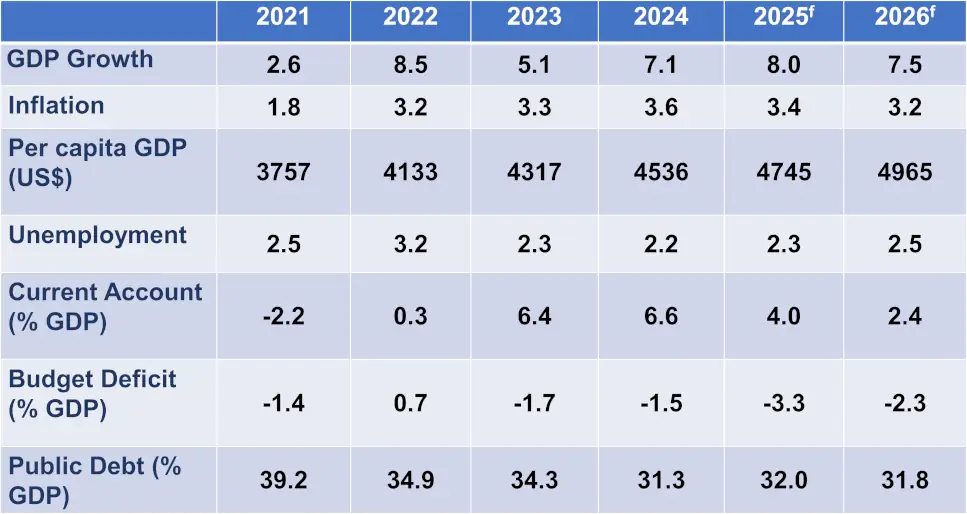
f – forecasts
Source: International Monetary Fund
Source: Worldbox
Useful Links
https://www.transparency.org/en
https://www.imf.org/en/Countries/VNM
About Worldbox Business Intelligence
Switzerland-based Worldbox Business Intelligence is a global leader in business data and intelligence. With over 400 million companies across all major and emerging markets, our solutions support real-time onboarding, KYB, and compliance verification through the delivery of credit reports, profiles, ownership and management, legal status and history details as well as financial and other business information.
Accessible via API, online search, and the AWS MCP Servers, available over AWS marketplace, Worldbox enables organizations to search, evaluate, and acquire company data with transparent pricing and seamless AI integration.
With its global network and Swiss precision, Worldbox empowers smarter, more efficient business decision-making.
“Worldbox Business Intelligence – Bringing Swiss Precision To Data”
 |
 |
 |
 |
Copyright (C) 2026 Worldbox Business Intelligence. All rights reserved.
Our mailing address is:
Worldbox Business Intelligence
Breitackerstrasse 1
Zollikon
Zurich 8702
Switzerland