![[Aggregator] Downloaded image for imported item #117961](https://asiagategroup.com/wp-content/uploads/worldbox-thailand-slider-9-14-26.jpg "[Aggregator] Downloaded image for imported item #117961")
Worldbox Business Intelligence Risk Rating – September 2026
THAILAND
Summary
Overall Risk Score
24/40 – Stable (Unchanged)
| Political risk: 5/10 – Stable (Unchanged)
Economic risk: 6/10 – Stable (Unchanged) Commercial risk: 6/10 – Stable (Unchanged) Technology risk: 7/10 – Stable (Unchanged) A country’s risk rating is based on four areas: political, economic, commercial and technological risk. Each area is scored from 1 to 10, where 1 is the highest risk and 10 is the lowest. |
ESG Risk: 6/10 – Stable (Unchanged)
Environmental, social and governance (ESG) risk is increasingly important to companies, investors and consumers across Southeast Asia. Our quarterly country risk reports therefore include a separate ESG score and analysis of each country’s environmental, social and governance performance, along with recent developments. |
Political Risk September Update
Stable at 5
Former prime minister, Thaksin Shinawatra, received a royal pardon in June and has already left the country for Dubai. Thaksin originally moved to Dubai in 2008 after being ousted from power in a 2006 military takeover. Once Thailand’s most powerful politician, Thaksin’s influence now appears considerably diminished. Thaksin’s once-dominant Pheu Thai Party is now a junior partner in the governing coalition after recording the worst election result for any Thaksin-linked bloc since he first swept to power in 2001. The Japan Times quoted analysts as saying that Thaksin is expected to maintain a lower profile than during his daughter Paetongtarn Shinawatra’s brief premiership, when critics accused him of exercising influence from behind the scenes by publicly promoting policies ranging from electricity-price cuts to government-backed digital assets. Thaksin’s party, Pheu Thai, also needs to reinvent itself after decades of relying on the Shinawatra family name. One analyst said the party needs to elevate a new generation of leaders, including Yodchanan Wongsawat, Thaksin’s nephew and now one of Prime Minister Anutin Charnvirakul deputy prime ministers if it hopes to regain political relevance.
In May, the founder of the Progressive Movement Party, Thanathorn Juangroongruangkit was acquitted of charges of defaming the monarchy, arising from comments he had made in 2021 criticising the government’s procurement of the COVID-19 vaccine. The lèse-majesté law criminalizes insults and threats towards the king, queen, and heirs to the Thai throne with sentences ranging from three to fifteen years in prison. Thanathorn’s Future Forward is still seen as the spiritual leader of the progressive movement, whose latest vehicle People’s Party lost the February election to conservative Bhumjaithai led by Prime Minister Anutin Charnvirakul, according to Bloomberg. Thanathorn was banned from politics for 10 years as part of the court ruling to disband Future Forward in 2020.
Political Risk – Context
Thailand is a constitutional monarchy. The legislature is bicameral, consisting of a directly-elected House of Representatives with 500 seats and an upper house, the Senate, all of whose members are appointed by the Royal Thai Military, under the new Constitution adopted in April 2017, to serve five-year terms.
The King is the Chief of State and the Monarchy is hereditary. Traditionally, he has little direct power but has been able to exert considerable influence over political affairs. In the case of the late King Bhumibol Adulyadej, who reigned from 1946 until his death in 2016, that reflected popular respect. Thailand also has one of the harshest lèse-majesté laws in the world, under which people can be charged for posting, sharing or liking social media posts that are deemed offensive to the monarchy.
The royal family and military usually work in tandem, often using the lèse-majesté laws to suppress political dissent. They were used, for example, to justify the arrests of pro-democracy protesters by the government of former prime minister Prayuth Chan-ocha, who led a military coup in 2014 and remained the country’s leader until August 2023. The 2014 power grab marked Thailand’s 13th successful coup since it became a constitutional monarchy in 1932.
As we forecasted in our previous report, the Thai-Cambodian border dispute re-escalated in December. Renewed fighting between the two neighbouring countries had killed at least 32 people, including soldiers and civilians, and displaced around 800,000, by mid-December. Each side has blamed the other for instigating the clashes, claiming self-defence and trading accusations of attacks on civilians. The conflict stems from a territorial dispute over the colonial-era demarcation of their 800km border. Five days of fighting in July killed dozens of people before a truce was brokered by the United States, China and Malaysia.
Thailand and Cambodia signed a fresh ceasefire agreement in late December but a few days after the new pact was signed, Thailand accused Cambodia of breaking the deal.
Shortly after the renewed outbreak of fighting, Prime Minister Anutin Charnvirakul dissolved parliament and called for fresh elections, which were held on 8th February. Anutin capitalised on a nationalist wave whipped up by the border conflict with Cambodia. Anutin’s Bhumjaithai Party (BJT) won around 194 seats in the 500-member House of Representatives, up from 71 seats in the 2023 poll. Meanwhile, the Progressive People’s Party (PP), which led most of the political opinion polls in the run up to the vote, suffered a steep decline – taking just 116 seats, down from the 151 seats won by its predecessor Move Forward in 2023. The Shinanwatra family were the biggest losers, however. Their Pheu Thai (PT), came third with just 76 seats, down from 141 in 2023—underlining the party’s declining electoral power. The result was seen as a victory for stability over change, and for nationalism over reform.
Anutin has constructed a 15-party coalition commanding roughly 290 seats — comfortably above the 251 needed for a simple majority. Cabinet posts are dominated by Bhumjaithai figures, with several portfolios allocated to key coalition partner Pheu Thac. Critically, lawmakers selected Sophon Zaram, a senior figure in the BJT, as speaker of the 500-member House of Representatives. The speaker plays a pivotal role in parliament, setting the legislative agendas and scheduling key votes for the lower house.
Sixty per cent of voters on 8 February also endorsed a referendum on amending the 2017 constitution crafted by the then military junta. The BJT will try to limit key goals of the reformers such as changes to the unelected Senate and limits to the monarchy’s political prerogatives.
Economic Risk September Update
Stable at 6
The economy grew by 2.2% in 2025, well below Thailand’s peers in the region and while the economy expanded in the first quarter of 2026 from the previous three months, supported by domestic demand and exports before the Middle East conflict escalated, activity is expected to slow, according to the central bank as the impact of the Middle East conflict bites. The impact of the conflict started to show towards the end of the quarter, reflected in a sharp decline in exports to the Middle East and weaker foreign tourist arrivals, the central bank added.
Although the economy grew by 2.8% in the first quarter of 2026, beating analyst expectations, the economic outlook for the full year remains modest, with the National Economic and Social Development Council forecasting between 1.5 and 2.5% growth. The World Bank is forecasting growth of just 1.6% in 2026. The forecasts reflect weak exports, high household debt, and reduced consumption. The global economy could also fare poorly in 2026 given high oil prices act like a hefty tax, depressing global economic activity.
The authorities received some good news with a June data release showing that inflation unexpectedly eased in May, staying within the central bank’s target range and reducing pressure for an interest-rate response. The consumer price index rose 2.79% in May from a year earlier, decelerating from 2.89% in April. However, while inflation remains within the Bank of Thailand’s 1%–3% target range, officials expect inflation to breach the bank’s target in the second half of 2026.
The Bank of Thailand cut its policy rate by 25 basis points to 1.00% in February to help offset the impact of US tariff uncertainty and a strong baht. It remained at this level by the end of June. The Bank of Thailand maintains that the increase in prices is temporary and has signalled a willingness to look through any near-term inflation spike, saying tighter monetary policy would do little to address a supply-driven shock.
According to a Bloomberg critique published in May 2026, monetary policy has been too conservative for too long, adding that “inflation has been uncomfortably low for years, a phenomenon that’s rare in Southeast Asia and more closely associated with Japan during its lost decades, and, more recently, China”. The central bank, says Bloomberg, rebuffed calls from successive governments and business for significantly lower rates to perk up the economy, especially after the post-Covid surge dissipated, as a threat to the bank’s independence. Only in the months before the Middle East war broke out, under a new governor, did officials begin to show urgency, claims the news agency.
The rising cost of jet fuel is likely to slow further the recovery of Thailand’s tourism sector, following a disappointing 2025 when the country recorded its first annual decline in international arrivals in a decade, excluding the Covid-19 pandemic years. International arrivals fell 7.23% year-on-year to 32.9 million visitors in 2025. The decline was most pronounced in short-haul markets, traditionally Thailand’s strongest feeder base. Chinese arrivals were projected to plunge 33%, while visitor numbers from Hong Kong fell 29%, South Korea 16% and Taiwan 11%. A combination of factors undermined the market. These include the Thai-Cambodian conflict, kidnapping concerns and an unexpected earthquake to severe flooding in Hat Yai in southern Thailand which disrupted transport with Malaysia. Tourism accounted for around 20% of GDP before the pandemic in 2019 and created employment for millions of often low-skilled Thais.
Economic Risk – Context
Thailand has been one of Southeast Asia’s most dynamic and successful tiger economies. The World Bank points out that over the past four decades, Thailand has made remarkable progress in social and economic development, moving from a low-income to an upper-middle-income country in less than a generation. The economy grew by an annual average of 7.5% during 1960–96 and by 5% during 1999–2005, following the Asian Financial Crisis.
However, Thailand’s growth rate has slumped over the past two decades and it is now one of the weakest performers in Southeast Asia.. As the OECD explains in a December 2025 report, “economic growth is weakening in the face of several long-term challenges. Catch-up in GDP per capita has slowed, and the pace of poverty reduction has diminished.”
Thailand faces a number of challenges that successive governments have failed to address. These include elevated household debt, an ageing population and low productivity. US tariffs, although reduced from the initially announced 36 to 19%, present a significant shock for the economy, while foreign tourist numbers have declined. The war with Cambodia and uncertainty about the long-term political outlook for the country are further problems.
The government has taken measures to address some of these challenges. In October, for example, the government said it would spend 10 billion baht (US$307 million) to buy bad debt. Thailand’s stubbornly high levels of household debt have shackled the economy for several years, with the ratio of household debt to GDP standing at 86.8% by the end of June, among the highest levels in Asia.
However, in November 2025 the IMF urged the government to do more. It called for “urgent structural reforms to strengthen resilience and improve growth potential. Key priorities include deepening trade and financial integration, reinvigorating structural transformation to boost labor productivity, and advancing export sophistication, alongside efforts to enhance social protection, governance, and climate resilience. Together, these policies would support stronger and more inclusive growth and facilitate external rebalancing.”
The OECD, in a December 2025 report, also called for further regulatory reforms, including easing restrictions on foreign direct investment and removing barriers to competition, to boost productivity. It added that creating a level playing field by reducing the dominant role of state-owned enterprises is also key to strengthening productivity in Thailand.
In February 2026, the East Asia Forum blamed short-term planning and political instability for Thailand’s economic malaise. It explained that:
“Successive Thai governments have inadequately prioritised productivity-raising economic reforms. A succession of short-term crises and domestic political turmoil has diverted attention from the country’s crucial long-term issues in favour of ineffective short-term measures, especially economic stimulus packages. Low productivity, not unemployment, is Thailand’s enduring problem. The continuing policy emphasis on economic stimulus ignores that essential fact.”
In a May release, the ratings agency Moody’s said that Thailand is among five large emerging markets – alongside Malaysia, India, Indonesia and Mexico – best able to withstand global shocks, helped by early reforms and strong buffers. It explained that these countries have shown greater resilience to global shocks over the past five years, despite facing the Covid-19 crisis, the global interest-rate tightening cycle, banking-sector stress and trade tensions. The agency warned, however, that the rising debt burden risks weakening Thailand’s ability to withstand crises over the longer term.
Commercial Risk September Update
Stable at 6
In May, Fitch Ratings said that it expects the outlook for Thai banks to deteriorate this year, despite solid earnings in the first quarter at the six domestic systemically important banks (D-SIB). It explained that while profitability remains sound, thinner net interest margins, weaker economic prospects and pressure on borrower-repayment capacity are likely to weigh on earnings and asset quality over the rest of the year. Fitch added that Thai banks retain strong buffers against asset-quality deterioration. Loan-loss allowance coverage has remained high, with the D-SIB average rising to 189% from 185% at end-2025. This gives banks room for future write-offs, and should limit the need for sharp increases in provisioning. The six banks are: Siam Commercial Bank, Bank of Ayudhya, Kasikornbank, Bangkok Bank, TMB Thanachart Bank and Krung Thai Bank.
Commercial Risk – Context
Thailand ranked 116th out of 182 countries in Transparency International’s 2025 Corruption Perceptions Index, falling from 107th place in 2024. It has fallen dramatically since 2015 when it was ranked in 38th place. Regionally, it now lies ahead of only the Philippines, Cambodia and Myanmar.
In a report published in April 2026, the International Trade Administration of the US confirmed the risks posed by corruption, adding that a lack of transparency in government procurement are major concerns. It adds that when corruption is suspected during the bidding process, government agencies and state enterprises reserve the right to accept or reject any or all bids and may also modify the technical requirements or call for a retender. The ITA says that this affords government agencies and state-owned enterprises considerable leeway in making procurements, while denying bidders recourse to challenge procedures.
The ITA adds that customs law in Thailand does not meet the standards established by the International Convention on the Simplification and Harmonization of Customs Procedures, otherwise known as “the Kyoto Convention.” Major problem areas include Thailand’s Customs Penalty Regime and Customs Valuation Procedures.
Thailand ranks 82nd in terms of economic freedom, according to the Heritage Foundation’s 2026 index, up from 85th in 2021. This ranking places Thailand in the “moderately free” category, and remains significantly below its 2021 ranking of 42nd. The reasons for the decline according to the Foundation lies in challenges relating property rights, judicial effectiveness, government integrity, and investment freedom.
The US State Department’s 2025 Investment Climate Statement advises US entities (and the warning is applicable to all foreign entities) planning to invest in Thailand to obtain qualified legal advice. It explains that Thai business regulations are governed predominantly by criminal rather than civil law. It adds that while foreigners are rarely jailed for improper business activities, yet violations of business regulations can carry heavy criminal penalties.
However, it adds that the legal system is based on the civil law system with strong common law influence and that the country has an independent judiciary that is generally effective in enforcing property and contractual rights. Most commercial and contractual disputes are generally governed by the Civil and Commercial Codes. The legal process is slow in practice and monetary compensation is based on actual damage that resulted directly from the wrongful act, according to the report.
Technology Risk September Update
Stable at 7
Foreign investment continues to flood into Thailand’s data centre sector. In May 2026, for example, Gorilla Technology Group, which is listed on the US NASDAQ, announced it had acquired land in Korat to develop a planned 200MW AI data centre campus. The company plans to build six data halls with a combined capacity to support 150MW of IT load once fully developed. Five halls are planned at approximately 30MW each, with one larger 50MW facility. During the same month, Digital Edge of Singapore and B.Grimm Power of Thailand announced the successful signing of a US$880 million green loan – the largest financing ever secured for a data centre project in Thailand – to finance the development of the joint venture’s 100MW BKK Campus in Chonburi.
Technology Risk – Context
The Global Innovation Index (GII), from the World Intellectual Property Organization, is an important index used by countries and multinational companies to assess innovation ecosystems and aid in policymaking and investment decisions.
Thailand ranked 45th out of 139 countries in the 2025 GII. Thailand ranks 10th among the 17 economies in Southeast Asia, East Asia, and Oceania. It ranks 4th among the 36 Upper middle-income group economies.
The 2025 World Digital Competitiveness Ranking highlights Thailand’s decline in digital competitiveness. Thailand dropped one rank to 38th place, with technology being the main drag on its competitiveness, reflecting poor progress in several sub-factors, including regulatory frameworks, capital, and technological framework. A key weakness is the lack of private investment in AI, despite strong potential in this area.
Government policies
Thailand Digital Economy and Society Development Plan (2018–2037) is the country’s main plan for developing its digital economy and society which drives cross-sector collaboration as one of the driving mechanisms. The Plan aims to:
- Develop high-efficiency digital infrastructure nationwide.
- Drive the economy with digital technology.
- Build a society with thorough and equal quality with digital technology.
- Transform the public sector into digital government.
- Develop and prepare manpower for the era of digital economy and society.
- Build confidence in digital technology usage.
Thailand’s digital economy is estimated to have grown by 7.3% to reach approximately US$140.3bn in 2025, according to the International Trade Administration of the US. In a report published in April 2026, the ITA said that government initiatives such as the Government Cloud Project are driving demand for cloud services, data centres, and AI technologies, encouraging collaboration with foreign tech providers. This flow in digital development has attracted fierce competition, with both local and international players like Huawei, ZTE, Intel, Ericsson, Cisco, Samsung, and HPE actively pursuing market share, added the ITA.
Infrastructure
Thailand is investing heavily in infrastructure, much of it focused on building its Eastern Economic Corridor (EEC). There are three key megaprojects at the core of these infrastructure plans:
- A high-speed rail linking Bangkok’s international airports at Don Mueang and Suvarnabhumi, with the emerging aerospace hub at U-Tapao International Airport. The project is scheduled to begin construction soon. When completed, this will seamlessly link Bangkok with the future “Aerotropolis” at U-Tapao.
- The Laem Cha Bang deep seaport (Phase 3) upgrade seeks to increase its total cargo capacity to 18.1 million 20-foot equivalent units (TEU) per year using the automated system and advanced full-scale services. This project has an estimated cost of THB 114 billion. Construction is ongoing, with phased completion expected by 2027.
- Development of the U-Tapao International Airport and its “Aerotropolis”, promoting investments in aerospace and aviation-related industries. The Thai government has been in discussions with major international aerospace firms to develop aircraft maintenance and related facilities. The project will support the country’s vision of becoming an ASEAN technological, manufacturing and service hub with strong connectivity to its neighbours, the ASEAN region, and beyond.
In addition, Thailand aims to transform Thailand’s Eastern Economic Corridor into a digital powerhouse, focusing on telecom infrastructure and smart city development. The plan will focus on enhancing the digital infrastructure and services to be modern, efficient, and capable of supporting future technological investments. The overall goal is to improve the quality of life for the people in the area and develop the EEC into a smart city of international standards.
Thailand is also experiencing huge investment in data centres with around 70 projects planned or underway, driven by global demand for AI and supported by government tax incentives. These projects are concentrated in the country’s EEC. In May 2026, Thailand approved six major projects worth a combined 958 billion baht, or US$29 billion. The approvals include a large-scale data infrastructure expansion by a local unit of TikTok valued at 842 billion baht, or approximately US$25 billion. To accelerate project implementation, the Board of Investments is selecting some of the data centre projects for Thailand FastPass, scheme, which is designed to streamline approval and permitting procedures, speed up coordination among relevant agencies – including the BOI, the Department of Industrial Works, the Industrial Estate Authority of Thailand, the Office of Natural Resources and Environmental Policy and Planning, the Customs Department and power-related agencies – and help strategic projects begin operations faster.
Education and skilled staff
Thailand faces a critical shortage of high-skilled workers, particularly in STEM, digital technology, and specialised sectors, according to the OECD. This is despite producing many graduates. The OECD says that 34% are over-qualified for their jobs, while 64.7% of working-age adults lack basic literacy and 74.1% lack digital skills. The country also suffers from aging demographics, an outdated rote-learning curriculum, and severe inequality in educational quality, adds the OECD Thailand can address this problem by reforming its education system and encouraging students into STEM subjects. It could also ease work permit regulations, making Thailand an attractive destination for international engineers and other STEM specialists.
Environmental, Social and Governance (ESG) September Update
Stable at 6
Thailand is transitioning from a fragmented, regulation-based environmental regime to a suite of primary legislation covering pollution disclosure, clean air, climate change, circular economy, and wetlands protection, according to a report issued by the law firm Dentons. It adds If the new government moves forward with these legislative proposals, it will shape Thailand’s ESG regulatory landscape for the next decade. It recommends that investors with exposure to Thailand assess how each framework may affect their compliance obligations, capital expenditure, and reporting requirements.
Environmental, Social and Governance (ESG) – Context
The United Nations’ Sustainable Development Goals (SDGs) are recognised as a beneficial framework for responsible investment. The Sustainable Development Report from Cambridge University Press assesses the progress of all UN Member States on the SDGs. It provides a useful means of ranking Southeast Asian countries on their ESG progress.
Thailand is ranked 43 out of 167 in the 2025 report, with a score of 75.34.
The US State Department’s 2025 Investment Climate Statement says that Thailand values the importance of environmental, social, and governance (ESG) disclosures, with both the SEC and the Bank of Thailand focused on this issue. SEC regulations on Sustainable and Responsible Investing fund disclosure requirements came into effect in April 2022, and the SEC, as the stock exchange regulator, mandates ESG reporting for listed companies in the 56-1 One Report annual public filing. The Stock Exchange of Thailand (SET) also provides resources, guidelines, and training to help companies with sustainability disclosures follow global reporting standards, including the Global Reporting Initiative (GRI) standards. In addition, SET annually announces Thailand Sustainability Investment (THSI), a list of Thai-listed companies with outstanding sustainability performance.
Environment – Thailand’s long coastlines, fragile agriculture system and susceptibility to extreme weather events make it vulnerable to the effects of climate change, according to the UNDP. It adds that the country has already experienced a marked increase in temperatures and changes in rainfall patterns over the past thirty years. Both of these changes have a significant effect on food production, particularly rice – the yields of which are essential to national food security. The country experienced an extreme heatwave in early 2026, with Bangkok’s heat index exceeding 52°C in nearly May and reaching the “extreme danger” level, with residents urged to avoid outdoor activity and watch for signs of heatstroke. Thailand could face extreme heat conditions comparable to those seen today in the Sahara by 2070, according to a report by the Singapore Straits Times published in late April 2026.
Social – The law provides for the right of workers in certain private-sector and state-owned enterprises to form and join independent trade unions, while Thais also enjoy the right to universal healthcare and a pension. There is a minimum wage law, although it does not cover some areas, such as government officers, state enterprise employees, domestic workers, maritime workers and agricultural workers. Employers may dismiss workers provided the employer pays severance. When an employer temporarily suspends business, in part or in whole, the employer must pay the employee at least 75% of his or her daily wages throughout the suspension period.
Governance – The law firm Dentons says that the key legal issues and challenges concerning corporate governance currently revolve around embezzlements, frauds, and falsification of financial and other records of several high-profile listed public companies in Thailand by the management of the companies through made-up international transactions.
Latest economic data
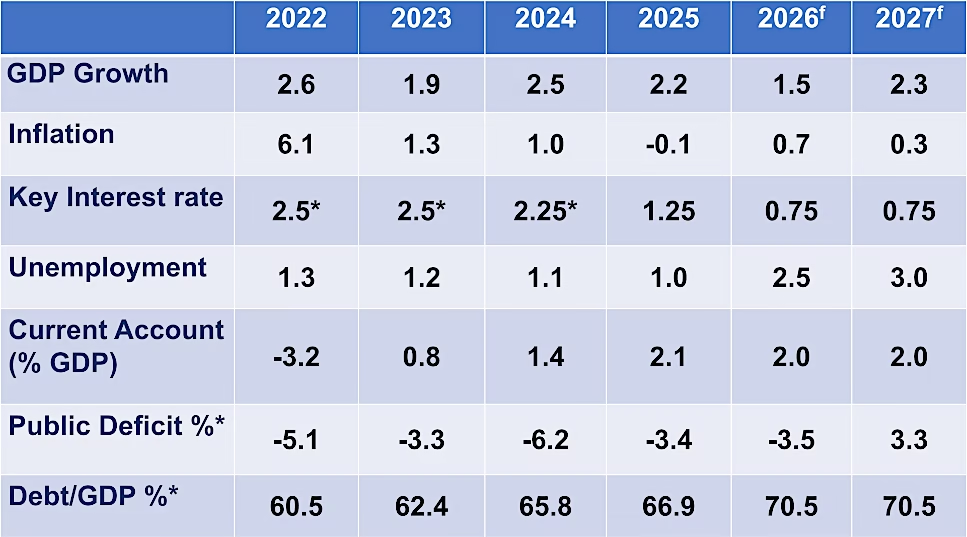
f forecasts.
* Worldbox Business Intelligence.
Source: IMF November 2025, World Bank except where stated.
Useful links
https://www.bangkokpost.com/news
https://www.nationthailand.com/
https://www.imf.org/en/countries/tha
https://www.adb.org/where-we-work/thailand

Source: Worldbox
Global Business Information from Worldbox
Worldbox provides trusted business information on more than 500 million companies across developed and emerging markets.
Access company profiles, credit risk reports, ownership and management details, legal status, financial information and other data to support onboarding, KYB, compliance and risk assessment.
Worldbox data is available through online search, API, Snowflake’s data platform, AWS Marketplace, and AI-ready access through AWS MCP Servers.
Need reliable information on a company or market? Contact Worldbox to discuss your requirements.

 |
 |
 |
 |
Copyright (C) 2026 Worldbox Business Intelligence. All rights reserved.
Our mailing address is:
Worldbox Business Intelligence
Breitackerstrasse 1
Zollikon
Zurich 8702
Switzerland