![[Aggregator] Downloaded image for imported item #121535](https://asiagategroup.com/wp-content/uploads/worldbox-myanmar-slider-9-14-26.jpg "[Aggregator] Downloaded image for imported item #121535")
Worldbox Business Intelligence Risk Rating – September 2026
MYANMAR
Summary
Overall Risk Score
12/40 – Elevated (Unchanged)
| Political risk: 3/10 – Elevated (Unchanged)
Economic risk: 3/10 – Elevated (Unchanged) Commercial risk: 3/10 – Elevated (Unchanged) Technology risk: 3/10 – Elevated (Unchanged) A country’s risk rating is based on four areas: political, economic, commercial and technological risk. Each area is scored from 1 to 10, where 1 is the highest risk and 10 is the lowest. |
ESG Risk: 3/10 – Elevated (Unchanged)
Environmental, social and governance (ESG) risk is increasingly important to companies, investors and consumers across Southeast Asia. Our quarterly country risk reports therefore include a separate ESG score and analysis of each country’s environmental, social and governance performance, along with recent developments. |
Political Risk September Update
Elevated at 3
A summit of Southeast Asian leaders that ended in the Philippines in May has exposed the divisions within the ASEAN regional bloc about the supposed political makeover in Myanmar, according to Nikkei Asia. Philippine President Ferdinand Marcos Jr. said that “it’s still a thorny problem for which we cannot say that there are obvious solutions. But there has been a nano-shift, perhaps, in the approach to the situation in Myanmar. There are no definitive answers as yet, but we are certainly going to work on it very, very hard.”
ASEAN is among the international groupings, agencies and nations that did not recognize the result of the recent election or the supposedly democratic transition. But the grouping has divided into two camps. In the first, Singapore, Malaysia and Indonesia want to stick to the 2021 Five-Point Consensus. This calls for: the restoration of peace and stability in Myanmar; an end to violence and an inclusive dialogue with “all parties” before an election is held. It also pushed for humanitarian access to help victims of the violence and an appointment of a special envoy for Myanmar as ASEAN’s point person to engage with its troubled member. In the other camp are Thailand, Laos, Brunei and Cambodia who want to re-engage with Myanmar.
During Myanmar junta chief Min Aung Hlaing’s state visit to Beijing in June, Chinese President Xi Jinping endorsed the regime as the “new Myanmar government.” The Diplomate interpreted other comments that Xi made as “advising Min Aung Hlaing that brute military force is failing, and he must instead master CCP-style totalitarian controls to pacify the public.” The Diplomat added that while “failing on the battlefield, they (the authorities) are laying the groundwork for a digital prison through draconian cyber laws, random street-level phone searches to criminalise virtual private networks, and the rapid expansion of forced informant networks.”
Political Risk – Context
The rebellion against the military, which has been in power since 1962, intensified significantly in 2023. Momentum continued to move towards the rebels in 2024 but the picture has proven more mixed in 2025 and 2026. China has thrown its full weight behind the junta, while Russia is also providing support and the opposition remains divided.
Consequently, the military now appears to have the initiative. Germany’s DW reported in May, for example, that “over the past year and a half, the military has reversed some territorial losses and mounted new offensives on several fronts, aided by thousands of drones and new conscripts”. The military-backed Union Solidarity and Development Party, which secured victory in the December and January polls also appears to be making some headway on the diplomatic front. That’s despite Western countries rejecting the election as a sham and dismissing the new government as the same military regime in all but name.
The foreign ministers of Thailand and China have paid official visits to President Min Aung Hlaing, while Thailand is lobbying hard for ASEAN, which has barred Myanmar from the bloc’s top-tier meetings since the coup, to restore full privileges.
However, the army still only controls a little over a fifth of the country and most of the larger towns. Its position remains highly vulnerable and outright military victory is a near impossibility. According to an article published in the Conversation, the Myanmar civil war also has links to the Russia-Ukraine war. Russia is providing strong support for the junta, while a small number of Ukrainian military advisers are now working with anti-junta groups.
The opposition remains divided. The military regime faces a range of ethnic armed groups; post-coup forces aligned with the shadow administration of the National Unity Government (NUG); and newer resistance groups, who have failed to unite. Al Jazeera recently concluded that in many cases, the military coup has sharpened differences among the ethnic groups themselves, of which there are about 20. It added that after decades of conflict, some have fractured and fought each other. While some remain focused on autonomy, others are driven more by financial interests or the influence of neighbouring China. For some, the current period of revolution burns with urgent necessity. For others, it is more of a bargaining chip for sectional interests. In other words, the civil war that has ravaged the country for decades shows no sign of any ending in the foreseeable future.
Meanwhile, the country’s political, humanitarian and security crisis continues to worsen, with escalating violence, mass displacement, organised crime and growing regional repercussions, according to the UN special envoy on Myanmar. Speaking in June, the envoy warned that Myanmar’s prolonged instability was generating growing regional and global implications, describing the country as a “global epicenter” for cybercrime, a major source of methamphetamine and opium, and the world’s leading source of landmine casualties. In addition, Myanmar is now among the world’s sixth most severe hunger hotspots. It is experiencing high levels of displacement, with more than 3.7 million people internally displaced and a further 1.6 million across the region.
Economic Risk September Update
Elevated at 3
The Middle East conflict has had a significant impact on the economy with Myanmar perhaps the worst hit among Asian countries that rely on the Gulf for their energy supplies. Myanmar imports roughly 90% of its fuel, heavily relying on refined petroleum products from Singapore and other ASEAN nations, which in turn depend on crude oil from Middle Eastern countries. Chinese imports account for less than 2% of the country’s needs, but China also relies heavily on oil imports from the Gulf, and is unlikely to emerge as an alternative fuel source. Russia is reportedly, however, stepping up fuel supplies.
Higher fuel prices have raised transport and logistics costs, increased production and distribution costs, and intensified foreign exchange demand for fuel imports After easing through late 2025, inflation rose sharply from March 2026, reaching 24.6% year-on-year in April.
Fulcrum, published by the ISEAS–Yusof Ishak Institute in Singapore, reports that fuel has also become scarce. It adds that there are reports of vehicles queuing for hours to refuel. Myanmar has grounded several domestic flights and is refuelling its international flights abroad due to domestic supply constraints. The publication adds that the government is restricting fuel sales, including introducing an “odd-even” system, based on the last digit of the vehicle’s license plate, and a QR code scheme that limits refuelling to just twice a week.
Fulcrum adds that the risks for key economic engines are growing. Industry — which already faced power constraints — now must contend with fuel shortages. Many factories, including those in the garment sector, rely on diesel generators for electricity. Diesel shortages could force some of these factories to close. The crisis also threatens the regime’s attempts to raise power production. VPower’s plans to restart two LNG-fired power stations may be jeopardised by LNG price pressures and availability issues, says Fulcrum.
Economic Risk – Context
Given the civil war raging in the country, it’s very difficult to gain an accurate picture of what is happening to the economy. The junta hasn’t published monthly economic data since mid-2022, and figures from the World Bank and other organisations are at best “guesstimates” of what is happening in the country. They could well be wildly inaccurate.
The junta’s economic policies are also damaging the country’s long-term prospects, according to the East Asia Forum. These policies include import substitution policies, state-enforced loan defaults on foreign lenders, excessive military spending, overprinting of domestic currency and the squeezing of dwindling foreign exchange reserves to fund military operations and circumvent sanctions.
The IndustriALL Global Union, which represents more than 50 million working people in more than 140 countries, has reported that Myanmar is no longer a “high-risk sourcing destination,” but is a war economy. Despite the condemnation of the military regime by Western governments, it continues to benefit from preferential trade treatment, says the Union. For example, Europe imports billions of euros-worth of textile and clothing products, much of it entering duty-free under the EU’s Everything But Arms (EBA) scheme. The scheme grants duty-free market access on the condition of compliance with core human rights and labour conventions. Those conditions are plainly not met, says IndustriALL Global Union, which has called on the EU to immediately suspend EBA preferences for Myanmar.
Commercial Risk September Update
Elevated at 3
Commercial risk has increased significantly since the coup, amid a deterioration in the ability of government ministries and the banking and legal systems to function effectively.
The Central Bank of Myanmar is injecting dollars into the market, with the aim of curbing instability in the foreign exchange market and currency devaluation. The central bank is collaborating with law enforcement agencies to combat and prosecute those who attempt to manipulate the currency market.
Commercial Risk – Context
Myanmar was rated as one of the most difficult countries in the Asia–Pacific region in which to do business even prior to the military coup and escalating civil war.
Since the coup, the banking system has been disrupted significantly. Sending money out of Myanmar is extremely difficult, with much stricter oversight by the central bank, harming international trade and commerce. Access to and use of the internet has also become more difficult, with internet shutdowns common, and the disruptive effect on business activity has been magnified by the coronavirus and the associated need for remote working. Privacy and data-security concerns have also increased. Entering, leaving and moving around the country are difficult, with staff safety concerns a major issue given the deteriorating security situation in many areas of the country.
Meanwhile, government decision-making and the administrative process are much slower and less predictable, affecting even routine matters such as tax administration and visa processing. Senior government personnel in many positions have changed, while new policies have been adopted, and the civil disobedience campaign has severely disrupted administrative processes.
The rule of law has suffered further setbacks. Even prior to the pandemic, businesses reported very low trust in the independence of the judiciary, with bribes and irregular payments in exchange for favourable judicial decisions very common.
In terms of corruption, Myanmar ranks 169th out of 182 countries in Transparency International’s 2025 Corruption Perceptions Index, moving down one place over the course of the year. In February 2026, Lieutenant General Tun Tun Naung, was sacked as Minister of Home Affairs in late January, and subsequently expelled from the military for allegedly taking protection payments from a scam syndicate.
A lack of adequate infrastructure also provides significant challenges to operating in Myanmar. Sanctions levied since the 1960s have caused Myanmar’s infrastructure to become outdated. Much of the country’s electrical grid relies on hydropower, and factory operation, for example, becomes unreliable during dry seasons. While there has been significant growth in the country’s paved road network, the vast majority of the network – around 60% – remains unpaved. Meanwhile, port capacity is limited and the railway service depends on ageing and unreliable equipment.
Technology Risk September Update
Elevated at 3
The potential legal dangers facing companies operating in Myanmar is highlighted by the lawsuit facing Norwegian telecoms firm Telenor ASA. The Justice and Accountability Initiative, a Swedish nonprofit organisation, has filed a civil class action suit against Telenor for sharing data with authorities in Myanmar from its local customers who were suspected of opposing the 2021 coup.
Technology Risk – Context
Government policies
Decades of military rule and civil war have hindered economic and technological progress in Myanmar. Even prior to the 2021 military coup, the army maintained a tight control on the internet. Following the coup, it imposed total internet blackouts, and adopted a series of legal manipulations and abuses to exert power over the internet. The army has also raised internet prices, erecting barriers to accessibility.
Rest of the World, a US-based non-profit publication, argues that Myanmar ties with China for the worst internet environment in the world. In addition to the problems detailed above, VPN bans have greatly affected small businesses and workers who rely on online platforms, as well as students, aid groups and journalists, said the publication, citing Wai Phyo Myint, Myanmar lead at the digital-rights non-profit Access Now.
Infrastructure
According to TechPolicy, since February 2021, the Myanmar military has turned the digital space into a battlefield through various oppressive measures such as arbitrary internet shutdowns, seizure of communication infrastructure, conducting mass surveillance, online censorship, data extraction, signal jamming, and the criminalisation of digital expression.
Figures published by Ookla indicate that internet users in Myanmar could have expected the following internet connection speeds in February 2026, reported in megabits per second (Mbps) Median fixed internet download speed: 31.25 Mbps.
Education and skilled staff
The 2021 military coup devastated Myanmar’s education system through widespread violence and school closures. Many teachers and students fled the country. Over 5 million children – more than half of Myanmar’s school-age population – dropped out of school, according to The Diplomat. Moreover, according to the United Nations, up to 90% of university students boycotted classes to protest the military regime.
In September 2025, the East Asia Forum accused the regime of the securitisation and militarisation of Myanmar’s education landscape. The military has arbitrarily detained and imprisoned teachers and students, occupied schools as operational bases, destroyed educational infrastructure, indoctrinated students with military ideals in public schools and imposed mandatory conscription on both men and women. The overall effect, says the publication, is that only 47% of school-aged children are enrolled, leaving almost 7 million school-aged children out of school.
Myanmar is also suffering a significant loss of human capital because of the war and military rule. According to a September 2025 article in East Asia Forum, around four in ten young people, particularly those with tertiary qualifications, are or have plans to emigrate, aggravating the country’s human capital crisis.
Environmental, Social and Governance (ESG) September Update
Elevated at 3
Unsurprisingly, given the conflict, very little is happening in terms of ESG issues in Myanmar at present. There were no developments over the quarter to report.
Environmental, Social and Governance (ESG) – Context
The United Nations’ Sustainable Development Goals (SDGs) are recognised as a beneficial framework for responsible investment. The Sustainable Development Report from Cambridge University Press assesses the progress of all 193 UN Member States on the SDGs. It provides a useful means of ranking Southeast Asian countries on their ESG progress.
Myanmar is ranked 116 out of 167 in the 2025 report, with a score of 63.6.
Environment
Myanmar is one of the most climate-vulnerable countries in the world, facing challenges such as floods, cyclones, extreme heat, and landslides. Myanmar’s low-lying coasts, where more than 5 million people live, are particularly exposed. The rural population relies on climate-vulnerable agriculture, fisheries, and forestry sectors for their livelihoods and are ill-prepared for an increasingly worsening climate. The Stimson Center, a nonpartisan, nonprofit policy research outfit based in the US, published a paper in May that highlighted the problems being caused by mining in the country’s eastern borderlands. It said that pollution is spreading through shared river systems, exposing communities in Myanmar and Thailand to escalating health, livelihood, and ecological risks.
Social
Myanmar is one of the 10 worst countries in the world for working people, according to the International Trade Union Confederation. Trade unions say that many workers are struggling for survival amid rising inflation and very low wages as well as high unemployment, triggering mass migration to other countries. The regime fails to protect workers’ rights or enforce existing labour laws. In January 2026 the government increased the daily minimum wage for workers to 7,800 kyats (around US$3.70). However, the new wage provision does not apply to small businesses employing fewer than 10 workers, family-owned enterprises, or similar small-scale operations.
Governance
This is another area where Myanmar scores very poorly, reflecting high levels of corruption and the lack of rule of law. The IFC – a sister organisation to the World Bank – reported in 2018 that the current level of governance standards in most firms in Myanmar was very low. It added that governance structures at Myanmar firms remained largely underdeveloped, with poorly functioning boards, antiquated management control processes, and low levels of transparency. Governance levels are likely to have deteriorated even further since then.
Latest economic data
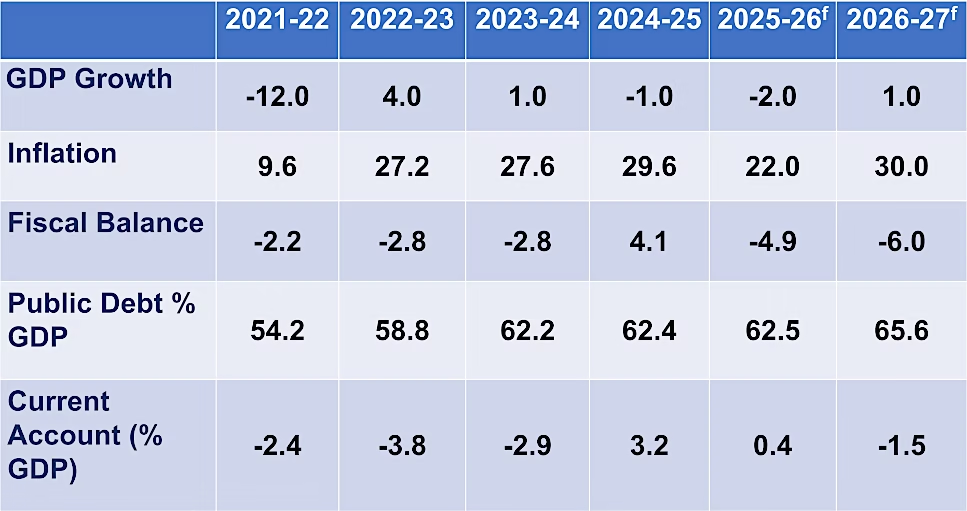
f – forecasts
Source: World Bank Economic Monitor June 2025
Useful links
https://www.worldbank.org/en/country/myanmar/publication/myanmar-economic-monitor-reports
https://www.transparency.org/en/cpi/2021
https://www.imf.org/en/Countries/MMR
https://www.adb.org/countries/myanmar/main

Source: Worldbox
Global Business Information from Worldbox
Worldbox provides trusted business information on more than 500 million companies across developed and emerging markets.
Access company profiles, credit risk reports, ownership and management details, legal status, financial information and other data to support onboarding, KYB, compliance and risk assessment.
Worldbox data is available through online search, API, Snowflake’s data platform, AWS Marketplace, and AI-ready access through AWS MCP Servers.
Need reliable information on a company or market? Contact Worldbox to discuss your requirements.

 |
 |
 |
 |
Copyright (C) 2026 Worldbox Business Intelligence. All rights reserved.
Our mailing address is:
Worldbox Business Intelligence
Breitackerstrasse 1
Zollikon
Zurich 8702
Switzerland