
Worldbox Business Intelligence Risk Rating – November 2025
THAILAND
Summary
| Overall Risk Score 25/40 (Stable)
Political risk: Downgrade 5/10 Economic risk: Stable 6/10 Commercial risk: Stable 7/10 Technology risk: Stable 7/10 The risk assessment of a country is made up of four components, being Political, Economic, Commercial and Technological. Each component is scored out of 10 with 1 being the highest risk and 10 the lowest. |
ESG Risk: 6/10 (Stable)*
*Environmental, social and governance (ESG) issues are becoming increasingly important to companies, investors and consumers in Southeast Asia. That is why we are now preparing a separate ESG score and section with our quarterly country risk reports. We explain how each country rates, looking at the E, S and G individually, and outline recent developments. |
Political Risk – Downgrade from 6 to 5
Thailand is a constitutional monarchy. The legislature is bicameral, consisting of a directly-elected House of Representatives with 500 seats and an upper house, the Senate, all of whose members are appointed by the Royal Thai Military, under the new Constitution adopted in April 2017, to serve five-year terms.
The King is the Chief of State and the Monarchy is hereditary. Traditionally, he has little direct power but has been able to exert considerable influence over political affairs. In the case of the late King Bhumibol Adulyadej, who reigned from 1946 until his death in 2016, that reflected popular respect. Thailand also has one of the harshest lèse-majesté laws in the world, under which people can be charged for posting, sharing or liking social media posts that are deemed offensive to the monarchy.
The royal family and military usually work in tandem, often using the lèse-majesté laws to suppress political dissent. They were used, for example, to justify the arrests of pro-democracy protesters by the government of former prime minister Prayuth Chan-ocha, who led a military coup in 2014 and remained the country’s leader until August 2023. The 2014 power grab marked Thailand’s 13th successful coup since it became a constitutional monarchy in 1932.
Fears of another yet military coup resurfaced in August 2025 after the country’s Constitutional Court removed the prime minister, Paetongtarn Shinawatra, over her handling of a border dispute with Cambodia. Paetongtarn was suspended in early July over a leaked phone call with veteran Cambodian leader Hun Sen amid a violent border dispute between the two countries. During the call, Paetongtarn referred to the elderly former dictator as “uncle,” professed love and respect for him, and criticized her own military commanders.
In September parliament voted for business tycoon Anutin Charnvirakul to become the country’s next prime minister, the third in two years. Anutin, 58, is a staunch royalist and his Bhumjaithai party is the main conservative force in parliament. Anutin is an experienced political operator, having previously served as a former deputy premier, interior minister and health minister.
Anutin essentially became prime minister by default. Bhumjaithai is only the third largest party in parliament. However, the largest party, the People’s party (formerly Move Forward), could not offer a nominee for prime minister because its only qualifying candidate had been banned by a court ruling. Meanwhile, the Constitutional Court has also banned two prime ministers from the second largest party, Thaksin Shinawatra’s Pheu Thai. The court has removed both Paetongtarn Shinawatra, and her predecessor Srettha Thavisin, who was barred from office in August 2014.
The election of Anutin does not suggest that Thailand’s recent political instability is about to end. Move Forward only agreed to back Anutin if he agreed to call an election within four months, and to start the process of amending the military-drafted constitution to make it more democratic. Move Forward is offering to support only the new government’s survival until the election, not any legislation. Anutin therefore has little opportunity to make an impact.
The armed conflict between Thailand and Cambodia lasted from July 24 to July 28, 2025, resulting in dozens of fatalities and the displacement of over 300,000 people. The century-old border dispute flared up with a Cambodian rocket barrage into Thailand on the morning of 24 July, followed by Thai air strikes. Since then, an army of Cambodian social media warriors, backed by state-controlled English language media channels, have unleashed a flood of allegations and inflammatory reports, many of which turned out to be false, according to the BBC World Service.
The BBC adds that the conflict has stirred intense animosity between Thai and Cambodian nationalists. Hundreds of thousands of Cambodian migrant workers have left Thailand, which will hit an already struggling Cambodian economy. In addition, Thai police have begun investigating powerful Cambodian business figures alleged to be linked to underworld gambling and scam centres, while trade worth billions of dollars between the two countries a year has stopped. A re-escalation of the conflict cannot be ruled out.
Economic Risk – Stable at 6
Thailand has been one of Southeast Asia’s most dynamic and successful tiger economies. The World Bank points out that over the past four decades, Thailand has made remarkable progress in social and economic development, moving from a low-income to an upper-middle-income country in less than a generation. The economy grew by an annual average of 7.5% during 1960–96 and by 5% during 1999–2005, following the Asian Financial Crisis.
However, concerns about the economy have grown over the past decade. These were highlighted by the Bank of Thailand (BoT) in August 2025 when the bank’s governor said that economy is facing deep-rooted structural issues, likening them to a “chronic disease” with declining growth potential, high inequality, and rising household debt.
Sethaput Suthiwartnarueput added that while official economic indicators remain strong, most citizens do not feel the benefits. Many struggle with insufficient salaries, high debt levels, and businesses continue to face liquidity problems, said the governor.
The governor highlighted the following challenges:
- Declining growth potential: Thailand’s economic growth capacity has been weakening, and after each crisis or shock, recoveries have consistently returned growth to lower levels than before. This continuous decline reflects a fundamental long-term problem that cannot be solved through short-term stimulus alone, as such measures may temporarily revive the economy but will eventually see it revert to its previous state. Addressing this is the first essential challenge, said the governor.
- High inequality: Thailand faces deeper inequality than many realise, not only in income but also in wealth and household assets, with numerous households suffering from negative net assets.
The Thai National Shippers’ Council has identified other factors that are undermining the economy’s potential. These include:
- Rising competition from Chinese imports and limited access to financing are major threats to Thai businesses and SMEs.
- Thailand’s heavy reliance on foreign materials and components makes it vulnerable to trade deficits. This issue becomes more critical if the US imposes tariffs that directly impact Thai businesses, increasing the cost of exports and reducing competitiveness.
- Thailand’s dependence on original equipment manufacturing models has stifled investment in research, development, and brand creation. This lack of innovation limits the country’s industrial competitiveness on the global stage.
- The lack of a workforce trained in digital and technological skills puts Thailand at a disadvantage. Without proper upskilling initiatives, the country risks falling behind in digital transformation, making it less attractive for foreign investors.
Commercial Risk – Stable at 7
Thailand ranked 107th out of 180 countries in Transparency International’s 2025 Corruption Perceptions Index, falling one place from 2023. It has fallen dramatically since 2015 when it was ranked in 38th place. Regionally, it lies behind Indonesia and Vietnam (in 99th and 88th place) respectively, Malaysia (ranked 57th) and Singapore (3rd).
Sornchai Chuwichien, assistant secretary-general of the National Anti-Corruption Commission said the fall in the score reflects a lack of transparency in Thai government’s spending. There are concerns over “populist” policies, the use of the budget for personal gain, unreasonable spending, and a lack of cost-effectiveness.
Thailand ranks 85th in terms of economic freedom, according to the Heritage Foundation’s 2025 index, down from 42nd in 2021. The Foundation says that Thailand’s economic fundamentals remain relatively solid, but economic freedom still faces challenges that include the need to advance institutional reform. It cites persistent political instability, which undermines the country’s investment climate and economic potential, as a major concern. It adds that the judicial system remains inefficient and vulnerable to political interference, and corruption persists.
The US State Department’s 2024 Investment Climate Statement reported that US businesses had repeatedly expressed concerns about Thailand’s customs regime. The report added that complaints centred on lack of transparency, the significant discretionary authority exercised by Customs Department officials, and a system of giving rewards to officials and non-officials for seized goods based on a percentage of the value of the goods.
Technology Risk – Stable at 7
The Global Innovation Index (GII), from the World Intellectual Property Organization, is an important index used by countries and multinational companies to assess innovation ecosystems and aid in policymaking and investment decisions.
Thailand ranked 41st out of 133 countries in the 2024 GII – its highest place in a decade and moving up from 44th place in 2020.
According to the World Bank’s Thailand Economic Monitor, published in February 2025, Thailand ranks lowest in ASEAN for business innovation. The World Bank said that Thailand’s production sector has yet to make significant progress in innovation, leaving it unable to meet evolving customer demands across various levels. This, the organisation adds, has contributed to declining sales, reduced production output, and falling employment levels, resulting in widespread business closures over the past year and into early 2025.
Government policies
Thailand’s digital economy is the second largest in Southeast Asia. It accounted for 6% of the country’s GDP (US$36 billion) in 2023, with projections indicating growth to 11% by 2027. Financial services, digital payments, fintech, and software and engineering industries, have seen some of the fastest rates of job creation over the past decade, according to the World Bank’s July 2025 Economic Monitor.
The Monitor added that:
“Thailand can leverage its near-universal mobile internet coverage and digital public infrastructure that is among the region’s most advanced. Widespread use of digital ID and digital payment systems (such as ThaID and PromptPay) provide a strong base for financial inclusion and the expansion of digital government and e-commerce. Since the COVID-19 pandemic, the e-commerce industry has grown at an annual average of 10 percent.”
Infrastructure
Thailand has already laid impressive groundwork for its digital journey, according to the World Bank’s July 2025 Economic Monitor. It explains that: “the country has nearly universal access to mobile broadband internet. This digital connectivity has supported a boom in e-commerce and digital payments, with platforms like ThaID and PromptPay becoming integral to daily life and demonstrating Thailand’s capacity for world-class digital public infrastructure. The recent surge in foreign direct investment in data centers may indicate investor confidence in Thailand’s digital sector, addressing the demand gap for high-quality data infrastructure and supporting the government’s “Cloud First” policy.”
AI adoption is low, according to the World Bank with only 6% of internet users accessing generative AI tools as of March 2024, the lowest rate among ASEAN countries. Barriers include low digital literacy, lack of awareness, and insufficient adoption incentives, especially among small firms, says the Bank. Despite issuing seven national AI policies and strategies, financial support for AI development is limited compared to regional leaders.
Education and skilled staff
The government says that “the most important element in the development of Thailand 4.0 is the Thai people”. It has a goal of transforming Thais into “more competent human beings” by reforming the education system, as well as changing curricula and teaching methods to foster a better learning ecosystem. Thailand currently ranks poorly in education. PISA, the OECD’s Programme for International Student Assessment, which measures 15-year-olds’ ability to use their reading, mathematics and science knowledge and skills to meet real-life challenges, ranks Thailand 47th among the 76 countries surveyed.
According to PISA, only one in five boys and one in seven girls in Thailand who excel in maths and science plan to pursue careers in engineering or science by age 30. The government is seeking to address the lack of STEM graduates. In December 2024, it launched a Thai–US Joint-Degree Sandbox for STEM Teacher Education to addresses critical shortcomings in teacher education, aiming to equip Thai teachers with internationally competitive skills.
The initiative, launched in collaboration with leading US universities, aims to overhaul undergraduate and graduate teacher training in science, mathematics and technology. It focuses on modernising curricula, integrating English as a medium of instruction, and ensuring that educators are equipped to meet global standards.
November Bulletin
Political Risk – Downgrade from 6 to 5
Thailand has entered a renewed period of uncertainty following the removal from office of the prime minister, Paetongtarn Shinawatra, over her handling of a border dispute with Cambodia. The installation of Anutin Charnvirakul has reduced the threat of another military coup for the time-being. The military will doubtless be content to see the leader of the main conservative and royalist party in parliament installed as prime minister.
However, the general election, which Anutin has promised to call in four months’ time, is unlikely to provide a permanent solution and may instead prolong political uncertainty further. Move Forward, the progressive party devoted to military reform and reform of the monarchy, would have a very good chance of winning an absolute majority in Parliament and picking the prime minister, placing them on a collision course with the military and palace. That could result in yet another intervention by the Constitutional Court or a military takeover.
The Thai military are currently rising a wave of patriotic fervour following the border clash with Cambodia and many Thais might even welcome the return of military rule. A poll published by the National Institute of Development Administration in August found that Thais trust the military the most in protecting the national interest and resolving the conflict with Cambodia, according to a report by Deutsche Welle. Only 15% of respondents said they had any level of trust in the civilian government over these matters.
Economic Risk – Stable at 6
The economy grew by just 2.5% overall in 2024, lagging behind regional peers, following an expansion of only 1.9% in 2023. In July 2025, the World Bank downgraded its 2025 economic forecasts for Thailand to 1.8%, significantly lower than the Bank of Thailand’s (BOT) projection of 2.3%. We believe the outcome could be even lower given the uncertainty surrounding the domestic political environment and the impact of President Trump’s tariffs. We anticipate that growth could accelerate slightly to around 2% in 2026 given the prospect of stabilising trade conditions. However, this is dependent on a resolution to the country’s political tensions.
While exports performed strongly during the first quarter, this was mainly due to a surge in exports before a 90-day tax deferral imposed by US President Trump. Thailand, which initially faced a 36% levy, now has a deal, like most of its neighbours, to reduce the tariffs to 19%. However, the agreement still lacks detail, and no written or signed documents. Thai exports to the US in 2024 amounted to around US$63bn, or about one-fifth of its total exports.
Inflation fell for the fourth consecutive month in July, reaching -0.70%, according to the Ministry of Commerce. Lower global oil prices and a government-led reduction in electricity tariffs, along with good weather conditions that boosted agricultural output were key contributors to the drop in inflation. The fact that core inflation, which excludes volatile food and energy prices, increased by 0.84% should allay concerns that the country could be entering a period of deflation.
A slowdown in tourism, one of the main pillars of the economy, is a major cause for concern. Tourist arrivals climbed to 35.5 million in 2024, a 26.3% year-over-year increase. However, in 2025, officials have scaled down projections for tourist arrivals to just to 33 million international visitors, down from a forecast of 39 million visitors made at the start of 2025.
A sharp fall in the number of Chinese visiting Thailand is key contributor to the tourism crisis. Chinese tourist arrivals have fallen by over 34% compared to pre-pandemic levels, with projections for 2025 significantly lower than in 2019. Concerns over security is the main reason for the decline in Chinese visitors, fuelled by reports of high-profile crimes on social media. The Thai-Cambodia border skirmish in July may also have impacted numbers.
Tourism accounted for around 20% of GDP before the pandemic in 2019 and creates employment for millions of often low-skilled Thais. The government is so concerned that it is considering offering free domestic flights to foreign tourists coming to the country.
Commercial Risk – Stable at 7
Thailand’s financial system remains stable, with non-performing loans (NPLs) at 2.8% and strong capital buffers amid subdued credit growth, according to the World Banks July 2025 Economic Monitor. However, profitability remains below pre-pandemic levels, and household debt, though declining to 87.9% of GDP, remains the highest in ASEAN at levels constraining to growth and consumption, the organisation adds.
In June 2025 S&P Global Ratings reaffirmed Thailand’s credit rating at BBB+ with a stable outlook, reflecting firm confidence in the nation’s economic fundamentals.
Technology Risk – Stable at 7
Bangkok is swiftly becoming a prominent hub for data centres in Southeast Asia, underpinned by robust energy infrastructure, according to Energy Digital publication. The publication adds that with its IT capacity now exceeding 2.5 GW, the city has ascended to the position of the second-largest market in the region after Johor. Its abundant land resources, reliable energy supply and strategic location as a conduit between East and West, have magnetised multinational operators and hyperscalers seeking to capitalise on these assets.
Energy Digital adds that Bangkok’s emergence as a hyperscale-ready market is underscored by investments from global cloud leaders. AWS has outlined a US$5bn commitment, Google is pledging a US$1bn facility in Chonburi, and Microsoft has inaugurated its first cloud region in Thailand. Meanwhile, Huawei, Alibaba and Tencent, alongside Bytedance’s US$8.8bn investment, are solidifying their presence.
Environmental, Social and Governance (ESG) – Stable at 6
The United Nations’ Sustainable Development Goals (SDGs) are recognized as a beneficial framework for responsible investment. The Sustainable Development Report from Cambridge University Press assesses the progress of all UN Member States on the SDGs. It provides a useful means of ranking Southeast Asian countries on their ESG progress.
Thailand is ranked 43 out of 167 in the 2025 report, with a score of 75.34.
The US State Department’s 2024 Investment Climate Statement says that Thailand is among the top countries in the world for environmental, social and governance disclosures, with both the Securities Exchange Commission (SEC) and the Bank of Thailand focused on this issue. New SEC regulations on Sustainable and Responsible Investing fund disclosure requirements came into effect in April 2022, and the SEC, as the stock-exchange regulator, mandates ESG reporting for listed companies in the 56-1 One Report annual public filing.
Environment: Thailand faces some severe environmental issues. Air pollution is among the most serious: in January 2025 air pollution in Bangkok forced the closure of more than 350 schools, the highest number in five years. Thailand’s second city of Chiang Mai is also badly affected by air pollution during the winter “burning season”, when cold, stagnant air traps smoke from fires that farmer start to burn off stubble. The annual crop-burning season causes air pollution lethal enough to prematurely kill 34,000 people every year according to some reports.
The issue of deforestation is more severe in Thailand than in many other Southeast Asian countries, primarily due to the rapid clearance of forests to accommodate agricultural expansion necessitated by population growth and the country’s focus on exporting agricultural products. The government is seeking to curb deforestation, but challenges persist, with incidences of illicit tree cutting and conversion of forested land into agricultural use continuing to pose threats to conservation efforts.
Social: The law provides for the right of workers in certain private-sector and state-owned enterprises to form and join independent trade unions, while Thais also enjoy the right to universal healthcare and a pension. There is a minimum wage law, although it does not cover some areas, such as government officers, state enterprise employees, domestic workers, maritime workers and agricultural workers.
Governance: Thailand ranked ninth on the Asian Corporate Governance Association’s recent report card on 12 Asia-Pacific markets in 2023, down from eighth place in 2020. Thailand’s fall was due in particular to lower scores for listed companies, investor participation and public governance. In 2024, the SEC and Stock Exchange of Thailand introduced new rules to flag or suspend the stock of troubled companies and escalate investigations.
November Bulletin
Environmental, Social and Governance (ESG) – Stable at 6
In May 2025, the Bangkok Post reported that the Stock Exchange of Thailand is hoping the recent launch of dozens of Thai ESG Extra funds will revive an index battered by US tariffs. Investors can now subscribe to 37 Thai ESG X funds that offer tax benefits of up to 800,000 baht, including the option to transfer investments from long-term equity funds.
Latest economic data
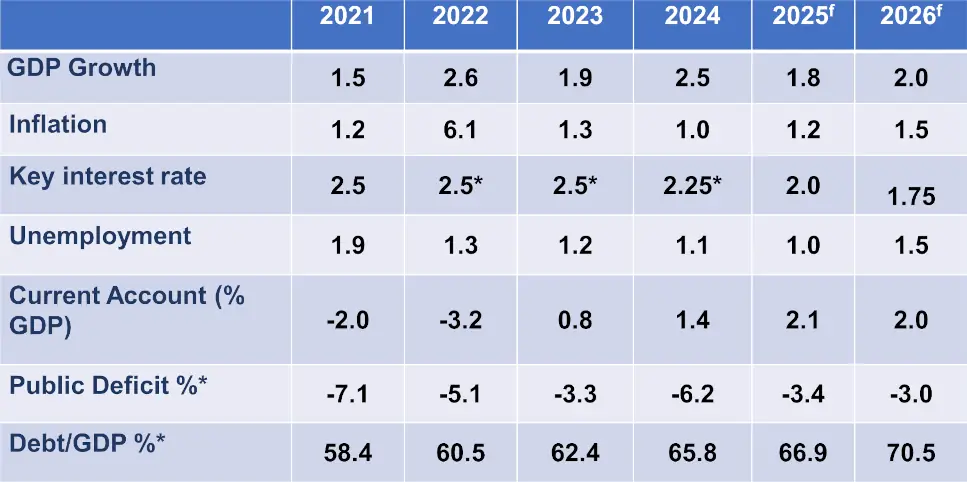
f forecasts
* Worldbox Business Intelligence
Source: IMF January 2024, World Bank except where stated
Source: Worldbox
Useful links
https://www.transparency.org/en/cpi/2021
https://www.imf.org/en/Countries/THA
https://www.adb.org/countries/thailand/main
About Worldbox Business Intelligence
Switzerland-based Worldbox Business Intelligence is a global leader in business data and intelligence. With over 400 million companies across all major and emerging markets, our solutions support real-time onboarding, KYB, and compliance verification through the delivery of credit reports, profiles, ownership and management, legal status and history details as well as financial and other business information.
Accessible via API, online search, and the AWS MCP Servers, available over AWS marketplace, Worldbox enables organizations to search, evaluate, and acquire company data with transparent pricing and seamless AI integration.
With its global network and Swiss precision, Worldbox empowers smarter, more efficient business decision-making.
“Worldbox Business Intelligence – Bringing Swiss Precision To Data”
Copyright (C) 2025 Worldbox Business Intelligence. All rights reserved.
Our mailing address is:
Worldbox Business Intelligence
Breitackerstrasse 1
Zollikon
Zurich 8702
Switzerland