Worldbox Country Risk Climate – November 2025
SINGAPORE
Summary
| Overall Risk Score 34 (Stable)
Political risk: Stable 9/10 Economic risk: Stable 8/10 Commercial risk: Stable 9/10 Technology risk: Stable 8/10 The risk assessment of a country is made up of four components, being Political, Economic, Commercial and Technological. Each component is scored out of 10 with 1 being the highest risk and 10 the lowest. |
ESG Risk: 8/10 (Stable)*
*Environmental, social and governance (ESG) issues are becoming increasingly important to companies, investors and consumers in Southeast Asia. That is why we are now preparing a separate ESG score and section with our quarterly country risk reports. We explain how each country rates, looking at the E, S and G individually, and outline recent developments. |
Political Risk – Stable at 9
Singapore is one of Southeast Asia’s most stable and prosperous countries. The electoral and legal framework allows for some political pluralism but constrains the activities of opposition parties and limits freedoms of expression, assembly and association. The media environment is controlled and self-censorship among journalists is common. There are also curbs on online content. The People’s Action Party (PAP) has ruled the country since it split from Malaysia in 1965.
Lawrence Wong became prime minister on 15 May 2024, succeeding Lee Hsien Loong, the eldest son of the country’s founding father, Lee Kuan Yew. Wong, the former deputy prime minister, became the fourth leader of Singapore since independence. Aged 52, he is only Singapore’s second leader not to come from the Lee family, after Goh Chok Tong, who governed between 1990 and 2004.
Wong led the ruling People’s Action Party (PAP) to a landslide in the May 2025 election, which was dominated by concerns over the cost of living and the country’s future economic stability. The PAP clinched 65.6% of the vote and an overwhelming majority of the 97 seats in parliament. Given the widespread global economic and geopolitical instability, it is little surprise that voters gravitated towards the safe choice of PAP. The main opposition, the centre-left Workers’ Party (WP), failed to capture more seats but continued to hold on to its 10 seats in parliament. Wong is the first PAP prime minister to have improved the party’s vote share in his first election.
Economic Risk – Stable at 8
Singapore is a high-income economy built on a business-friendly regulatory environment and strong investments in infrastructure, education, healthcare and public services. The city-state is among the world’s most competitive economies, according to the World Bank. Political stability, low corruption rates and transparent public institutions have underpinned its growth as a leading business and financial hub in Asia.
The economy is heavily trade-dependent and has an open investment regime, with some licensing restrictions in the financial services, professional services and media sectors. The government is committed to maintaining a free market but also actively plans Singapore’s economic development, including through a network of state-owned enterprises.
Following independence in 1965, the economy experienced rapid industrialization in the 1960s, with manufacturing emerging as the main driver of growth. The manufacturing and services sectors remain the twin pillars of Singapore’s high-value-added economy.
Manufacturing is increasingly hi-tech: the country is the world’s fifth-largest exporter of hi-tech products in sectors such as semiconductors, pharmaceuticals, medical and aerospace engineering. Electronics account for close to half of the manufacturing sector’s output, with semiconductors being particularly important.
The government actively promotes the country as a centre for research, development and innovation by offering tax incentives, research grants and partnership opportunities with domestic research agencies. Singapore remains a regional hub for thousands of multinational companies and maintains its reputation as a world leader in dispute resolution, financing and project facilitation for regional infrastructure development.
The country is also an important global maritime and aviation hub, and claims to have the best seaport in Asia, while Changi Airport is routinely voted as being among the best in the world. Singapore is home to the world’s largest transshipment container port, linked to over 600 ports worldwide.
Singapore’s broad-based post-pandemic recovery has outpaced its peers and the economy’s average growth from 2020-24 was higher than the five-year average preceding the pandemic, according to the latest Article IV assessment of the economy by the IMF, released in July 2025.
However, the IMF warned that deepening geoeconomic fragmentation could threaten Singapore’s financial interconnectedness and role as a global financial centre. It added that continuing developments and the adoption of AI technologies are associated with both upside (e.g., stronger productivity) and downside (e.g., labour market disruptions and cyberthreats) risks.
The organisation also warned over the longer term, climate change continues to pose a threat to growth prospects, with potential spillovers to the financial sector and economic activity. Finally, the IMF said that Singapore’s aging population may threaten its potential growth outlook and put increasing pressure on its fiscal resources.
However, the IMF also acknowledged that “Singapore’s robust public finances and fiscal institutions leave it well-positioned to tackle increased medium-term spending needs to meet higher healthcare costs due to Singapore’s aging population, climate transition costs, structural transformation amid technological change, and the need to refresh aging infrastructure and public housing.”
Commercial Risk – Stable at 9
Singapore consistently ranks as one of the best economies in the world in which to operate. The country ranks in first place in terms of economic freedom out of 184 countries, according to the Heritage Foundation 2025 Index of Economic Freedom. In its 2025 report on Singapore, Freedom House said that:
“Strong protection of property rights and effective enforcement of anticorruption laws sustain the foundations of Singapore’s economic freedom. Tax rates are competitive, and the regulatory environment encourages vibrant economic activity. Openness to global commerce boosts productivity and facilitates the emergence of a more dynamic and competitive financial sector. The business start-up process is straightforward. There is no statutory minimum wage, but the National Wage Council guides wage adjustments. Inflation is under control despite the challenging external environment.”
Singapore is also consistently rated as one of the least corrupt societies in the world, ranking third in Transparency International’s (TI) 2024 Corruption Perceptions Index, up two places from the previous year. It is the only Asian country ranked in the top 10. Singapore has tackled corruption decisively and garnered international recognition for its incorruptibility and clean public sector, according to TI.
Singapore benefits from excellent infrastructure, reflecting high levels of investment supported by years of political stability and economic prosperity. The country hosts superb transport links, for example, and its nationwide fibre network provides its citizens with among the fastest home internet speeds in the world.
Singapore is consistently regarded as among the “smartest” cities in the world. For example, the 2025 Smart City Index ranked Singapore as the smartest city in East and Southeast Asia, ahead of Beijing, Shanghai, Hong Kong and Seoul, and as the world’s ninth-smartest city. The report found that Singapore was excelling in areas like providing satisfactory basic sanitation for the poorest areas, public transport and public safety.
Technology Risk – Stable at 8
The Global Innovation Index (GII), from the World Intellectual Property Organization, is an important index used by countries and multinational companies to assess innovation ecosystems and aid in policymaking and investment decisions.
Singapore ranks fourth out of 133 countries in the 2024 GII – moving up from 15th place in 2020. Singapore ranks fourth among the 51 high-income group economies, and first among the 17 economies in South East Asia, East Asia and Oceania.
Over the last decade, Singapore has grown into one of the largest tech startup clusters in Asia, home to around 4500 tech startup and over 510 venture-capital firms, with a scientific research base of nearly 40,000 researchers, scientists and engineers, according to Startup Genome. It is also home to 80 of the world’s top 100 technology businesses. In the first half of 2025, Singapore startups attracted 92% of Southeast Asia’s funding. The country’s strong talent base, convenient location, government support and favourable tax policies have been credited for Singapore’s rise.
Singapore is investing heavily in automation, AI and integrated systems, as well as sustainability, and is seeking to establish itself as a regional hub for these technologies. Singapore is also a well-established hub for medical research and device manufacturing.
Government policies
Singapore’s policymakers have played a significant role in helping the state transition into a high-income economy in less than 40 years, according to the UN’s World Intellectual Property Organization (WIPO).
WIPO says the policies can be summarized into two categories:
- Supply-push innovation policies – these intend to build the infrastructure and make investments that stimulate innovations.
- Demand-pull innovation policies – these intend to facilitate the adoption of new products and services to mitigate the risk of developing them.
WIPO adds that key public spending on critical infrastructure, such as Singapore’s smart-city infrastructure and healthcare, contributed to the growth in innovative activities by indigenous startups. In addition, public investment in education, and in research and development, contributed to the state’s strong reputation in regional and international research, with two universities ranking as second and third in Asia in 2025, according to the Asia University Rankings produced by Times Higher Education. They are the National University of Singapore and Nanyang Technological University.
In the 2025 budget released in February 2025, the government devoted significant resources to structural spending measures such as top-ups to the Changi Airport Development Fund, Coastal and Flood Protection Fund, Future Energy Fund (totalling 2% of GDP), and National Productivity Fund (0.4% of GDP) are geared toward building future-proof infrastructure, managing the climate transition, and attracting investment in high-tech areas such as biotech and semiconductors.
The government has also been instrumental in providing the demand for Singaporean-led technological innovations, according to WIPO. It explains that the government is an early adopter of relatively unproven new technologies or novel forms of services in sectors such as mobility, energy and, more recently, public healthcare during the Covid-19 crisis. Because of this, several inventions became viable commercial innovations that have broadly diffused to the private sector, says WIPO.
WIPO also believes one crucial element of Singaporean public policies is the state’s innovation-friendly environment. Local innovators are able to rely on the support of specialized institutions to scale up their startups. These services encourage commercial efforts by making it easier for entrepreneurs to understand matters related to intellectual property protection, venture capital, mergers and acquisitions, or initial public offering.
Infrastructure
Singapore’s infrastructure ranks among the best in the world. It has one of the most reliable electricity supplies globally, for example, with an average interruption time of less than one minute per customer per year. The country ranks in second place in the world of digital competitiveness, according to World Digital Competitiveness Ranking 2025, produced by IMD, having moved steadily up the rankings in recent years. Singapore is also one of the biggest data-centre markets in Asia and one of the top submarine-cable hubs globally, with connections to 25 active subsea cables and more to come.
Education and skilled staff
Education in Singapore is seen as being among the best in the world. Singapore was ranked number one for mathematics, science and reading in the OECD’s Programme for International Student Assessment (Pisa) 2022. The National University of Singapore ranked in third place globally for interdisciplinary science in a Times Higher Education review published in November 2024, and is highest ranked in Asia. Nanyang Technological University is in ninth position.
November Bulletin
Political Risk – Stable at 9
The resounding victory for PAP at the May 2025 election can be taken as a ringing endorsement for Prime Minister Lawrence Wong, who took office in May 2024. The margin of victory in most seats was significant, with the opposition decimated and PAP candidates winning more than two-thirds of the vote in 18 of 33 constituencies.
Anything other than a victory for PAP would have been a huge shock, but closer result would also have undermined Wong’s authority and led to greater scrutiny of government policies
The most pressing problems facing Wong include high living costs and a shortage of housing. In September 2025, Singapore was ranked the most expensive city to live in for both locals and expatriates, according to a survey of 45 Asian cities.
Economic Risk – Stable at 8
Singapore escaped relatively lightly from the Trump administration’s rollout of global tariffs. Trump imposed 10% tariffs on Singapore, while placing much higher tariffs on the neighbouring countries even after the governments of those countries managed to negotiate them down. The open-trade oriented nature of the economy, however, means that Singapore will be affected should global trade slow significantly as a result of Trump’s tariff policy.
The relatively low nature of the tariff placed on the island republic reflects the fact that Singapore is the only country in Southeast Asia with which the US has a trade surplus. However, the US could still impose sector-specific tariffs, such as on pharmaceuticals or semiconductors, which would have a particular impact on Singapore.
The economy exceeded expectations in 2024, with GDP growing by 4.4% according to government data released in February. The economy expanded by 4.3% in the final quarter of 2024, lifting full-year growth to its strongest performance since 2011, excluding the post-pandemic rebound in 2021. Manufacturing, a major driver of the export-reliant economy, expanded by 4.2% in the last quarter of the year, while construction and services grew by 5.9% and 4.3% respectively.
In August 2025, the Ministry of Trade and Industry (MTI) upgraded Singapore’s growth forecast for 2025 to between 1.5 and 2.5%, up from 0% to 2% previously. The upward revision reflects the better-than-expected performance of the Singapore economy in the first half of 2025, when the economy grew by 4.3%. MTI said the 90-day pause in Trump’s reciprocal tariffs led to the performance of most advanced and regional economies to be “more resilient than expected”. However, it warned that “Singapore’s economic outlook for the rest of the year remains clouded by uncertainty, with the risks tilted to the downside,”
Singapore’s annual inflation rate fell to a lower-than-expected 0.6% in July, the lowest level seen since January 2021. The central bank said that inflation should remain “moderate” in the near term, citing an easing in global crude oil prices, while food commodity price hikes should also stay contained. Domestically, slower nominal wage growth and productivity increases “should contribute to a moderation in unit labour costs,” the MAS said. The central bank forecast that core inflation would average between 0.5% and 1.5% for 2025, down from 2.8% in 2024.
The central bank eased monetary policy in January and April to offset weaker growth, but kept its monetary policy unchanged in July 2025. The central bank uses the exchange rate as its key policy tool, reflecting the fact that international trade flows dwarf the island nation’s domestic activity. Consequently, the Singapore dollar operates under a managed float-currency regime, based on a basket of currencies representing the city-state’s major trade partners. The rate is allowed to trade within an undisclosed band.
Commercial Risk – Stable at 9
In its July 2025 Article IV assessment of Singapore’s economy, the IMF said the country’s financial sector remains resilient. The current tight macroprudential policy should continue to prevent a buildup of housing related systemic risks. The IMF underscored the importance of continued vigilance on vulnerabilities from cross border and foreign exchange exposures and a small number of highly leveraged corporates and households. Exposures to commercial real estate and the connections between non-bank financial institutions and banks also merit vigilance. In this regard, The IMF welcomed the authorities’ efforts to step up stress testing and contingency planning. Continued efforts to strengthen the AML/CFT framework will also be important.
In July 2025, S&P Global warned that Singapore’s three biggest lenders are expected to post declines in their net profits for the April-June quarter amid falling interest rates and slower loan growth. Singaporean banks posted record profits in 2024, fuelled by the rising stature of the city-state as a global financial hub.
Technology Risk – Stable at 8
Singapore is set to benefit from massive investment in artificial intelligence (AI) operations from a host of multinationals in 2025, as the government’s support and strategy to create an ecosystem for the disruptive technology bears fruit, according to fDi Intelligence. The publication says mining giant BHP, cloud computing specialist Oracle, professional services firm PwC and southeast Asian super-app Grab have collectively set out plans to invest billions of dollars into AI hubs in Singapore in 2025. OpenAI, the company behind ChatGPT, also has an office in the city state.
Environmental, Social and Governance (ESG) – Stable at 8
The United Nations’ Sustainable Development Goals (SDGs) are recognized as a beneficial framework for responsible investment. The Sustainable Development Report from Cambridge University Press assesses the progress of all 193 UN Member States on the SDGs. It provides a useful means of ranking Southeast Asian countries on their ESG progress.
Singapore is ranked 69 out of 167 in the 2025 report, with a score of 71.5. Singapore has the highest score in the ASEAN region, a reflection of the country’s advanced economy, the rule of law and the increasing attention paid to ESG issues by the authorities.
Environment – Singapore is a liveable and sustainable city, with clean air and a generally healthy environment, a robust and diversified supply of water, green spaces and a highly efficient public transport network.
The government’s Singapore Green Plan 2030 sets ambitious targets to improve the environment and place the city on course to reach its net-zero target by 2050. Goals include developing over 130 hectares (ha) of new parks, and enhancing around 170 ha of existing parks with more lush vegetation and natural landscapes by 2026. The plan also calls for a doubling of the annual tree-planting rate between 2020 and 2030, to plant 1 million more trees across Singapore.
Social – Singapore has a reputation for authoritarianism that the government is seeking to address. In 2023, it launched its Forward Singapore vision, which seeks to review and refresh the social contract between the government and the people. The exercise involved consulting more than 200,000 Singaporeans over 16 months to discuss issues ranging from careers to ageing and environmental sustainability. The key points of Forward Singapore include:
- An ambition to support families through every stage of life.
- Highlighting the need for Singaporeans to pursue lifelong learning.
- Encouraging people to enhance the careers through guidance and skills training and a commitment to reduce the wage gap between the highest and lowest paid.
- Enabling seniors to age well through national programmes like Healthier SG and Age Well SG.
- Optimising limited land and environmental resources, strengthening food and water security, and upholding fiscal prudence and responsibility.
In the latest Article IV assessment of the economy by the IMF, released in July 2025, IMF welcomed Forward Singapore and the authorities’ efforts to promote a stronger and more inclusive economy, including introducing a temporary financial support scheme for involuntarily unemployed workers. It added that continuing efforts to support workers to reskill and helping firms to adopt AI technologies, as well as investments, including in climate resilient infrastructure, were important.
Governance – This is another area where Singapore scores highly. The country’s success as a global commercial and financial hub is based on its willingness to embrace international standards, especially in corporate law and capital markets regulation. The authorities have updated their corporate governance code several times over the past 20 years and are moving from a voluntary “comply-or-explain” approach to a partially mandatory one.
Moreover, the Heritage Foundation in its 2025 report on economic freedom says that “the overall rule of law is well respected in Singapore. The country’s property rights score is above the world average; its judicial effectiveness score is above the world average; and its government integrity score is above the world average.”
November Bulletin
Environmental, Social and Governance (ESG) – Stable at 8
Singapore law firms are seeing a surge in client demand for sustainability-related advice as companies scramble to meet tighter ESG rules, according to the Singapore Business Review. It cites key drivers as including Singapore’s Green Plan 2030, the 2050 net-zero target, and the Carbon Tax Act, along with the implementation of Article 6 of the Paris Agreement, all of which create new compliance requirements for businesses. These shifts have generated more work for law firms advising on carbon tax, emission projects, and regulatory alignment.
Latest economic data
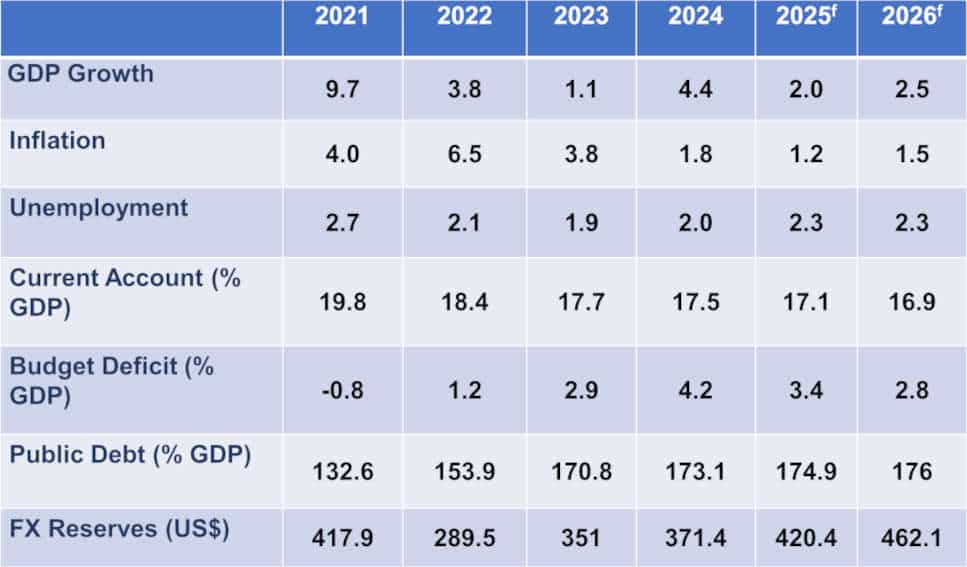
f forecasts
Source: IMF article IV assessment July 2025
Useful Links
https://www.transparency.org/en/cpi/2021
https://www.imf.org/en/Countries/SGP
https://www.straitstimes.com/global

Source: Worldbox
About Worldbox Business Intelligence
Switzerland-based Worldbox Business Intelligence is a global leader in business data and intelligence. With over 400 million companies across all major and emerging markets, our solutions support real-time onboarding, KYB, and compliance verification through the delivery of credit reports, profiles, ownership and management, legal status and history details as well as financial and other business information.
Accessible via API, online search, and the AWS MCP Servers, available over AWS marketplace, Worldbox enables organizations to search, evaluate, and acquire company data with transparent pricing and seamless AI integration.
With its global network and Swiss precision, Worldbox empowers smarter, more efficient business decision-making.
“Worldbox Business Intelligence – Bringing Swiss Precision To Data”
Copyright (C) 2025 Worldbox Business Intelligence. All rights reserved.
Our mailing address is:
Worldbox Business Intelligence
Breitackerstrasse 1
Zollikon
Zurich 8702
Switzerland