Worldbox Business Intelligence Risk Rating – May 2025
THAILAND
NEW – Technology is an increasingly important driver of economic success, and we are now including a separate Technology sector in our quarterly country risk reports and integrating the core into our overall score.
Summary
| Overall Risk Score 26/40 (Stable)
Political risk: Stable 6/10 Economic risk: Stable 6/10 Commercial risk: Stable 7/10 Technology risk: Stable 7/10 The risk assessment of a country is made up of four components, being Political, Economic, Commercial and Technological. Each component is scored out of 10 with 1 being the highest risk and 10 the lowest. |
ESG Risk: 6/10 (Stable)*
*Environmental, social and governance (ESG) issues are becoming increasingly important to companies, investors and consumers in Southeast Asia. That is why we are now preparing a separate ESG score and section with our quarterly country risk reports. We explain how each country rates, looking at the E, S and G individually, and outline recent developments. |
Political Risk – Stable at 6
Thailand is a constitutional monarchy. The legislature is bicameral, consisting of a directly-elected House of Representatives with 500 seats and an upper house, the Senate, all of whose members are appointed by the Royal Thai Military, under the new Constitution adopted in April 2017, to serve five-year terms.
The King is the Chief of State and the Monarchy is hereditary. Traditionally, he has little direct power but has been able to exert considerable influence over political affairs. In the case of the late King Bhumibol Adulyadej, who reigned from 1946 until his death in 2016, that reflected popular respect. Thailand also has one of the harshest lèse-majesté laws in the world, under which people can be charged for posting, sharing or liking social media posts that are deemed offensive to the monarchy.
The royal family and military usually work in tandem, often using the lèse-majesté laws to suppress political dissent. They were used, for example, to justify the arrests of pro-democracy protesters by the government of former prime minister Prayuth Chan-ocha, who led a military coup in 2014 and remained the country’s leader until August 2023. The 2014 power grab marked Thailand’s 13th successful coup since it became a constitutional monarchy in 1932.
The military and the royal family also successfully blocked the reformist-minded Move Forward party from taking power after it far exceeded expectations to win 151 of the 500 seats in the lower house during the May 2023 election. Move Forward had wanted to reform or even abolish the lèse-majesté laws.
Pheu Thai formed a broad coalition without Move Forward and was able to win the support of the Senate to form a government. Pheu Thai reneged on a campaign pledge not to support pro-military parties.
In August 2024, the Constitutional Court ruled Prime Minister Srettha Thavisin had breached a requirement that ministers have “evident integrity” and high ethical standards by appointing a minister with a prison record. He was ousted from his post as Thailand’s 30th prime minister after 11 months and 14 days.
He was replaced by Pheu Thai leader Paetongtarn Shinawatra, who gained overwhelming support from coalition MPs to become only the second woman in Thai history to serve as prime minister. She is the daughter of Thaksin Shinawatra, who is regarded as Pheu Thai’s patriarch and de-facto leader, and who was prime minister from 2001 to 2006.
Having easily survived a no-confidence vote in late March (see May Political Risk bulletin), Prime Minister Paetongtarn Shinawatra has said she has no plans to reshuffle the cabinet.
Economic Risk – Stable at 6
Thailand has been one of Southeast Asia’s most dynamic and successful tiger economies. The World Bank points out that over the past four decades, Thailand has made remarkable progress in social and economic development, moving from a low-income to an upper-middle-income country in less than a generation. The economy grew by an annual average of 7.5% during 1960–96 and by 5% during 1999–2005, following the Asian Financial Crisis.
However, concerns about the economy have grown over the past decade. In its 2024 Article IV Consultation, released in January 2025, the IMF, for example, noted that while the economy was gradually recovering, it was doing so at a slower pace than it peers.
The IMF said the economic underperformance was rooted in Thailand’s longstanding structural weaknesses, while emerging external and domestic headwinds had also contributed to subdued inflation. It added that the “outlook remains highly uncertain with significant downside risks.”
Very high levels of private debt are a key concern. Household debt stands at 89% of GDP according to an IMF report released in April 2025, among the highest levels in Asia. The IMF warned that as well as weighing on consumption, the high debt level also hurts investment and the economy more broadly.
The ageing population is another challenge. An official report has revealed that as of January 2024, 13.2 million Thai citizens were aged over 60, or about 20% of the entire population, while children accounted for 17%. The report forecast that by 2037, the percentage of children would drop to 14.3% while the over 60s would account for 29.85%. Thailand’s fertility rate stood at 1.08 in 2023, the second lowest in Southeast Asia after Singapore’s 0.97, with many young Thais saying they simply cannot afford to have children. Deputy Prime Minister Somsak Thepsutin has warned that on current trends, the population could be halved, from its current 66 million to 33 million, within 60 years.
Inadequate education and skills are another cause for concern. Critics say that Thailand’s military leaders have neglected to fund an education system capable of producing a workforce suited to the digital era. According to a recent World Bank report, two-thirds of Thai youth and adults are “below the threshold levels of foundational reading literacy”, while three-quarters have poor digital literacy skills. Meanwhile, Thailand’s English-language proficiency ranks among the lowest in ASEAN.
Commercial Risk – Stable at 7
Thailand ranked 107th out of 180 countries in Transparency International’s 2025 Corruption Perceptions Index, falling one place from 2023. It has fallen dramatically since 2015 when it was ranked in 38th place. Regionally, it lies behind Indonesia and Vietnam (in 99th and 88th place) respectively, Malaysia (ranked 57th) and Singapore (3rd).
Sornchai Chuwichien, assistant secretary-general of the National Anti-Corruption Commission said the fall in the score reflects a lack of transparency in Thai government’s spending. There are concerns over “populist” policies, the use of the budget for personal gain, unreasonable spending, and a lack of cost-effectiveness.
Thailand ranks 85th in terms of economic freedom, according to the Heritage Foundation’s 2025 index, down from 42nd in 2021. The Foundation says that Thailand’s economic fundamentals remain relatively solid, but economic freedom still faces challenges that include the need to advance institutional reform. It cites persistent political instability, which undermines the country’s investment climate and economic potential, as a major concern. It adds that the judicial system remains inefficient and vulnerable to political interference, and corruption persists.
The US State Department’s 2024 Investment Climate Statement reported that US businesses had repeatedly expressed concerns about Thailand’s customs regime. The report added that complaints centred on lack of transparency, the significant discretionary authority exercised by Customs Department officials, and a system of giving rewards to officials and non-officials for seized goods based on a percentage of the value of the goods.
NEW
Technology Risk – Stable at 7
The Global Innovation Index (GII), from the World Intellectual Property Organization, is an important index used by countries and multinational companies to assess innovation ecosystems and aid in policymaking and investment decisions.
Thailand ranked 41st out of 133 countries in the 2024 GII – its highest place in a decade and moving up from 44th place in 2020.
Government policies
Thailand’s digital economy is the second largest in Southeast Asia. It accounted for 6% of the country’s GDP (US$36 billion) in 2023, with projections indicating growth to 11% by 2027. Accelerated technology adoption, supportive government policies, and the success of sectors such as ICT and e-commerce are driving this growth.
Following the Covid-19 pandemic, Thailand swiftly adopted digital technologies in both the public and private sectors. This shift has been encouraged by government support aiming to establish Thailand as a regional ICT hub. The US International Trade Commission (ITC) says the digital landscape is competitive, with both local and international players like Huawei, ZTE, Intel, Ericsson, Cisco, Samsung and HPE vying for market share.
The National Digital Economy and Society Commission has set a target of increasing the digital sector’s contribution to 30% of GDP by 2027, with a focus on enhancing cloud infrastructure and attracting foreign investment.
Meanwhile, the ITC says that under Thailand’s national ICT strategy, known as Thailand 4.0, the Thai government envisions Thailand becoming an ASEAN digital hub. According to the Office of the National Broadcasting and Telecommunications Commission, wider adoption of applications using 5G could contribute US$9.3 billion, or 10% of GDP, to the Thai economy by 2035. With the support of the Thai government, the plan encourages digital creativity and innovation, the development of new technology, and the move towards a digitally driven economy.
Infrastructure
The 5G mobile network currently covers more than 95% of the population. Thailand ambitious Thailand 4.0 programme promotes industrial-scale digital transformation while establishing an economic corridor in eastern Thailand.
Thailand 4.0 is part of Thailand’s more extensive digital transformation policy, “A National Digital Blueprint”, which targets the development of Thailand’s digital economy over the next 20 years. The Thai government has set a target for Thailand to become a developed country in 2037.
Education and skilled staff
The government says that “the most important element in the development of Thailand 4.0 is the Thai people”. It has a goal of transforming Thais into “more competent human beings” by reforming the education system, as well as changing curricula and teaching methods to foster a better learning ecosystem. Thailand currently ranks poorly in education. PISA, the OECD’s Programme for International Student Assessment, which measures 15-year-olds’ ability to use their reading, mathematics and science knowledge and skills to meet real-life challenges, ranks Thailand 47th among the 76 countries surveyed.
According to PISA, only one in five boys and one in seven girls in Thailand who excel in maths and science plan to pursue careers in engineering or science by age 30. The government is seeking to address the lack of STEM graduates. In December 2024, it launched a Thai–US Joint-Degree Sandbox for STEM Teacher Education to address critical shortcomings in teacher education, aiming to equip Thai teachers with internationally competitive skills.
The initiative, launched in collaboration with leading US universities, aims to overhaul undergraduate and graduate teacher training in science, mathematics and technology. It focuses on modernising curricula, integrating English as a medium of instruction, and ensuring that educators are equipped to meet global standards.
May Bulletin
Political Risk – Stable at 6
The government of prime minister Paetongtarn Shinawatra easily survived a no-confidence vote in parliament on 26th March, a development that should boost confidence the ability of the governing coalition to remain in power for the next six months to a year at least. Critics charged Paetongtarn with mismanagement and allowing her father, former prime minister Thaksin Shinawatra of controlling her administration.
Thaksin certainly wields considerable influence. Thaksin has spoken openly and frequently about policies that include legalising gambling and adopting cryptocurrency and has championed a $14 billion handout scheme to stimulate the economy, all of which the Pheu Thai-led government has pursued.
However, while he holds no elected position, Thaksin remains very popular in the country particularly among poorer Thais who prospered under his 2001 to 2006 rule. That popularity suggests that accusing Thaksin of influencing the government is unlikely to affect its appeal to many Thai voters. The fact that Thaksin is also despised by the country’s conservative establishment is also unlikely to harm the coalition among poorer Thais.
Economic Risk – Stable at 6
The economy grew less than expected in the final quarter of 2025, expanding by 3.2%. According to official figures, the economy grew by just 2.5% overall in 2024, lagging behind regional peers, following an expansion of only 1.9% in 2023. Indonesia’s GDP, by contrast, has been growing consistently at around 5%, while the Philippines and Vietnam both expanded by more than 5% in 2024.
Officials anticipate growth of between 2.3% and 3.3% in 2025 but the outlook is extremely opaque given uncertainty about the outlook for trade and global growth amidst the new US administration’s tariff policies. President Trump imposed a tariff of 36% on Thailand’s exports to the US in April. Thailand’s exports to the US account for around 10% of GDP. Thailand is also connected to North American supply chains, making it vulnerable to US tariffs on Canada and Mexico.
The Thai government responded by saying it will increase US imports, lower some of the higher taxes on American goods and address non-tariff barriers, as it seeks to negotiate a better deal on the tariffs, now due to come into effect in July. Thailand has also said it seek to balance trade with the US within 10 years.
However, there has been some better news on inflation, which reached its target range in January for the first time since May last year, lifted by higher energy and food prices. That should help allays fears that Thailand could descend into deflation. The headline consumer price index rose 1.23% in December from a year earlier, within the central bank’s target of 1% to 3%, after the previous month’s annual increase of just 0.95%.
Tourism one of the main pillars of the economy appears to be thriving again following the pandemic. Tourist arrivals climbed to 35.5 million in 2024, a 26.3% year-over-year increase. KGI Securities expects numbers to rise to around 38 million this year, close the to the pre-Covid peak of 39 million in 2019.
Commercial Risk – Stable at 7
In December 2024, S&P Global maintained Thailand’s Sovereign Credit Rating at BBB+, with a stable outlook. The agency expects the government to continue prioritizing investments that align with national strategies.
These include the development of the Eastern Economic Corridor and large-scale transportation infrastructure projects. Investments by state enterprises and public-private partnerships are expected to drive these initiatives forward.
The agency also noted the importance of domestic political stability, explaining that consistent economic policies and stable political conditions could pave the way for an upgrade in Thailand’s credit rating to A-, as they would enable more effective economic policymaking.
Technology Risk – Stable at 7
Thai digital experts are raising concerns that Thailand may be left behind in the global AI race unless it invests in developing its domestic AI workforce, according to a late March report in the Nation newspaper. It quoted Dr Atip Asvanund, director of the Digital Council for Economy and Society of Thailand, as noting that the country has a limited pool of skilled programmers compared to Malaysia’s robust STEM education.
Environmental, Social and Governance (ESG) – Stable at 6
The United Nations’ Sustainable Development Goals (SDGs) are recognized as a beneficial framework for responsible investment. The Sustainable Development Report from Cambridge University Press assesses the progress of all UN Member States on the SDGs. It provides a useful means of ranking Southeast Asian countries on their ESG progress.
Thailand is ranked 45 out of 166 in the 2024 report, with a score of 74.7.
The US State Department’s 2024 Investment Climate Statement says that Thailand is among the top countries in the world for environmental, social and governance disclosures, with both the Securities Exchange Commission (SEC) and the Bank of Thailand focused on this issue. New SEC regulations on Sustainable and Responsible Investing fund disclosure requirements came into effect in April 2022, and the SEC, as the stock-exchange regulator, mandates ESG reporting for listed companies in the 56-1 One Report annual public filing.
Environment: Thailand faces some severe environmental issues. Air pollution is among the most serious: in January 2025 air pollution in Bangkok forced the closure of more than 350 schools, the highest number in five years. Thailand’s second city of Chiang Mai is also badly affected by air pollution during the winter “burning season”, when cold, stagnant air traps smoke from fires that farmer start to burn off stubble. The annual crop-burning season causes air pollution lethal enough to prematurely kill 34,000 people every year according to some reports.
The issue of deforestation is more severe in Thailand than in many other Southeast Asian countries, primarily due to the rapid clearance of forests to accommodate agricultural expansion necessitated by population growth and the country’s focus on exporting agricultural products. The government is seeking to curb deforestation, but challenges persist, with incidences of illicit tree cutting and conversion of forested land into agricultural use continuing to pose threats to conservation efforts.
Social: The law provides for the right of workers in certain private-sector and state-owned enterprises to form and join independent trade unions, while Thais also enjoy the right to universal healthcare and a pension. There is a minimum wage law, although it does not cover some areas, such as government officers, state enterprise employees, domestic workers, maritime workers and agricultural workers.
Governance: Thailand ranked ninth on the Asian Corporate Governance Association’s recent report card on 12 Asia-Pacific markets in 2023, down from eighth place in 2020. Thailand’s fall was due in particular to lower scores for listed companies, investor participation and public governance. In 2024, the SEC and Stock Exchange of Thailand introduced new rules to flag or suspend the stock of troubled companies and escalate investigations.
May Bulletin
Environmental, Social and Governance (ESG) – Stable at 6
Thailand’s environmental, social and governance funds scheme assets grew almost four-fold in just one year thanks to government measures that made it more attractive to investors, according to a January Morningstar report. The 30-plus funds in the scheme ended 2024 with 32 billion baht (US$922 million) of total assets under management, up from 6.5 billion baht when it was launched in December 2023, Morningstar says in a report on January 13.
The scheme provides investors with tax incentives until 2032 to encourage sustainable investment.
Latest economic data
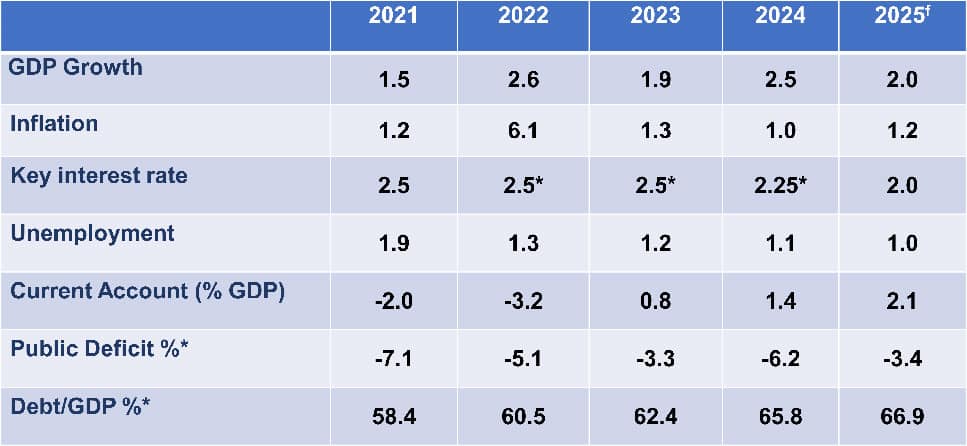
f forecasts
* Worldbox Business Intelligence
Source: IMF January 2024, World Bank except where stated
Useful links
https://www.transparency.org/en/cpi/2021
https://www.imf.org/en/Countries/THA
https://www.adb.org/countries/thailand/main
About Worldbox Business Intelligence
Worldbox Business Intelligence, headquartered in Switzerland, is a Global API data solution provider of business intelligence and used in data analytics.
With the Global API solution Worldbox Business Intelligence enables clients and partners a frictionless real time onboarding, KYC and compliance verification, while rapid global investigations are provided, if needed.
Worldbox Business Intelligence provides global data in a standardised structure on more than 320 Million companies worldwide. It’s global network of subsidiaries, branches and desks allows the precise and efficient collection of data on key target territories for clients and partners.”
“Worldbox Business Intelligence – Bringing Swiss Precision To Data”
Copyright (C) 2025 Worldbox Business Intelligence. All rights reserved.
Our mailing address is:
Worldbox Business Intelligence
Breitackerstrasse 1
Zollikon
Zurich 8702
Switzerland