Worldbox Country Risk Climate May 2025
CAMBODIA
NEW – Technology is an increasingly important driver of economic success, and we are now including a separate Technology sector in our quarterly country risk reports and integrating the core into our overall score.
Summary
| Overall Risk Score 23/40 (Stable)
Political risk: Stable 6/10 Economic risk: Stable 7/10 Commercial risk: Stable 6/10 Technology risk: Stable 4/10 The risk assessment of a country is made up of four components, being Political, Economic, Commercial and Technological. Each component is scored out of 10 with 1 being the highest risk and 10 the lowest. |
ESG Risk: 4/10 (Stable)*
*Environmental, social and governance (ESG) issues are becoming increasingly important to companies, investors and consumers in Southeast Asia. That is why we are now preparing a separate ESG score and section with our quarterly country risk reports. We explain how each country rates, looking at the E, S and G individually, and outline recent developments. |
Political Risk – Stable at 6
Nominally a parliamentary democracy with a bicameral parliament and a king as head of state, Cambodia is a one-party state. Hun Sen, who became prime minister in 1985 and his Cambodian People’s Party (CPP) dominates the political scene. Hun Sen stepped down as prime minister in 2023 with his eldest son Hun Manet being sworn in as the new prime minister.
The transfer followed a landslide victory for Hun Sen’s ruling Cambodian People’s Party at the July election. It won 120 of 125 seats. The US, EU and other Western nations refused to send observers to the poll, saying it was neither free nor fair. In May, the main opposition party and the sole credible challenger to Hun Sen was barred from contesting the vote. The decision by the electoral authorities to ban the Candlelight Party for allegedly filing the wrong paperwork echoes developments in the run up to the 2018 election.
Worldbox Business Intelligence does not expect any significant shifts in policy making following the succession of Hun Manet. Even though he has relinquished the prime minister’s job, Hun Sen, 71, is expected to retain a large amount of control as his party’s president and president of the Senate. However, Cambodia’s political stability could well be challenged. Manet is untested and his promotion would certainly not be welcomed in some parts of the CPP or the country at large. His support is reportedly limited to younger urbanites.
Relations between Cambodia and the US are a key concern with relations becoming increasingly strained in recent years. In particular, the US has been concerned by China’s growing influence over the kingdom. That is likely to be the key focus of the Trump administration rather than human rights, which was a major matter of concern for the Biden government.
Economic Risk – Stable at 7
Cambodia experienced some of the highest economic growth in the world in the two decades prior to the pandemic. Driven by garment exports and tourism, annual growth averaged 7.7% between 1998 and 2019. The rapid growth resulted in significant gains in poverty reduction with the poverty rate in Cambodia declining to 18% in 2020 from just under 50% percent in 2007. From 2000 to 2020, life expectancy increased from 58 years to over 70.
Consequently, President Trump’s decision to impose the highest tariff rate in the global trade war on Cambodia, at 49%, poses a significant risk to the economy. The US is the largest buyer of goods from the Kingdom, accounting for 40% of Cambodian exports.
The US has claimed that Cambodia’s tariffs on the US reach as high as 97%, a claim disputed by Cambodia, as well as by multiple sources of tariffs data, including the World Trade Organization. The WTO cites a figure of 7.9%. Meanwhile the US argument that tariffs will encourage jobs to return to the US seems very unlikely in the case of Cambodia. The average garment worker earns just a few hundred dollars a month in Cambodia and even with tariffs US workers simply couldn’t compete.
Talks between the US and Cambodian governments on the tariffs are already underway, with Phnom Penh offering to slash tariffs and taxes on US goods.
Given Cambodia’s trade surplus with the U.S. is relatively low compared with other nations, Worldbox Business Intelligence believes concern over China’s growing influence over Cambodia, outlined in the political risk section, may explain why Phnom Penh was hit so hard by tariffs. Washington may therefore press Phnom Penh to loosen ties with China.
Cambodia is known to want to lessen its dependence on China but Trump’s approach is a risky strategy and could result in Cambodia moving even closer to China. That’s because Cambodia is already heavily dependent on China, which accounted for nearly half of all FDI into the country in 2024. China is also Cambodia’s most important trade partner and second largest export market.
The Trump administration’s decision to cancel significant aid flows into Cambodia had already undermined its reputation within the kingdom as a reliable partner. Just last October, USAID announced around US$55 million in disbursements to the kingdom, all abruptly cancelled by the Trump administration. Meanwhile, China continues to supply significant aid.
Commercial Risk – Stable at 6
Cambodia ranked joint 158th out of 180 countries in Transparency International’s (TI) 2024 Corruption Perceptions Index, unchanged from the previous year. Cambodia is the second-lowest-rated country in the Association of Southeast Asian Nations (ASEAN), ahead of only Myanmar, and one of the lowest-rated countries in Asia.
Pech Pisey, executive director at Transparency International Cambodia, said that systematic corruption remains a widespread problem and is complicit in the erosion of democracy. He noted that Cambodia had tightened restrictions on fundamental rights, including freedom of expression, and pointed to corruption in the judicial system.
The Heritage Foundation ranks Cambodia as “mostly unfree”, according to its 2025 Freedom Index. The country’s score of 58.2 makes its economy the 98th freest out of 184 countries in the world. Its rating has decreased by 0.9 points from last year. Cambodia is ranked 20th out of 39 countries in the Asia-Pacific region, and its economic freedom score is lower than the world and regional averages.
NEW
Technology Risk – Stable at 4
The Global Innovation Index (GII), from the World Intellectual Property Organization, is an important index used by countries and multinational companies to assess innovation ecosystems and aid in policymaking and investment decisions.
Cambodia ranked 103rd out of 133 countries in the 2024 GII, up from 110th place in 2020. Mobile internet coverage extends to over 90% of the population, with a strong presence in urban areas.
Cambodia ranked 86th in the world for mobile speeds and 107th for fixed broadband speeds in November 2024, according to Ookla Speedtest Intelligence.
The country has made significant progress in the areas of telecommunications, information technology, e-commerce, digital government, tech startups and new technology in recent years. Businesses in Cambodia are increasingly adopting new technologies, such as cloud computing, artificial intelligence (AI) and blockchain. The adoption of technology is facilitated by Cambodia’s young and tech-savvy population: 60% of the population is under 30 years old.
Government policies
The government has recognized the importance of internet speed in its development agenda, as outlined in the Cambodia Digital Economy and Society Policy Framework 2021–2035. It is seeking to address the monopolistic nature of the telecoms sector by amending laws and regulations related to the management of digital infrastructure to enhance competitiveness and promote infrastructure sharing among telecommunications operators.
Infrastructure
Cambodia’s government has made significant investments in the country’s telecommunications infrastructure, helping to improve internet access and speed. The Hong Kong–Phnom Penh submarine fibre-optic cable network – a US$165 million project that is expected to be completed in 2025 and will provide Cambodia with high-speed internet access – provides a prime example.
However, foreign direct investment remains skewed towards traditional industries such as garment manufacturing.
Education and skilled staff
The government is keen to encourage growth in the number of STEM graduates, a policy skew reflected in the emergence of newer institutions such as CamTech University, the Cambodia Academy of Digital Technology (CADT), and Paragon International University, alongside the long-established Institute of Technology of Cambodia. Officials are aiming for 50% of university graduates to major in STEM subjects by 2030. Currently, the number of students majoring in STEM remains very low compared with other countries in the region.
May Bulletin
Political Risk – Stable at 6
Cambodia’s political environment and human rights record is under international scrutiny again following the killing of an opposition MP in Thailand in January. Members of the political opposition in Cambodia, including the banned Cambodia National Rescue Party (and other banned opposition political party supporters and members, have faced human rights abuses in the country and overseas, with many having been jailed, according to Amnesty International.
The organisation adds that Cambodian activists have reported being the subject of violent repression in Thailand including threats, harassment, surveillance and forced return to Cambodia by the Thai government.
However, it is unlikely that the government will face any real pressure over the issue. The Trump administration does not appear to be placing the same emphasis on human rights as previous US governments. Meanwhile, the EU is focused on creating friendly relations with countries in the region in the hope of displacing US influence as the Trump administration alienates local partners with tariffs and the withdrawal of aid.
Economic Risk – Stable at 7
The latest Asian Development Bank (ADB) report – released in April 2025 – forecasts continued healthy growth in 2025 and 2026, driven by external demand for manufactured goods and the continued recovery in the tourism sector It projects growth of 6.1% in 2025 and 6.2% in 2026 after an expansion of 6.0% in 2024.
However, Worldbox Business Intelligence is far less sanguine believing that Trump’s tariff policies will have significant impact on global and Cambodian growth. We are therefore projecting growth of just 4% this year. To be fair to the ADB, it does acknowledge that the forecasts were finalized prior to the 2 April announcement of new tariffs by the U.S. administration, and the baseline projections only reflect tariffs that were in place as of March 2025.
The importance of the garment sector, which will be badly hit by the tariffs should they remain in place at the current level of 49%, to the Cambodian economy is clear from its performance in 2024. The garment sector surged with 23.5% export growth, while non-garment exports such as electrical components, vehicle accessories, and wooden goods grew at a slower 6.2%, compared to 20.7% the previous year. Construction activity saw a gradual recovery, but output remained below pre-pandemic levels due to weak domestic demand.
The services sector grew by an estimated 4.5%, largely on the back of tourism, according to the ADB. International arrivals increased by 22.9% to 6.7 million, returning to pre-pandemic numbers. However, the majority arrived by land, indicating a shift toward more budget-conscious regional tourists.
Inflation averaged just 0.8% in 2024, down from 2.1% in 2023, due to lower fuel prices and stabilised food costs says the ADB. However, it warns that inflationary pressures are building, with projections showing a rise to 3.7% in 2025 before moderating to 2.4% in 2026. The increase is attributed to a low-base effect and higher domestic demand, particularly for food.
Commercial Risk – Stable at 6
The Ministry of Land Management, Urban Planning and Construction, and Credit Bureau (Cambodia) Co., Ltd (CBC), a leading financial data infrastructure in Cambodia, have launched Property Verification Service for 198 members of CBC, comprising banks, microfinance institutions, leasing companies and rural credit institutions.
The Property Verification Service provides details of a property’s owner, the address (with geocoordinates) and any active or closed pledges on the property by third parties. The information in the report is customized to suit the needs of banks and financial institutions in Cambodia.
The service will allow banks and financial institutions to complete property verification in a quick, convenient and reliable manner, enabling them to efficiently assess any risks associated with the property. It is claimed that this will also make the loan application process easier for borrowers.
Technology Risk – Stable at 4
The use of AI in Cambodia is “very limited”, and it could take up to five years for Cambodia to catch up with current levels of AI utilization in developed countries such as the US and South Korea, according to a local tech entrepreneur interviewed by the Khmer Times in November. Sok Sopheakmonkol, co-founder of Codingate, a Cambodia-based business solutions company, said that language barriers present a significant hurdle to the development of AI, explaining that Khmer is largely unavailable on AI platforms, and only English speakers can use AI in Cambodia. Inadequate investment in customized AI technology and automation is another challenge, with many large tech companies unwilling to invest in Cambodia due to the limited size of the local market.
Environmental, Social and Governance (ESG) – Stable at 4
The United Nations’ Sustainable Development Goals (SDGs) are recognized as a beneficial framework for responsible investment. The Sustainable Development Report from Cambridge University Press assesses the progress of UN Member States on the SDGs. It provides a useful means of ranking Southeast Asian countries on their ESG progress.
Cambodia is ranked 104 out of 166 in the 2024 report, with a score of 64.9.
Environment: Cambodia has one of the highest rates of deforestation in the world, with forest cover down to around 46% of the country’s land area, from 72% in 1973. Air pollution and water scarcity are two other major environmental concerns. Air pollution causes a number of significant health problems, including asthma, chronic bronchitis, decreased lung function, and premature death. Meanwhile, around 20% of the population lacks essential access to clean water.
Social: Workers’ rights are enshrined in law but in practice few of these laws are obeyed or enforced. To meet quotas, workers are often either forced to work overtime, “enticed to do so with a small bonus that is usually never paid”, according to the Borgen Report. In addition, many companies employ children under 15 even though the law states that employees should be aged 15 plus.
Governance: ESG principles have only recently appeared on the corporate agenda in Cambodia. According to the GRI Sustainability Disclosure Database, however, the total number of sustainability reports in Cambodia has more than doubled since 2015, with the majority of these reports coming from the financial services sector.
May Bulletin
Environmental, Social and Governance (ESG) – Stable at 4
In March 2025, the gambling company Prince Holding Group won the “Best in Country Excellence – Best in Cambodia” award at the 17th Annual Global CSR & ESG Awards. The company focuses on initiatives that promote education, healthcare, youth empowerment, and community development in Cambodia. Through its philanthropic arm, Prince Foundation, the Group continues to implement programs aimed at fostering long-term impact.
Latest economic data
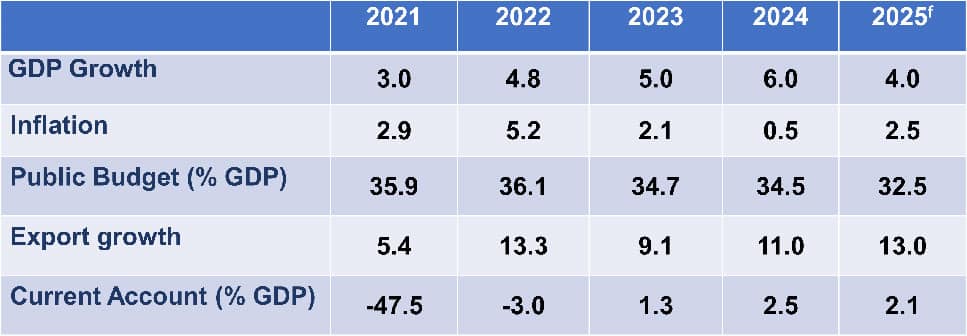
f – forecasts
Source: AMRO/IMF/World Bank/Asian Development Bank
Useful Links
https://www.transparency.org/en/cpi/2021
https://www.imf.org/en/Countries/KHM
https://www.adb.org/countries/cambodia/main
https://dashboards.sdgindex.org/profiles/cambodia
About Worldbox Business Intelligence
Worldbox Business Intelligence, headquartered in Switzerland, is a Global API data solution provider of business intelligence and used in data analytics.
With the Global API solution Worldbox Business Intelligence enables clients and partners a frictionless real time onboarding, KYC and compliance verification, while rapid global investigations are provided, if needed.
Worldbox Business Intelligence provides global data in a standardised structure on more than 320 Million companies worldwide. It’s global network of subsidiaries, branches and desks allows the precise and efficient collection of data on key target territories for clients and partners.”
“Worldbox Business Intelligence – Bringing Swiss Precision To Data”
Copyright (C) 2025 Worldbox Business Intelligence. All rights reserved.
Our mailing address is:
Worldbox Business Intelligence
Breitackerstrasse 1
Zollikon
Zurich 8702
Switzerland