Worldbox Business Intelligence Risk Rating – March 2025
THE PHILIPPINES
Summary
NEW – Technology is an increasingly important driver of economic success, and we are now including a separate Technology sector in our quarterly country risk reports and integrating the core into our overall score.
| Overall Risk Score 28/22 (Stable)
Political risk: Stable 8/10 Economic risk: Stable 7/10 Commercial risk: Stable 7/10 Technology risk: Stable 6/10 The risk assessment of a country is made up of four components, being Political, Economic, Commercial and Technological. Each component is scored out of 10 with 1 being the highest risk and 10 the lowest. |
ESG Risk: 7/10 (Stable)*
*Environmental, social and governance (ESG) issues are becoming increasingly important to companies, investors and consumers in Southeast Asia. That is why we are now preparing a separate ESG score and section with our quarterly country risk reports. We explain how each country rates, looking at the E, S and G individually, and outline recent developments. |
Political Risk – Stable at 8
The Philippines is a multi-party, representative democracy modelled on the US system. This involves a presidential system of government with a bicameral legislature and an independent judiciary. The president is limited to one six-year term. According to Freedom House:
“Elections are free from overt restrictions. However, established political elites benefit from structural advantages, and highly organized disinformation campaigns and widespread vote buying undermine fair competition. Corruption is endemic, and anticorruption bodies struggle to uphold their mandates. Journalists and activists perceived as critical of the government or other powerful interests can face criminal cases, and in some cases violent and even deadly attack.”
The current president, Ferdinand “Bongbong” Marcos Junior, was elected in a landslide at the May 2022 presidential election. The son of former dictator Ferdinand Marcos, who ruled the country from 1965 to 1986, Marcos Jr remains relatively popular, with an approval rating of 47% according to an independent survey carried out in November 2024.
However, the relative political calm that followed the 2022 election came to an end in 2024. Firstly, Sara Duterte, daughter of political opponent and former president Rodrigo Duterte, terminated her alliance with Marcos Jr in June. Her resignation from office meant the end of the once celebrated “UniTeam”.
Since then, the split has become increasingly acrimonious. In November, Sara Duterte announced on her Facebook page that she had hired assassins to kill the president, and dreamed of cutting off his head. She also threatened to dig up the body of the president’s father and dump the ashes in the sea. Marcos responded by calling Duterte’s comments “reckless” and “troubling”. The Philippines National Bureau of Investigation summoned the vice-president to explain her threats. Duterte subsequently denied the comments were real. She is also facing claims she misappropriated funds from both the Office of the Vice President and the Department of Education.
Surprisingly, the president may have little option but to keep Duterte in the vice-presidency for now. She enjoys strong popular support in the south and among the millions of overseas Filipino workers. She could be removed by impeachment, but getting sufficient support in the Senate for the process could prove difficult.
Marcos may have to wait until the mid-term elections due in May 2025, in which the entire lower house and half of the 24 senatorial seats will be contested. If Marcos emerges victorious, he may feel confident enough to strike against Duterte. Meanwhile, Duterte will be hoping her candidates will fare well and establish a launching pad for the 2028 presidential race.
Adding to the drama, former president Rodrigo Duterte is seeking to return to the political scene. In October, he launched a bid to become mayor of Davao, the southern city stronghold that he led for some 20 years before becoming president. The election will take place in May 2025.
The Dutertes are battling for survival, with Duterte Sr facing local and international investigations over the drug war in which thousands of people were killed while he was president. Richard Heydarian, senior lecturer at the Asian Center of the University of the Philippines, reportedly said that the Dutertes are at their most vulnerable moment in almost a decade. In March Duterte was arrested by the ICC and deported to the Hague on a warrant for crimes against humanity.
CNN quoted Ranjit Singh Rye, an assistant professor of political science at the University of the Philippines, as saying that at the heart of the feud is geopolitics, specifically how the Philippines should balance its relationships with China and the US. The Marcos administration has pivoted towards Washington – the Philippines’ oldest and closest ally – particularly strengthening its military alliance, in a move that reverses Duterte’s pro-Beijing tilt for investment in infrastructure
Economic Risk – Stable at 7
The Philippines is the third-largest economy in the Southeast Asian region, after Indonesia and Thailand. The economy has been one of the most dynamic in the East Asia and Pacific region, powered by increasing urbanization, a growing middle class, and a large and young population. Services and manufacturing account for around 90% of GDP, with agriculture’s share falling steadily to around 10%.
In its annual Article IV report on the economy, completed in October 2024, the IMF said that the Philippine economy had navigated multiple external headwinds in recent years and remained among the best-performing economies in the region.
The IMF added that the economy holds significant potential, due to abundant natural resources, an untapped “blue” economy, and a sizeable demographic dividend. However, it noted that unlocking the medium-term growth potential “will crucially depend on comprehensive and well-sequenced structural reforms”.
These reforms, coupled with strengthened social protection programmes, said the IMF, should aim to boost job creation, enhance productivity, increase resilience to climate change, and reduce poverty and inequality. Priority areas included upgrading infrastructure, making significant investments in healthcare and education, addressing land fragmentation and low productivity in the agricultural sector, and enhancing governance. Finally, the IMF said that digitalization provided an important opportunity to improve access to quality education, promote financial inclusion, and enhance public spending efficiency.
However, an article in Fulcrum, published by the Yusof Ishak Institute (ISEAS) in Singapore in November 2024, provided a far less rosy view of the Philippine economy. It argued that the country remains stuck in a lower-middle-income trap, and is lagging behind its ASEAN peers. The article said that the mismanagement of the pandemic by former president Rodrigo Duterte meant that the scars on the Philippine economy are now permanent.
Consequently, the Philippines needs GDP growth in excess of 10% a year to return to its pre-pandemic GDP trend. The Fulcrum article added that Vietnam officially overtook the Philippines in per-capita income during the pandemic, “a remarkable development because just a few decades ago, Vietnam was economically worse off than the Philippines”. It also pointed out that the economy had been stuck in the lower-middle-income category since 1989, when the World Bank first developed its country classification by income.
The article, however, also struck a note of optimism. It argued that, given the Philippines is now a service-driven economy, with services accounting for 62.3% of GDP in 2023, it “seems to have largely missed out on the promise of industrialization, insofar as industry—especially if export-oriented—holds out great potential technological progress and positive spillovers”. The article cited a World Bank study that showed “that Vietnam’s booming exports have made ripples across its economy so that even workers in non-export-oriented industries have benefitted”.
The author believes that Vietnam’s experience shows it may not be too late for the Philippines to industrialize, explaining that the first step is to address the dearth of investments, especially in export manufacturing. He concluded, “It is not too late for the Philippines, but its leaders must step up and not be lulled into complacency by the sparkly growth figures.”
Commercial Risk – Stable at 7
The US State Department’s latest Investment Climate report on the Philippines, published in August 2024, says the government remains committed to improving its overall investment climate and sustaining economic growth.
The report adds that in recent years the country has taken steps to open new sectors of the economy to foreign investment. Amendments to the Public Services Act opened sectors such as railways, airports, expressways and telecommunications to 100% foreign ownership.
However, impediments to foreign investment – including poor infrastructure, high power and logistics costs, regulatory inconsistencies, a cumbersome bureaucracy, and corruption – have hampered the government’s efforts. Traffic in major cities and congestion in the ports remain barriers to doing business. Large, family-owned conglomerates dominate the economic landscape, sometimes crowding out smaller businesses.
The Philippines ranks joint 115th out of 180 countries in Transparency International’s 2023 Corruption Perceptions Index – lower than the likes of Thailand and Vietnam, and ranked equally with Indonesia. The Philippines fell one place from its 2022 ranking. According to the Philippines Corruption Report by GAN, high levels of corruption severely restrict the efficiency of businesses operating in the Philippines.
The country lies in 88th place in terms of economic freedom, as ranked in the Heritage Foundation’s 2024 Index. The Philippines is ranked 18th out of 39 countries in the Asia-Pacific region, and its economic freedom score is higher than the world and regional averages. The Philippines’ economy is considered “mostly unfree”, according to the 2024 Index.
NEW
Technology Risk – Stable at 6
The Global Innovation Index (GII), from the World Intellectual Property Organization, is an important index used by countries and multinational companies to assess innovation ecosystems and aid in policymaking and investment decisions.
The Philippines ranked 53rd out of 133 countries in the 2024 GII, down from 50th place in 2020.
The Philippines ranked 76th in the world for mobile speeds and 55th for fixed broadband speeds in November 2024. That marks a significant improvement over previous years. The Ookla Speedtest Intelligence carried out in July 2024 found the Philippines’ speed of 94.42 Mbps in Q2 2024 was behind some of its Southeast Asian peers’ median download speeds – for example, Singapore (284.93 Mbps), Thailand (231.01 Mbps), Vietnam (135.00 Mbps) and Malaysia (132.72 Mbps).
Government policies
The Philippines has experienced a significant increase in the use of digital technology in several industries, driven primarily by a tech-savvy population, government policies that encourage digital adoption, and investments both locally and internationally.
The Philippine Development Plan 2023–2028 specifies digital transformation as one of its underlying themes. The Philippines envisions achieving a robust digital economy to make the country “globally competitive”. The goal is to bridge the “digital divide” across the archipelago, where nearly 40% of the country lacks reliable internet access.
The government has also recognized the importance of artificial intelligence (AI) for economic growth and innovation, establishing initiatives such as the National AI Roadmap and the establishment of the National AI Research Center to foster AI adoption and research.
Infrastructure
The Philippine government has launched a National Fiber Backbone project aimed at building a cable network across the archipelago. Upon completion in 2026, the project should increase the national broadband penetration rate from 33% to 65%, extending high-speed internet access to 70 million of the current 115 million population. It is hoped the project will also lower the price of internet connectivity.
Education and skilled staff
The Philippines is struggling to produce enough STEM graduates to meet demand, with less than a quarter of senior high-school students enrolled in STEM subjects. A shortage of skilled professionals with expertise in AI, meanwhile, has created a talent gap that has impacted the ability of companies to develop and implement sophisticated AI solutions.
March Bulletin
Political Risk – Stable at 8
Tensions with China over disputed territory in the South China Sea continue to simmer. In December, China accused the Philippines of having “provoked trouble” with US backing. Philippine officials had earlier reported that Chinese coastguard vessels fired water cannon and collided with a Filipino boat on the way to deliver supplies to Filipino fishermen around the Scarborough Shoal, a move that drew condemnation from the US.
Also in December, it was reported that the Philippines was considering launching a new arbitration case against China over alleged breaches of international law in the South China Sea, and was lobbying other countries. A 2016 arbitral award found China’s claim over almost the entire South China Sea to be groundless, but Beijing rejected the ruling.
Beijing and Manila have been involved this year in a series of confrontations at reefs and outcrops in the disputed waters.
With Rodrigo Duterte and his supporters running in the midterm elections, the Philippines’ alliance with the US will become a huge source of contention. Duterte will naturally favour closer ties with China, at the expense of western relations, resulting in deep conflict within the government. Marcos Jr may find difficulty passing laws relating to military enterprises with the US, fracturing the union between the two nations.
Should Sara Duterte win the presidency in 2028, as is currently predicted, she will be faced with a difficult decision. Remain loyal to the West and preserve a relationship six years in the making, or ally with China like her father. The Philippines is at the epicentre of the conflict between the superpowers, and it cannot continue to move backwards and forwards between the two. It must choose a side and stick to it, or suffer continuous political upheaval.
Economic Risk – Stable at 7
The Philippines economy to grew by 5.6% in 2024, according to the Philippines Department of Finance. The growth forecast for 2024 was revised down, by the World Bank, from 6.0%, due to weaker-than-expected growth in the third quarter of 2024. Several typhoons have affected millions of people, destroyed crops and property, damaged infrastructure, and disrupted economic activity, particularly in tourism and construction. The World Bank foresees growth of 6.1% in 2025 and 6.0% in 2026.
Inflation rose to an annual 2.5% in November, from 2.3% in October, largely due to the impact of the typhoons, which have disrupted food supplies. The central bank has reduced policy rates three times since August, and in November it said rates could decrease by a further 100 basis points in 2025.
According to the 2025 budget, unveiled in October, spending is set to increase by a significant and well-above-inflation rate of 10%, confirming the government’s commitment to increasing public spending by borrowing and running deficits. The budget deficit of 5.3%, down from 5.6% in 2024, is based on the assumption that GDP will grow by at least 6.5%, inflation will remain below 4%, and the benchmark interest rate will not exceed 5.5%.
Commercial Risk – Stable at 7
In its October 2024 Article IV press release, the IMF said that systemic risk within the financial system remained at moderate levels, with a banking sector characterized by strong capitalization, liquidity and profitability. However, it called for continued vigilance against pockets of vulnerability in the real-estate sector and a fast-growing consumer credit market.
The IMF added that adjusting macroprudential policy as credit picks up, including by moving towards a positive neutral level for the countercyclical capital buffer, would help pre-empt the build-up of vulnerabilities.
It also said that important progress had been made in addressing Anti-Money Laundering/Combating the Financing of Terrorism (AML/CFT) issues, and the current momentum should be maintained to close the outstanding gaps in the AML/CFT framework and achieve prompt removal from the Financial Action Task Force grey list.
Technology Risk – Stable at 6
BM Philippines reported in December that many companies in the Philippines are quietly adopting and investing in AI. According to a recent Ecosystm report sponsored by IBM, the initial excitement and enthusiasm in AI adoption this year has given way to companies focusing on creating “tangible value through robust infrastructure, efficient operations, and skilled talent”. The study found that 23% of AI investment by businesses in the Philippines in 2025 will focus on customer experience, 18% on back-office business-process automation, and 17% on employee experience and productivity.
Environmental, Social and Governance (ESG) – Stable at 7
The United Nations’ Sustainable Development Goals (SDGs) are recognized as a beneficial framework for responsible investment. The Sustainable Development Report from Cambridge University Press assesses the progress of all UN Member States on the SDGs. It provides a useful means of ranking Southeast Asian countries on their ESG progress.
The Philippines is ranked 92 out of 166 in the 2024 report, with a score of 67.5.
Environment – The Philippines faces four major environmental challenges, according to the environmental organization Earth.Org. They are:
- Air pollution – stemming from the fact that over half of the population is dependent on the burning of fossil fuels to meet its daily energy needs. The World Health Organization says that air pollution kills around 120,000 Filipinos every year.
- Plastic pollution – around 2.7 million tons of plastic waste is generated every year. That stems from an insufficient waste-management system, coupled with a high dependence on single-use plastics.
- Marine pollution – around 20% of the plastic waste ends up in the sea. Theresa Lazaro, the country’s Foreign Affairs Undersecretary, has said that “there would be more plastics than fish by 2050, while oceans would be overheated and acidified if people fail to act now”. In recent years, the government has initiated various measures to curb marine pollution in the country.
- Rising sea levels – the sea level in Manila has been rising by around 2.6 centimetres per year, from an average rate of 1.3 millimetres per year in the 1900s, with groundwater use in the country’s capital enhancing the risk of sea-level rise, according to a Philippine Climate Change Assessment report published in July. The report concluded that the sea-level rise poses a significant threat to the Philippines, particularly in terms of inundation.
Social – According to the US State Department, the Department of Labor’s Bureau of Working Conditions monitors and inspects compliance with wage, hour, and health and safety laws in all sectors, including workers in the formal and informal sectors, and non-traditional labourers. However, labour groups say enforcement is lax particularly in terms of occupational safety and health standards in workplaces.
Governance – According to the US State Department’s 2024 Investment Climate statement, Responsible Business Conduct (RBC) is practised in the Philippines, although no domestic laws require it. The Philippine Tax Code provides RBC-related incentives to corporations, such as tax exemptions and deductions. Various non-government organizations and business associations also promote RBC. US companies report strong and favourable responses to RBC programmes among employees and within local communities.
March Bulletin
Environmental, Social and Governance (ESG) – Stable at 7
In November, the Asian Development Bank approved a US$500 million policy-based loan to strengthen the Philippines’ efforts to tackle climate change. The Philippines faces the highest disaster risk globally, according to the World Risk Index 2022–2024. Recent typhoons have highlighted the country’s vulnerability to extreme weather events, with potential economic damage from climate-related disasters reaching up to 7.6% of GDP by 2030, according to ESG News.
Latest economic data
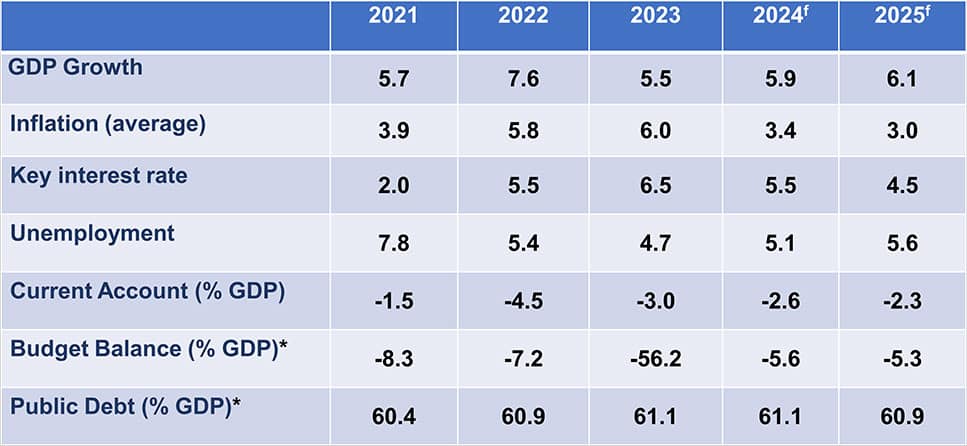
f forecasts
* Official figures
Source: World Bank/International Monetary Fund, December Article IV consultation, except where stated
Useful links
https://www.transparency.org/en/cpi/2021
https://www.imf.org/en/Countries/PHL
https://www.adb.org/countries/philippines/main
https://business.inquirer.net/
https://mb.com.ph/category/business/business-news/
https://fulcrum.sg/about-fulcrum/
About Worldbox Business Intelligence
Worldbox Business Intelligence, headquartered in Switzerland, is a Global API data solution provider of business intelligence and used in data analytics.
With the Global API solution Worldbox Business Intelligence enables clients and partners a frictionless real time onboarding, KYC and compliance verification, while rapid global investigations are provided, if needed.
Worldbox Business Intelligence provides global data in a standardised structure on more than 300 Million companies worldwide. It’s global network of subsidiaries, branches and desks allows the precise and efficient collection of data on key target territories for clients and partners.”
“Worldbox Business Intelligence – Bringing Swiss Precision To Data”
Copyright (C) 2025 Worldbox Business Intelligence. All rights reserved.
Our mailing address is:
Worldbox Business Intelligence
Breitackerstrasse 1
Zollikon
Zurich 8702
Switzerland