Worldbox Country Risk Climate – March 2025
SINGAPORE
Summary
NEW – Technology is an increasingly important driver of economic success, and we are now including a separate Technology sector in our quarterly country risk reports and integrating the core into our overall score.
| Overall Risk Score 34/40 (Stable)
Political risk: Stable 9/10 Economic risk: Stable 8/10 Commercial risk: Stable 9/10 Technology risk: Stable 8/10 The risk assessment of a country is made up of four components, being Political, Economic, Commercial and Technological. Each component is scored out of 10 with 1 being the highest risk and 10 the lowest. |
ESG Risk: 8/10 (Stable)*
*Environmental, social and governance (ESG) issues are becoming increasingly important to companies, investors and consumers in Southeast Asia. That is why we are now preparing a separate ESG score and section with our quarterly country risk reports. We explain how each country rates, looking at the E, S and G individually, and outline recent developments. |
Political Risk – Stable at 9
Singapore is one of Southeast Asia’s most stable and prosperous countries. The electoral and legal framework allows for some political pluralism but constrains the activities of opposition parties and limits freedoms of expression, assembly and association. The media environment is controlled and self-censorship among journalists is common. There are also curbs on online content. The People’s Action Party (PAP) has ruled the country since it split from Malaysia in 1965.
Lawrence Wong became prime minister on 15 May 2024, succeeding Lee Hsien Loong, the eldest son of the country’s founding father, Lee Kuan Yew. Wong, the former deputy prime minister, became the fourth leader of Singapore since independence. Aged 52, he is only Singapore’s second leader not to come from the Lee family, after Goh Chok Tong, who governed between 1990 and 2004.
Wong will lead the PAP into the country’s next general election, which has to take place by November 2025. Wong won praise for his handling of the government’s response to the Covid-19 pandemic.
The East Asia Forum describes Wong as the protégé of Lee Hsien Loong, having worked closely with Lee as his Principal Private Secretary for three years. Since stepping up as prime minister, Wong has indicated that he wants to make changes, but this will not be easy while Lee Hsien Loong continues to sit in Cabinet as Senior Minister, the East Asia Forum says.
Economic Risk – Stable at 8
Singapore is a high-income economy built on a business-friendly regulatory environment and strong investments in infrastructure, education, healthcare and public services. The city-state is among the world’s most competitive economies, according to the World Bank. Political stability, low corruption rates and transparent public institutions have underpinned its growth as a leading business and financial hub in Asia.
The economy is heavily trade-dependent and has an open investment regime, with some licensing restrictions in the financial services, professional services and media sectors. The government is committed to maintaining a free market but also actively plans Singapore’s economic development, including through a network of state-owned enterprises.
Following independence in 1965, the economy experienced rapid industrialization in the 1960s, with manufacturing emerging as the main driver of growth. The manufacturing and services sectors remain the twin pillars of Singapore’s high-value-added economy.
Manufacturing is increasingly hi-tech: the country is the world’s fifth-largest exporter of hi-tech products in sectors such as semiconductors, pharmaceuticals, medical and aerospace engineering. Electronics account for close to half of the manufacturing sector’s output, with semiconductors being particularly important.
The government actively promotes the country as a centre for research, development and innovation by offering tax incentives, research grants and partnership opportunities with domestic research agencies. Singapore remains a regional hub for thousands of multinational companies and maintains its reputation as a world leader in dispute resolution, financing and project facilitation for regional infrastructure development.
The country is also an important global maritime and aviation hub, and claims to have the best seaport in Asia, while Changi Airport is routinely voted as being among the best in the world. Singapore is home to the world’s largest transshipment container port, linked to over 600 ports worldwide.
Commercial Risk – Stable at 9
Singapore consistently ranks as one of the best economies in the world in which to operate. The country ranks in first place in terms of economic freedom, according to the Heritage Foundation. In its 2024 report on Singapore, Freedom House said that:
“The foundations of Singapore’s economic freedom are sustained by strong protection of property rights and effective enforcement of anticorruption laws. Tax rates are competitive, and a transparent regulatory environment encourages vibrant economic activity. Openness to global commerce encourages both productivity and the emergence of a more dynamic and competitive financial sector. The business start-up process is straightforward.”
Singapore is also consistently rated as one of the least corrupt societies in the world, ranking fifth in Transparency International’s (TI) 2023 Corruption Perceptions Index. It is the only Asian country ranked in the top 10. Singapore has tackled corruption decisively and garnered international recognition for its incorruptibility and clean public sector, according to TI.
Singapore benefits from excellent infrastructure, reflecting high levels of investment supported by years of political stability and economic prosperity. The country hosts superb transport links, for example, and its nationwide fibre network provides its citizens with among the fastest home internet speeds in the world.
Singapore is consistently regarded as the “smartest” city in Asia. For example, the 2024 Smart City Index ranked Singapore as the smartest city in the region, ahead of Beijing, Taipei and Seoul, and as the world’s fifth-smartest city. The report found that Singapore was excelling in areas like providing satisfactory basic sanitation for the poorest areas, public transport and public safety.
NEW
Technology Risk – Stable at 8
The Global Innovation Index (GII), from the World Intellectual Property Organization, is an important index used by countries and multinational companies to assess innovation ecosystems and aid in policymaking and investment decisions.
Singapore ranks fourth out of 133 countries in the 2024 GII – moving up from 15th place in 2020. Singapore ranks fourth among the 51 high-income group economies, and first among the 17 economies in South East Asia, East Asia and Oceania.
Over the last decade, Singapore has grown into one of the largest tech startup clusters in Asia, home to around 4500 young ventures and over 400 venture-capital firms, with a scientific research base of nearly 40,000 researchers, scientists and engineers, according to Nikkei Asia, quoting Startup Genome. The country’s strong talent base, convenient location, government support and favourable tax policies have been credited for Singapore’s rise.
Singapore is investing heavily in automation, AI and integrated systems, as well as sustainability, and is seeking to establish itself as a regional hub for these technologies. Singapore is also a well-established hub for medical research and device manufacturing.
Government policies
Singapore’s policymakers have played a significant role in helping the state transition into a high-income economy in less than 40 years, according to the UN’s World Intellectual Property Organization (WIPO).
WIPO says the policies can be summarized into two categories:
- Supply-push innovation policies – these intend to build the infrastructure and make investments that stimulate innovations.
- Demand-pull innovation policies – these intend to facilitate the adoption of new products and services to mitigate the risk of developing them.
WIPO adds that key public spending on critical infrastructure, such as Singapore’s smart-city infrastructure and healthcare, contributed to the growth in innovative activities by indigenous startups. In addition, public investment in education, and in research and development, contributed to the state’s strong reputation in regional and international research, with two universities ranking as first and second in Asia in 2019 and 2020.
The government has also been instrumental in providing the demand for Singaporean-led technological innovations, according to WIPO. It explains that the government is an early adopter of relatively unproven new technologies or novel forms of services in sectors such as mobility, energy and, more recently, public healthcare during the Covid-19 crisis. Because of this, several inventions became viable commercial innovations that have broadly diffused to the private sector, says WIPO.
WIPO also believes one crucial element of Singaporean public policies is the state’s innovation-friendly environment. Local innovators are able to rely on the support of specialized institutions to scale up their startups. These services encourage commercial efforts by making it easier for entrepreneurs to understand matters related to intellectual property protection, venture capital, mergers and acquisitions, or initial public offering.
Infrastructure
Singapore’s infrastructure ranks among the best in the world. It has one of the most reliable electricity supplies globally, for example, with an average interruption time of less than one minute per customer per year. The country is ranked first in Asia for ICT infrastructure, according to INSEAD, The Global Talent Competitiveness Index 2022. It has the fastest fixed-broadband speed in the world, according to Speedtest, and the fastest download (87.1 Mbps) and upload (14.9 Mbps) speeds in Southeast Asia, according to Opensignal’s Global Mobile Network Experience Awards 2023. Singapore is also one of the biggest data-centre markets in Asia and one of the top submarine-cable hubs globally, with connections to 25 active subsea cables and more to come.
Education and skilled staff
Education in Singapore is seen as being among the best in the world. Singapore was ranked number one for mathematics, science and reading in the OECD’s Programme for International Student Assessment (Pisa) 2022. The National University of Singapore ranked in third place globally for interdisciplinary science in a Times Higher Education review published in November 2024, and is highest ranked in Asia. Nanyang Technological University is in ninth position.
March Bulletin
Political Risk – Stable at 9
The cost of living remains Singaporeans’ main concern ahead of the election to be held this year, according to Blackbox Research’s sentiment tracker SensingSG. Jobs and employment constituted the second main concern, followed by the state of the economy.
Over a quarter of the electorate have yet to decide who to vote for, according to the survey. Younger Singaporeans between 21 and 29 are the least certain age group, with a third undecided about their choice. Before he took his oath of office as Singapore’s fourth prime minister in May, Lawrence Wong claimed that the ruling PAP could lose the election, but such an outcome is extremely unlikely. The PAP is the only political group that has ruled Singapore since it gained independence in 1965, winning every election with ease.
The other main challenges facing Lawrence Wong include balancing Singapore’s close relations with both China and the US, a difficult task given that the two powers are battling for influence in the region, amid escalating tensions over Taiwan. However, Singapore could have a major role to play in defusing such tensions. That’s because, despite its friendly ties with China, Singapore continues to retain close, albeit unofficial, relations with Taiwan.
Economic Risk – Stable at 8
The economy exceeded expectations in 2024, with GDP growing by 4.4% according to government data released in February. The economy expanded by 4.3% in the final quarter of 2024, lifting full-year growth to its strongest performance since 2011, excluding the post-pandemic rebound in 2021. Manufacturing, a major driver of the export-reliant economy, expanded by 4.2% in the last quarter of the year, while construction and services grew by 5.9% and 4.3% respectively.
The manufacturing sector is expected to remain a “shining light”, with continued robust growth in 2025, driven by demand for the chips used in computers, smartphones and artificial intelligence (AI) devices, according to CNA. The news agency adds that AI technology, in particular, has been increasingly implemented to raise productivity and improve growth prospects.
The strong economic performance augurs well for the PAP’s prospects in this year’s general election. Indeed, Prime Minister Lawrence Wong was quick to latch on to the figures, saying most workers had seen their wages outpace inflation and could expect to see their incomes continue to rise.
Singapore’s Trade Ministry said in February that it expected growth of between 1% and 3% in 2025. However, the latest data suggest that figure should be comfortably exceeded. Much depends on the US’s tariff policy under President Trump. However, Worldbox Business Intelligence believes Singapore and other Southeast Asian countries should continue to benefit from the movement of manufacturing out of China, a key target of Trump’s tariffs.
Singapore’s annual inflation rate in the final quarter of 2024 of 1.9% was the lowest in almost three years, creating room for the central bank to ease monetary policy in 2025. The central bank may wait until it can assess the impact of Trump’s economic policies.
The central bank uses the exchange rate as its key policy tool, reflecting the fact that international trade flows dwarf the island nation’s domestic activity. Consequently, the Singapore dollar operates under a managed float-currency regime, based on a basket of currencies representing the city-state’s major trade partners. The rate is allowed to trade within an undisclosed band.
Commercial Risk – Stable at 9
In its July 2024 Article IV assessment of Singapore’s economy, the IMF said that the financial sector remains sound, with solid capital and liquidity buffers, while adding that vigilance against potential vulnerabilities remains important. It also stressed that the tight macroprudential policy stance is appropriate and should be maintained to prevent the buildup of systemic risks from the housing market. The IMF urged the authorities to continue monitoring banks’ cross-border and foreign-exchange exposures, the small segment of highly leveraged corporates and households, and the linkages between non-bank financial institutions and banks.
Singapore’s largest banks are likely to face pressure on margins as the global interest-rate cycle eases, but they are poised to sustain steady net incomes as the country continues to attract global capital, according to a report from the ratings agency S&P Global, released in January 2025. Overall, the agency said that Singapore’s banks are likely to sustain their profits and performance in 2025.
Technology Risk – Stable at 8
US–China rivalry is spurring tech investment in Singapore, “Asia’s top startup ecosystem”, according to Nikkei Asia. The media outlet says that technology-intensive firms are sprouting in the city-state and have become an increasingly important part of the startup investment scene. Often referred to as “deep tech”, these startups are born out of scientific research in areas with potentially large social impacts, like Autonomous Vehicles, semiconductors, robotics and pharmaceuticals, adds Nikkei Asia. It quoted investors as saying the industry, which tends to remain under the radar due to more complex technology and expertise, is gaining importance amid the US–China trade war and supply-chain shifts.
Environmental, Social and Governance (ESG) – Stable at 8
The United Nations’ Sustainable Development Goals (SDGs) are recognized as a beneficial framework for responsible investment. The Sustainable Development Report from Cambridge University Press assesses the progress of all 193 UN Member States on the SDGs. It provides a useful means of ranking Southeast Asian countries on their ESG progress.
Singapore is ranked 65 out of 193 in the 2024 report, with a score of 71.4. Singapore has the highest score in the ASEAN region, a reflection of the country’s advanced economy, the rule of law and the increasing attention paid to ESG issues by the authorities.
Environment – Singapore is a liveable and sustainable city, with clean air and a generally healthy environment, a robust and diversified supply of water, green spaces and a highly efficient public transport network.
The government’s Singapore Green Plan 2030 sets ambitious targets to improve the environment and place the city on course to reach its net-zero target by 2050. Goals include developing over 130 hectares (ha) of new parks, and enhancing around 170 ha of existing parks with more lush vegetation and natural landscapes by 2026. The plan also calls for a doubling of the annual tree-planting rate between 2020 and 2030, to plant 1 million more trees across Singapore.
Social – Singapore would be rated higher but for concerns around social issues such as workers’ rights and political freedom in areas such as expression, assembly and association. Independent news sites face challenges when operating in the country. However, the government provides excellent social housing at relatively low cost; in 2022, 77% of the resident population lived in public housing provided by the Housing and Development Board. In addition, most people work 40 to 50 hours a week and enjoy very high living standards and good pension provision. Singapore, with its very low crime rate, is one of the safest countries in the world in which to live, and educational standards are also very high.
Governance – This is another area where Singapore scores highly. The country’s success as a global commercial and financial hub is based on its willingness to embrace international standards, especially in corporate law and capital markets regulation. The authorities have updated their corporate governance code several times over the past 20 years and are moving from a voluntary “comply-or-explain” approach to a partially mandatory one.
March Bulletin
Environmental, Social and Governance (ESG) – Stable at 8
Singapore has solidified its leadership in sustainability reporting, surpassing global benchmarks in six of twelve key indicators, according to KPMG’s 2024 Survey of Sustainability Reporting, released in November. Singapore is one of only seven countries where all top 100 companies report on sustainability, compared with a global average of 79%.
Latest economic data
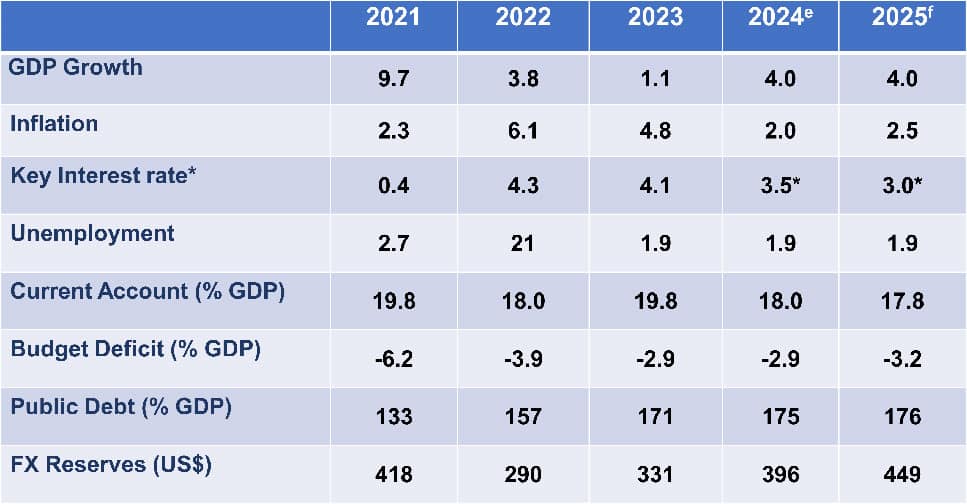
f forecasts
e estimates
* Worldbox Business Information forecast
Source: IMF article IV assessment July 2024
Useful Links
https://www.transparency.org/en/cpi/2021
https://www.imf.org/en/Countries/SGP
https://www.straitstimes.com/global
About Worldbox Business Intelligence
Worldbox Business Intelligence, headquartered in Switzerland, is a Global API data solution provider of business intelligence and used in data analytics.
With the Global API solution Worldbox Business Intelligence enables clients and partners a frictionless real time onboarding, KYC and compliance verification, while rapid global investigations are provided, if needed.
Worldbox Business Intelligence provides global data in a standardised structure on more than 300 Million companies worldwide. It’s global network of subsidiaries, branches and desks allows the precise and efficient collection of data on key target territories for clients and partners.”
“Worldbox Business Intelligence – Bringing Swiss Precision To Data”
Copyright (C) 2025 Worldbox Business Intelligence. All rights reserved.
Our mailing address is:
Worldbox Business Intelligence
Breitackerstrasse 1
Zollikon
Zurich 8702
Switzerland