Worldbox Country Risk Climate March 2025
INDONESIA
Summary
NEW – Technology is an increasingly important driver of economic success, and we are now including a separate Technology sector in our quarterly country risk reports and integrating the core into our overall score.
| Overall Risk Score 31/40 (Stable)
Political risk: Stable 8/10 Economic risk: Stable 8/10 Commercial risk: Stable 8/10 Technology risk: Stable 7/10 The risk assessment of a country is made up of four components, being Political, Economic, Commercial and Technological. Each component is scored out of 10 with 1 being the highest risk and 10 the lowest. |
ESG Risk: 6/10 (Stable)*
*Environmental, social and governance (ESG) issues are becoming increasingly important to companies, investors and consumers in Southeast Asia. That is why we are now preparing a separate ESG score and section with our quarterly country risk reports. We explain how each country rates, looking at the E, S and G individually, and outline recent developments. |
Political Risk – Stable at 8
The Republic of Indonesia was created in 1945 after a long period of Dutch colonial rule and Japanese occupation during the Second World War. Indonesia is today the world’s third largest democracy (and largest Muslim democracy). A directly elected president serves as both head of state and of government. There is a maximum two-term (five years per term) limit on the presidency. A directly elected House of Representatives (the lower house of the bicameral People’s Consultative Assembly) acts as a counterweight to the president.
While now a thriving democracy, Indonesia has experienced long periods of authoritarian rule. The mercurial and charismatic dictator Sukarno ruled the country from 1945 to 1967. General Suharto overthrew Sukarno in 1967, ruling until 1998 when he stepped down amid widespread unrest.
Defence Minister Prabowo and his vice-presidential running mate, Gibran Rakabuming Raka, elected in the February 2024 presidential election, took over the reins of power from President, Joko Widodo (popularly known as Jokowi), in October. Probowo’s cabinet appointments have indicated he wishes to continue the generally successful economic policies followed by his predecessor.
Prabowo reappointed the highly-regarded Sri Mulyani Indrawati as finance minister, a role she has held since 2016 – two years into former president Joko Widodo’s first term – and previously from 2005 to 2010 under Susilo Bambang Yudhoyono. Since her first appointment in 2005, Indrawati has become synonymous with reforms and fiscal prudence in the eyes of investors and analysts alike, according to Nikkei Asia. The news agency adds that at a time when the government is focused on moving Indonesia up the manufacturing value chain and transitioning it to a high-income economy, her presence sends a signal that these ambitions won’t compromise the country’s hard-earned fiscal credibility.
Overall, around a third of Cabinet posts are held by incumbents from the previous administration under Joko Widodo. The inclusion of several key ministers from the previous Cabinet suggests Prabowo is consolidating his hold over Indonesia’s political and government elites.
Economic Risk – Stable at 8
The economy has recovered form the pandemic with growth of 5.0% recorded in 2023. Private consumption is the key driver of growth, with the economy much more dependent on domestic demand than other regional economies. Export volumes have grown in recent years, however, benefiting from buoyant global demand for commodities. International tourism has largely recovered from the decline caused by the pandemic. Investment has remained dynamic, partly due to public infrastructure projects.
However, according to an OECD report published in November 2024, growth in recent years has been insufficient to bring convergence in income towards advanced economies; GDP per capita has remained around one quarter of the OECD average since 2010. Fiscal policy has been prudent over the past two decades and debt remains moderate. Yet, borrowing costs remain high and the tax base is limited.
According to the World Bank, Indonesia now stands at a critical juncture in its economic development, with the private sector poised to assume a more pivotal role in driving growth and innovation. To transcend its middle-income status, Indonesia must accelerate annual growth to more than 6%, according to the World Bank. That would require a productivity increase of 3% – one percentage point higher than recent averages. Attaining the ambitious goal of high-income status by 2045 demands a significantly more dynamic and productive private sector, adds the World Bank.
Despite considerable progress in reforming the economy over the past 10 years, the private sector still faces significant challenges. These include regulatory unpredictability and corruption. Access to finance and regulatory compliance costs are also substantial productivity constraints. In addition, A few large firms dominate the private sector, while most enterprises remain small and less productive. The World Bank concludes that enhancing regulatory consistency and fostering access to international markets are key to unleashing the potential of the Indonesian private sector and driving sustained economic growth.
Commercial Risk – Stable at 8
Corruption remains a challenge and acts as a major deterrent to business and investment. Indonesia was ranked 115th (out of 180 countries) in Transparency International’s Corruption Perception Index (CPI) for 2023, with a CPI score of 34 – sliding down from 38 and a ranking of 96th in 2021. In terms of the Association of Southeast Asian Nations (ASEAN), Indonesia lies behind Singapore, Malaysia, Vietnam and Thailand.
Indonesia’s economic freedom score (from the Heritage Foundation) is 63.5, and it ranks 53rd in the 2024 Freedom Index, moving up from 60th in the 2023 Index. Indonesia is ranked 10th out of 39 countries in the Asia-Pacific region. The country’s economic freedom score is higher than the world and regional averages. Indonesia’s economy is considered “moderately free”, according to the 2024 Index.
Indonesia has undertaken wide-ranging reforms to address structural weaknesses in the economy and improve competitiveness, according to the Heritage Foundation. Recent reforms have put a greater emphasis on improving regulatory efficiency, enhancing regional competitiveness, and creating a more vibrant private sector through decentralization. However, institutional shortcomings continue to undercut momentum for more dynamic economic development. In the absence of a well-functioning legal and regulatory framework, corruption remains a serious impediment to the emergence of a more dynamic private sector.
NEW
Technology risk – Stable at 7
The Global Innovation Index (GII), from the World Intellectual Property Organization, is an important index used by countries and multinational companies to assess innovation ecosystems and aid in policymaking and investment decisions.
Indonesia ranked 54th out of 133 countries in the 2024 GII , moving up from 85th place in 2020.
Indonesia jumped 13 places from 77th to 64th out of 193 countries in the E-Government 2024 Survey released by the United Nations Department for Economic and Social Affairs in September. Indonesia has improved its information and communications technology (ICT) infrastructure and expanded digital literacy programmes to improve access to e-government services, the report said.
Indonesia’s digital economy is among the fastest growing in Southeast Asia, projected to exceed $130 billion by 2025, according to a joint report by Google, Temasek, and Bain & Company. The country’s rapid internet penetration—and a young, tech-savvy population are key drivers of this growth.
Government policies
According to the International Trade Administration of the US, the government has positioned the digital economy as a cornerstone of its broader economic development strategy. Central to this ambition is the “Making Indonesia 4.0” roadmap, which aims to position the country as a leading digital economy by 2030. This plan is underpinned by significant government initiatives, including the “100 Smart Cities” program and the “National Strategy for Artificial Intelligence (2020-2045),” both designed to enhance digital infrastructure, boost innovation, and integrate advanced technologies across various sectors.
The government’s commitment is further evidenced by the Digital Indonesia Roadmap 2021-2024, which outlines specific goals for expanding digital infrastructure, increasing the digital skills of the workforce, and encouraging the adoption of digital technologies in businesses, particularly small and medium-sized enterprises (SMEs). The roadmap also emphasizes e-commerce, fintech, and the acceleration of digital transformation in public services, intending to create a more inclusive digital economy.
Indonesia’s Ministry of Communication and Information Technology (Kominfo) plays a pivotal role in driving these strategies, with a focus on expanding internet access, developing a comprehensive 5G network, and promoting cybersecurity measures. The government also plans to establish a national data centre and strengthen regulatory frameworks to attract more investment in the digital sector.
Infrastructure
Over the past decade, Indonesia has dramatically increased its internet penetration from 34.9% to 79.5%, or around 221 million people, according to the Director of the Telecommunication and Information Accessibility Agency (BAKTI) at the Ministry of Communication and Informatics, speaking in September. Earlier, in February, the government outlined its Indonesia Digital 2045 Vision, which calls for a 30-fold improvement in internet speed.
Education and skilled staff
Basic education is almost universal in Indonesia, but the quality is often poor, with significant variation across provinces, contributing to a shortage of skilled workers, according to the OECD. It calls for the continuation of campaigns to strengthen skills training, including through incentives for employers. It adds that in primary and secondary education, harmonising curricula and increasing funding is essential. However, Indonesia still ranks as the seventh largest producer of STEM graduates globally, with 300,000 arriving on the market each year.
March Bulletin
Political Risk – Stable at 8
Comments by President Prabowo Subianto in December have reignited concerned about the former army general’s commitment to democracy. Speaking at a meeting of regional leaders, Prabowo suggested scrapping direct elections for regional leaders on cost ground. Prior to coming to power in October, Prabowo previously repeatedly said that direct elections — both regional and presidential — are “expensive” and that “western ideas” of democracy do not work in Indonesia.
Prabowo and his Gerindra party have also called for a return to Indonesia’s 1945 constitution, under which the president was elected by parliament rather than by popular vote. The old constitution also did not have any term limits on the presidency. These provisions were changed after the downfall of the dictator General Suharto, who ruled Indonesia from 1967 until his fall in 1998 following nationwide unrest. Indonesians did not elect the president in a direct vote until 2004.
Worldbox Business Intelligence believes any move to amend the constitution would trigger protests, given high turnouts at recent elections that suggest Indonesians cherish their ability to elect – and depose – leaders. The turnout at the February presidential vote amounted to 81%, while it reached over 70% at the November regional elections. Moreover, in August, legislators cancelled plans to ratify revisions to election laws after thousands of people protested in front of the parliament building.
Economic Risk – Stable at 8
Retaining Finance Minister Indrawati could prove a key determinant of whether Prabowo is able to deliver on his promise of raising economic growth to 8% and closing inequality levels in Indonesia. Indrawati can certainly be relied on to take on Prabowo if she feels he is trying to steer the economy in the wrong direction. She left the government in 2010 due to her uncompromising stance on corruption.
Her main concern is likely to surround Prabowo’s intention of raising government expenditure to drive economic growth. Prabowo’s flagship campaign promise of free school lunches, for example, involves an annual bill of up to $29 billion. Pressure on the government finances is already growing as debt servicing costs rise, while government’s guarantees on the debt of overleveraged state-owned builders could also leave taxpayers with a hefty bill to pay.
According to Nikkei Asia, Indrawati is widely respected for her ability to push through politically challenging decisions that have created a positive environment for growth while maintaining fiscal stability. It is unlikely she would allow the deficit to exceed 3% under her watch or oversee a sustained rise in public debt toward 60% of GDP.
The proposed 2025 State Budget, announced in September 2025, includes President-elect Prabowo Subianto’s key election promises, including the free nutritious meal programme allocated under education, and security-related programmes (food security and self-sufficiency, and the country’s military modernisation). It also includes the continuation of outgoing President Joko Widodo’s policies and projects.
The 2025 budget deficit was set at 2.53% of GDP, compared to the 2.29% shortfall for 2024; however, this is still below the 3 percent budget deficit ceiling. The debt level is expected to increase to 50%, below the maximum debt-to-GDP ratio of 60% of GDP limit stipulated under the state financing law.
Indonesia is targeting economic growth of 5.2% in 2025, similar to the level seen in 2024 with inflation targeted at around 2.5%, up from around 2.2% in 2024. Bank Indonesia cut interest rates in September by 25 bps to 6.00%. The cut was the first easing of monetary policy seen in three years and further rate cuts are likely in 2025.
Indonesia’s economic growth is forecast to average 5.1% per year from 2024 to 2026, according to the World Bank’s Indonesia Economic Prospects report, despite headwinds from a subsiding commodity boom, increased volatility in food and energy prices, and rising geopolitical uncertainty.
Commercial Risk – Stable at 8
Indonesia’s micro, small, and medium enterprises (MSME) borrowers remain weak on the back of an unequal recovery of activity following the COVID-19 crisis. MSME borrowers were significantly affected, resulting in weak loan growth, according to a report by UOB Kay Hian.
Technology risk – Stable at 7
In October, Indosat Ooredoo Hutchison (IOH), Indonesia’s second-largest telecommunications provider, launched the country’s first artificial intelligence (AI) experience centre at Solo Technopark, supported by a 5G network infrastructure and technology from Chinese telecommunications equipment manufacturer Huawei.
The facility marks the first phase of IOH’s broader AI investment strategy, with the company announcing plans to invest US$200 million in an expanded AI Centre of Excellence focused on AI-cloud infrastructure development and technical training programmes.
Environmental, Social and Governance (ESG) – Stable at 6
The United Nations’ Sustainable Development Goals (SDGs) are recognized as a beneficial framework for responsible investment. The Sustainable Development Report from Cambridge University Press assesses the progress of all UN Member States on the SDGs. It provides a useful means of ranking Southeast Asian countries on their ESG progress.
Indonesia is ranked 78 out of 166 in the 2024 report, with a score of 69.4.
Environment: Issues facing Indonesia include deforestation, water pollution from industrial waste and sewage, and air pollution in urban areas. The expansion of agriculture, particularly clearing land for palm oil production, is the major cause of deforestation. However, the logging industry is also a significant contributor to deforestation, with illegal logging occurring in many protected areas. Mining activities, such as coal and gold mining, have also led to the destruction of large areas of forests and the pollution of waterways.
The problem of air pollution is worsening, with Jakarta routinely ranked at the top of the list of the world’s most polluted major cities. Forest fires, pollution from coal-fired plants, emissions from cars, open burning, and biomass burning for cooking and heating are among the main causes. Environmentalists have expressed concern that the Prabowo administration will worsen the environmental situation, given Prabowo’s signalling of strong support for boosting mining industries and sectors that exploit natural resources.
Social: The law provides, with some restrictions, provides for the rights of workers to join independent unions, conduct legal strikes, and bargain collectively. The law prohibits antiunion discrimination. Most workers are not covered by the minimum wage laws. However, the authorities only enforce labour regulations, including minimum wage regulations, in the formal sector, which employs around 4 in 10 workers. Those in the informal sector have few protections.
Governance: Indonesia continues to bring its legal, regulatory, and accounting systems into compliance with international norms and agreements. However, the regulations and enforcement are not yet up to international standards for shareholder protection. Indonesian businesses are required to undertake responsible business conduct (RBC) activities under Law No. 40/2007 concerning Limited Liability Companies.
March Bulletin
Environmental, Social and Governance (ESG) – Stable at 6
The Indonesian mining sector has seen improving scores in their adoption of environmental, social, and governance (ESG) principles, but there is still a long way ahead to sustainability, according to a report from the Bumi Global Karbon (BGK) Foundation published in December.
Latest economic data
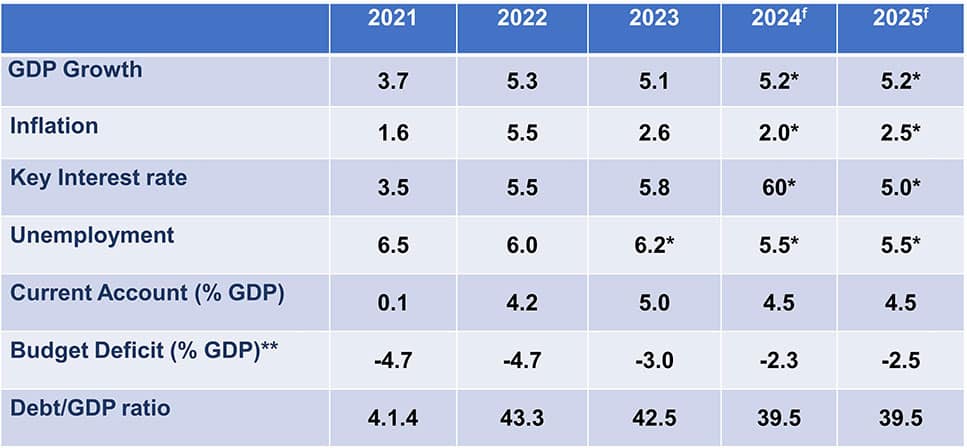
f forecasts
* Worldbox Business Intelligence
** Official Figures
Source: Asian Development Bank, except where stated
Useful Links
https://www.adb.org/countries/indonesia/main
https://www.transparency.org/en/cpi/2021
https://www.imf.org/en/Countries/IDN
https://www.thejakartapost.com/
https://www.abc.net.au/news/topic/indonesia
About Worldbox Business Intelligence
Worldbox Business Intelligence, headquartered in Switzerland, is a Global API data solution provider of business intelligence and used in data analytics.
With the Global API solution Worldbox Business Intelligence enables clients and partners a frictionless real time onboarding, KYC and compliance verification, while rapid global investigations are provided, if needed.
Worldbox Business Intelligence provides global data in a standardised structure on more than 300 Million companies worldwide. It’s global network of subsidiaries, branches and desks allows the precise and efficient collection of data on key target territories for clients and partners.”
“Worldbox Business Intelligence – Bringing Swiss Precision To Data”
Copyright (C) 2025 Worldbox Business Intelligence. All rights reserved.
Our mailing address is:
Worldbox Business Intelligence
Breitackerstrasse 1
Zollikon
Zurich 8702
Switzerland