Worldbox Country Risk Climate March 2025
CAMBODIA
NEW – Technology is an increasingly important driver of economic success, and we are now including a separate Technology sector in our quarterly country risk reports and integrating the core into our overall score.
Summary
| Overall Risk Score 23/40 (Stable)
Political risk: Stable 6/10 Economic risk: Stable 7/10 Commercial risk: Stable 6/10 Technology risk: Stable 4/10 The risk assessment of a country is made up of four components, being Political, Economic, Commercial and Technological. Each component is scored out of 10 with 1 being the highest risk and 10 the lowest. |
ESG Risk: 4/10 (Stable)*
*Environmental, social and governance (ESG) issues are becoming increasingly important to companies, investors and consumers in Southeast Asia. That is why we are now preparing a separate ESG score and section with our quarterly country risk reports. We explain how each country rates, looking at the E, S and G individually, and outline recent developments. |
Political Risk – Stable at 6
Nominally a parliamentary democracy with a bicameral parliament and a king as head of state, Cambodia is in fact a one-party state. Hun Sen, who became prime minister in 1985 and his Cambodian People’s Party (CPP) dominates the political scene. Hun Sen stepped down as prime minister in 2023 with his eldest son Hun Manet being sworn in as the new prime minister.
The transfer followed a landslide victory for Hun Sen’s ruling Cambodian People’s Party at the July election. It won 120 of 125 seats. The US, EU and other Western nations refused to send observers to the poll, saying it was neither free nor fair. In May, the main opposition party and the sole credible challenger to Hun Sen was barred from contesting the vote. The decision by the electoral authorities to ban the Candlelight Party for allegedly filing the wrong paperwork echoes developments in the run up to the 2018 election.
Worldbox Business Intelligence does not expect any significant shifts in policy making following the succession of Hun Manet. Even though he has relinquished the prime minister’s job, Hun Sen, 71, is expected to retain a large amount of control as his party’s president and president of the Senate. However, Cambodia’s political stability could well be challenged. Manet is untested and his promotion would certainly not be welcomed in some parts of the CPP or the country at large. His support is reportedly limited to younger urbanites.
Relations between Cambodia and the US may deteriorate following the US government’s decision, in September 2024, to sanction senator and business tycoon Ly Yong Phat of the CPP and his conglomerate LYP Group Co., O-Smach Resort, and three hotels owned or controlled by Ly “for their role in serious human rights abuses related to the treatment of workers subjected to forced labor in online investment scam operations”.
The US has become alarmed at Cambodia-based criminal industries increasingly impacting American citizens. The US embassy in Cambodia estimates that US citizens have lost over US$100 million to Cambodia-based cyberscams.
Cambodia’s foreign ministry responded by saying that the sanctions against Ly Yong Phat were “misleading” and “politically motivated”, adding that the casino tycoon has played a “widely recognized” role in advancing the country’s development.
US–Cambodian relations have become strained during the past decade, partly over American concerns about the suppression of Cambodia’s political opposition. During the same period, Phnom Penh and Beijing have drawn closer, and the US move against Ly Yong Phat could drive Phnom Penh to further strengthen its ties with Beijing.
Economic Risk – Stable at 7
Cambodia experienced some of the highest economic growth in the world in the two decades prior to the pandemic. Driven by garment exports and tourism, annual growth averaged 7.7% between 1998 and 2019. The rapid growth resulted in significant gains in poverty reduction with the poverty rate in Cambodia declining to 18% in 2020 from just under 50% percent in 2007. From 2000 to 2020, life expectancy increased from 58 years to over 70.
If Cambodia is to achieve its goal of becoming an upper-middle-income economy by 2030 and a high-income economy by 2050, it needs to maintain this high growth rate. In a blog published in December 2023, the World Bank called on the government to use the current economic slowdown to implement reforms. It said these are the need to overcome various challenges. They include declining productivity. It said further improvements to the business environment are critical for boosting the productivity and competitiveness of Cambodian firms.
The blog argued that the cost of doing business remains relatively high in Cambodia, reducing international competitiveness and inhibiting innovation and shifts into higher value activities. It called on the government to strengthen the predictability of the regulatory environment and expand small and medium-sized enterprises’ access to finance.
The World Bank added that further efforts to streamline complex and restrictive business entry requirements, together with improvements to the functioning of the insolvency framework, would help reduce costs of entry and exit. The blog also called on the government to upgrade infrastructure and to boost productivity and international competitiveness. It added that the government also needs to address shortfalls in education that are resulting in growing skills shortages and declining labour productivity growth.
In a September 2024 Article IV consultation, the IMF also called on the government to implement structural reforms “to enhance human capital, make the business environment more competitive, and strengthen institutions and governance”. This, it said, “would promote inclusive and sustainable economic development”.
Commercial Risk – Stable at 6
Cambodia ranked joint 158th out of 180 countries in Transparency International’s (TI) 2023 Corruption Perceptions Index, although it moved down eight places over the course of the year. Between 2019 and 2022, the country’s score had steadily risen. Cambodia is the second-lowest-rated country in the Association of Southeast Asian Nations (ASEAN), ahead of only Myanmar, and one of the lowest-rated countries in Asia.
Pech Pisey, executive director at Transparency International Cambodia, said that systematic corruption remains a widespread problem and is complicit in the erosion of democracy. He noted that Cambodia had tightened restrictions on fundamental rights, including freedom of expression, and pointed to corruption in the judicial system.
The Heritage Foundation ranks Cambodia as “mostly unfree”, according to its 2024 Freedom Index. The country’s score of 55.6 makes its economy the 106th freest out of 184 countries in the world. Its rating has decreased by 0.9 points from last year. Cambodia is ranked 21st out of 39 countries in the Asia-Pacific region, and its economic freedom score is lower than the world and regional averages.
NEW
Technology Risk – Stable at 4
The Global Innovation Index (GII), from the World Intellectual Property Organization, is an important index used by countries and multinational companies to assess innovation ecosystems and aid in policymaking and investment decisions.
Cambodia ranked 103rd out of 133 countries in the 2024 GII, up from 110th place in 2020. Mobile internet coverage extends to over 90% of the population, with a strong presence in urban areas.
Cambodia ranked 86th in the world for mobile speeds and 107th for fixed broadband speeds in November 2024, according to Ookla Speedtest Intelligence.
The country has made significant progress in the areas of telecommunications, information technology, e-commerce, digital government, tech startups and new technology in recent years. Businesses in Cambodia are increasingly adopting new technologies, such as cloud computing, artificial intelligence (AI) and blockchain. The adoption of technology is facilitated by Cambodia’s young and tech-savvy population: 60% of the population is under 30 years old.
Government policies
The government has recognized the importance of internet speed in its development agenda, as outlined in the Cambodia Digital Economy and Society Policy Framework 2021–2035. It is seeking to address the monopolistic nature of the telecoms sector by amending laws and regulations related to the management of digital infrastructure to enhance competitiveness and promote infrastructure sharing among telecommunications operators.
Infrastructure
Cambodia’s government has made significant investments in the country’s telecommunications infrastructure, helping to improve internet access and speed. The Hong Kong–Phnom Penh submarine fibre-optic cable network – a US$165 million project that is expected to be completed in 2025 and will provide Cambodia with high-speed internet access – provides a prime example.
However, foreign direct investment remains skewed towards traditional industries such as garment manufacturing.
Education and skilled staff
The government is keen to encourage growth in the number of STEM graduates, a policy skew reflected in the emergence of newer institutions such as CamTech University, the Cambodia Academy of Digital Technology (CADT), and Paragon International University, alongside the long-established Institute of Technology of Cambodia. Officials are aiming for 50% of university graduates to major in STEM subjects by 2030. Currently, the number of students majoring in STEM remains very low compared with other countries in the region.
March Bulletin
Political Risk – Stable at 6
In September, Cambodia withdrew from a two-decade-old regional economic development agreement with Vietnam and Laos – a move that suggests ties with Vietnam could deteriorate.
The Cambodia–Laos–Vietnam Development Triangle Area (CLV-DTA) agreement, which was signed in 1999 and entered into force in 2004, was designed to develop 13 once-remote border provinces: five in Vietnam, four in Cambodia, and four in Laos.
According to The Diplomat, concerns about the agreement began circulating on Cambodian social media back in July, with critics claiming that the agreement had led Cambodia to cede territory and control of natural resources in its four northeastern provinces. On 11 August, several thousand Cambodians took part in protests against the CLV-DTA agreement in South Korea, Japan, Canada and Australia.
The issue is sensitive in Cambodia because many Cambodians view Vietnam as a “traditional enemy” that has long plotted to take over the country. The large Vietnamese population within Cambodia is viewed with suspicion and has in the past been treated brutally.
Vietnam launched its invasion of Cambodia in 1978, after the Khmer Rouge attacked Vietnam, and following years of a genocide carried out by the Khmer Rouge against ethnic Vietnamese within Cambodia. The Vietnamese army captured Cambodia within two weeks and ejected the Khmer Rouge from power.
According to The Diplomat, the termination of the agreement does not mean relations between Vietnam and Cambodia are about to collapse into open acrimony. It adds that “there are still enough mutual interests to keep things on an even keel. But it is increasingly evident that the kinship between Hanoi and Phnom Penh can no longer be taken for granted.”
Economic Risk – Stable at 7
The Asian Development Bank (ADB) states that the growth for Cambodia is 5.8% for 2024 and 6.0% for 2025. It has revised down its earlier inflation projection for 2024 from 2.0% to 0.5%, reflecting the slow increase in food prices and the decline in fuel prices in the first half of 2024. However, it anticipates that inflation will accelerate to 2.5% in 2025.
According to the ADB, “the rebound in the manufacturing sector—especially garments, footwear, and travel goods—is powering the country’s economic growth. Agriculture and tourism are steadily gaining ground, while continued inflows of foreign direct investment are fuelling the country’s economic momentum. Together, these forces are setting the stage for Cambodia to achieve a robust growth in 2025 and beyond.”
The report added that reduced prices for fuel-related goods and services, along with decreased fertilizer costs, have supported agricultural production. This, says the ADB, will provide much-needed relief for people – especially the most vulnerable – who have faced challenges in recent years due to rising food and fuel prices.
Potential risks to Cambodia’s economic outlook identified by the ADB include: weaker growth in major economies like the People’s Republic of China, Europe and the US; high private debt; volatile global fuel prices; and severe impact from extreme weather events.
Commercial Risk – Stable at 6
The Ministry of Land Management, Urban Planning and Construction, and Credit Bureau (Cambodia) Co., Ltd (CBC), a leading financial data infrastructure in Cambodia, have launched Property Verification Service for 198 members of CBC, comprising banks, microfinance institutions, leasing companies and rural credit institutions.
The Property Verification Service provides details of a property’s owner, the address (with geocoordinates) and any active or closed pledges on the property by third parties. The information in the report is customized to suit the needs of banks and financial institutions in Cambodia.
The service will allow banks and financial institutions to complete property verification in a quick, convenient and reliable manner, enabling them to efficiently assess any risks associated with the property. It is claimed that this will also make the loan application process easier for borrowers.
Technology Risk – Stable at 4
The use of AI in Cambodia is “very limited”, and it could take up to five years for Cambodia to catch up with current levels of AI utilization in developed countries such as the US and South Korea, according to a local tech entrepreneur interviewed by the Khmer Times in November. Sok Sopheakmonkol, co-founder of Codingate, a Cambodia-based business solutions company, said that language barriers present a significant hurdle to the development of AI, explaining that Khmer is largely unavailable on AI platforms, and only English speakers can use AI in Cambodia. Inadequate investment in customized AI technology and automation is another challenge, with many large tech companies unwilling to invest in Cambodia due to the limited size of the local market.
Environmental, Social and Governance (ESG) – Stable at 4
The United Nations’ Sustainable Development Goals (SDGs) are recognized as a beneficial framework for responsible investment. The Sustainable Development Report from Cambridge University Press assesses the progress of UN Member States on the SDGs. It provides a useful means of ranking Southeast Asian countries on their ESG progress.
Cambodia is ranked 104 out of 166 in the 2024 report, with a score of 64.9.
Environment: Cambodia has one of the highest rates of deforestation in the world, with forest cover down to around 46% of the country’s land area, from 72% in 1973. Air pollution and water scarcity are two other major environmental concerns. Air pollution causes a number of significant health problems, including asthma, chronic bronchitis, decreased lung function, and premature death. Meanwhile, around 20% of the population lacks essential access to clean water.
Social: Workers’ rights are enshrined in law but in practice few of these laws are obeyed or enforced. To meet quotas, workers are often either forced to work overtime, “enticed to do so with a small bonus that is usually never paid”, according to the Borgen Report. In addition, many companies employ children under 15 even though the law states that employees should be aged 15 plus.
Governance: ESG principles have only recently appeared on the corporate agenda in Cambodia. According to the GRI Sustainability Disclosure Database, however, the total number of sustainability reports in Cambodia has more than doubled since 2015, with the majority of these reports coming from the financial services sector.
March Bulletin
Environmental, Social and Governance (ESG) – Stable at 4
In October, Cambodia updated its Nationally Determined Contribution, committing to a 42% reduction in greenhouse-gas emissions across key sectors by 2030. Cambodia’s Long-Term Strategy for Carbon Neutrality, submitted to the United Nations in 2021, outlines its vision for achieving carbon neutrality by 2050. Cambodia was the first ASEAN nation to submit such a roadmap, as it aims to create a resilient, low-carbon society.
Latest economic data
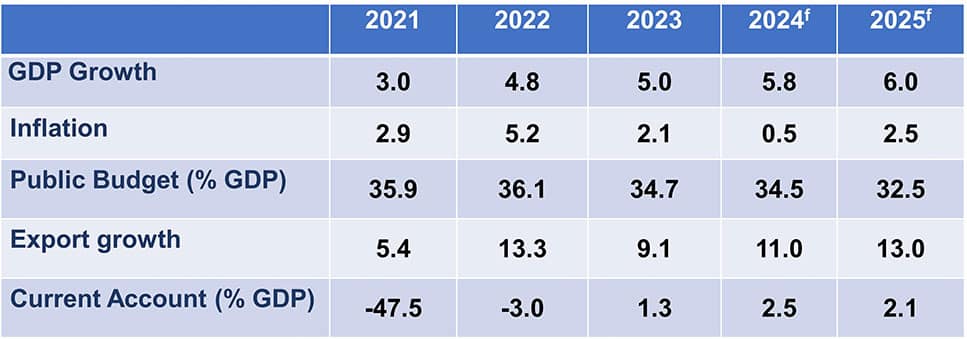
f – forecasts
Source: AMRO/IMF/World Bank/Asian Development Bank
Useful Links
https://www.transparency.org/en/cpi/2021
https://www.imf.org/en/Countries/KHM
https://www.adb.org/countries/cambodia/main
https://dashboards.sdgindex.org/profiles/cambodia
About Worldbox Business Intelligence
Worldbox Business Intelligence, headquartered in Switzerland, is a Global API data solution provider of business intelligence and used in data analytics.
With the Global API solution Worldbox Business Intelligence enables clients and partners a frictionless real time onboarding, KYC and compliance verification, while rapid global investigations are provided, if needed.
Worldbox Business Intelligence provides global data in a standardised structure on more than 300 Million companies worldwide. It’s global network of subsidiaries, branches and desks allows the precise and efficient collection of data on key target territories for clients and partners.”
“Worldbox Business Intelligence – Bringing Swiss Precision To Data”
Copyright (C) 2025 Worldbox Business Intelligence. All rights reserved.
Our mailing address is:
Worldbox Business Intelligence
Breitackerstrasse 1
Zollikon
Zurich 8702
Switzerland