![[Aggregator] Downloaded image for imported item #97683](https://asiagategroup.com/wp-content/uploads/worldbox-cambodia-slider-8-13-26.jpg "[Aggregator] Downloaded image for imported item #97683")
Worldbox Country Risk Climate August 2026
CAMBODIA
Summary
Overall Risk Score
17/40 – Elevated (Unchanged)
| Political risk: 4/10 – Elevated (Unchanged)
Economic risk: 3/10 – Elevated (Unchanged) Commercial risk: 4/10 – Elevated (Unchanged) Technology risk: 6/10 – Stable (Unchanged) The risk assessment of a country is made up of four components, being Political, Economic, Commercial and Technological. Each component is scored out of 10 with 1 being the highest risk and 10 the lowest. |
ESG Risk: 6/10 – Stable (Unchanged)*
*Environmental, social and governance (ESG) issues are becoming increasingly important to companies, investors and consumers in Southeast Asia. That is why we are now preparing a separate ESG score and section with our quarterly country risk reports. We explain how each country rates, looking at the E, S and G individually, and outline recent developments. |
Political Risk August Update
Elevated at 4
The government continues to crackdown on scam centres based in the country. Hun Sen has been quoted as saying that Cambodia “will do whatever it takes to let the world know that it has successfully destroyed online scams.” The Singaporean news agency CNA has quoted researchers as saying that Cambodia’s scam industry may generate between US$12.5 billion and US$19 billion a year, though the figures are difficult to verify because much of the money moves through cryptocurrency, underground banking and offshore structures. The main centres of the industry are Sihanoukville in Cambodia’s south, and Poipet on the western border with Thailand, along the country’s eastern flank, and along the border with Vietnam. Cambodia has new anti-scam legislation, enacted since April, and has been targeting compounds for months. Some 300 different facilities have been targeted by police action since July, Chhay Sinarith, senior minister and chair of Cambodia’s Commission for Combating Online Scams, told CNA in an interview.
Political Risk – Context
Nominally a parliamentary democracy with a bicameral parliament and a king as head of state, Cambodia is a one-party state. Hun Sen, who became prime minister in 1985 and his Cambodian People’s Party (CPP) dominates the political scene. Hun Sen stepped down as prime minister in 2023 with his eldest son Hun Manet being sworn in as the new prime minister.
The transfer followed a landslide victory for Hun Sen’s ruling Cambodian People’s Party at the July 2023 election. It won 120 of 125 seats. The US, EU and other Western nations refused to send observers to the poll, saying it was neither free nor fair. In May, the main opposition party and the sole credible challenger to Hun Sen was barred from contesting the vote. The decision by the electoral authorities to ban the Candlelight Party for allegedly filing the wrong paperwork echoes developments in the run up to the 2018 election.
Worldbox Business Intelligence does not expect any significant shifts in policy making following the succession of Hun Manet. Even though he has relinquished the prime minister’s job, Hun Sen, 73, is expected to retain a large amount of control as his party’s president and president of the Senate.
The border conflict between Thailand and Cambodia that erupted in July has come to halt. The conflict stems from a territorial dispute over the colonial-era demarcation of their 800km (500-mile) border. Each side has blamed the other for instigating the renewed fighting, claiming self-defence, while trading accusations of attacks on civilians. However, it is possible fighting could flare up again. Cambodian Prime Minister Hun Manet, for example, claimed in February 2026 that Thailand continues to occupy parts of Cambodia after multiple ceasefire agreements ended months of fighting. Hun Manet called upon Thailand to begin border demarcation through the countries’ Joint Boundary Commission process. However, Worldbox Business Intelligence believes that the conflict was largely driven by Thai internal politics. The military and royalist establishment leveraged the dispute to pull off a surprise electoral victory in the February Thai election, riding on a wave of patriotic fervour. Having dealt Thai reformers a significant setback it is unlikely that Thailand will want to restart the conflict in the foreseeable future.
Cambodia’s former opposition leader Kem Sokha, who was serving a 27-year sentence for treason, was pardoned in June. Sokha’s CNRP party came close to securing a shock victory in the 2013 general election over Hun Sen’s CPP despite accusations of vote-rigging and intimidation. The move comes after years of criticism of Sokha’s treatment by the United Nations, Western governments, and human rights groups. However, the Diplomat publication believes the pardon does not represent a sign of liberalization, and Sokha will remain under close observation by the authorities to ensure that he does not engage in any “political” activities.
Economic Risk August Update
Elevated at 3
Cambodia’s economy grew by 4.8% in 2025, slowing from 6% in 2024 as domestic and external shocks weigh on activity, according to the IMF. These included a leadership transition, tariff shocks, online scams and a border conflict with Thailand that had serious political, economic and security repercussions.
The border conflict with Thailand has caused significant economic losses. Tourism, for example, accounts for nearly 10% of GDP and has already been hard hit with visitors from Thailand, a key market down by nearly a third even prior to the December outbreak of fighting. Many international tourists to Cambodia enter and exit the country via Thailand and Cambodia has now placed restrictions on border crossings by land and air.
Millions of thousands of Cambodians work abroad, mainly in Thailand, and their remittances are a key economic lifeline for many families. In September, even prior to the current outbreak of fighting, nearly one million Cambodian migrant workers reportedly crossed back into Cambodia, placing heavy pressure on the job market and the loss of an average $1.5 billion in remittances per year. However, by March 2026, nearly a million Cambodian workers had returned to Thailand.
In May 2026, Cambodia revised down its 2026 economic growth forecast to 4.2%, down from an initial 5%. Prime Minister Hun Manet attributed the revision to soaring oil and gas prices, driven by instability in the Middle East and ongoing border friction with Thailand. The outlook forecasts a recovery to 5% in 2027, with a medium-term average of 5.5% through 2029. Cambodia’s economy remains heavily dependent on exports of garments, footwear, and travel goods, as well as on tourism, agriculture, and construction. Officials warned that sustained global volatility could further affect these key pillars.
Lingering tensions between Cambodia and Thailand continue to have an impact. In May, Thailand scrapped a 25-year old agreement with Cambodia aimed at jointly exploring offshore energy resources in disputed waters. The decision, announced by Thai Prime Minister Anutin Charnvirakul, marks a significant shift in bilateral relations and raises fresh uncertainty over the future of energy cooperation in the region.
Economic Risk – Context
Cambodia experienced some of the highest economic growth in the world in the two decades prior to the pandemic. Driven by garment exports and tourism, annual growth averaged 7.7% between 1998 and 2019. The rapid growth resulted in significant gains in poverty reduction with the poverty rate in Cambodia declining to 18% in 2020 from just under 50% percent in 2007. From 2000 to 2020, life expectancy increased from 58 years to over 70.
Since 2018, total exports to the world have doubled to USD 26 billion, and newly approved investment projects surged 88%, reflecting robust investor confidence and the global relocation trend.
A UN report released in April 2026 warned that the 2025 border conflict between Thailand and Cambodia has triggered a “double shock” of mass displacement and economic collapse, which threatens to undo years of developmental gains in Cambodia. The report said that the conflict forced over 644,000 people to flee their homes while simultaneously driving nearly 900,000 Cambodian migrant workers back across the border. Internally displaced families saw average earnings decline by 34% while remittances were projected to drop by $942 million combined through 2026. Agricultural production has been hit by falling farm-gate prices and a 42% crop loss for displaced farmers. The report said that total exports to Thailand contracted by 13.5%, while tourism receipts in 2025 were slashed by US$855 million as international arrivals fell sharply.
The UN is calling for a “transformative recovery” plan that moves away from traditional aid. The report’s primary recommendation is to immediately stabilize household consumption through time-bound income support and cash-for-work programmes. These initiatives would hire displaced workers to rehabilitate the very infrastructure — irrigation canals, roads and schools — damaged during the hostilities.
In May, the Khmer Times reported Casey Barnett, the former President of the American Chamber of Commerce in Cambodia, as forecasting that in the next 75 years, Cambodia’s economy and population could exceed Thailand’s if Cambodia implements the right policies. From 2015 to 2025, Cambodia’s gross domestic product (GDP) grew by an average of 5.5% per year, while Thailand’s GDP grew by just 2% per year. The gap between the two countries’ population is also narrowing. Last year, Thailand had a birth rate of 1.2 births per woman, while Cambodia had 2.5 per woman.
Commercial Risk August Update
Elevated at 4
In its December 2025 Article IV review the IMF warned that financial sector vulnerabilities have intensified as depository financial institutions continue to face deteriorating asset quality and declining profitability. The nonperforming loan (NPL) ratio exceeded 8% at mid-2025, driven by lacklustre activities in hospitality sectors and market corrections in construction and real estate amid continued property price declines and a sizable supply overhang. It added that capital adequacy and liquidity buffers remained broadly adequate, while banks continue to hold substantial real estate collateral even after foreclosures, with constraints in the court-led resolution framework. Recent sanctions from US and UK governments reportedly reflect AML concerns.
According to the local publication KiriPost, a series of bank closures and anti-scam enforcements have challenged public confidence in Cambodia’s banking sector, highlighting the need to strengthen consumer protection, supervision, deposit safeguards, and dispute resolution. Earlier this year, Cambodia intensified online scam crackdowns, leading to thousands of foreigners being deported, and some banks, allegedly connected to illegal activities, have been shut down. Prince Bank Plc, whose owner Chen Zhi was arrested and deported to China, ceased operations in January, while Panda Commercial Bank Plc subsequently had its license revoked. In March, H-Pay’s license was also revoked by the central bank after an investigation found that the company violated regulatory requirements.
Commercial Risk – Context
The US State Department’s 2025 Investment Climate Statement on Cambodia says that the country offers several foreign direct investment (FDI) incentives to investors including 100% foreign ownership of companies, corporate tax holidays, reduced corporate tax rates, duty-free import of capital goods, and no restrictions on capital repatriation.
However, it points out that US investors report various challenges. These include a small market size, systemic corruption, limited supply of skilled labour, inadequate infrastructure (including high energy costs), lack of transparency in some government approval processes, and preferential treatment given to local or other foreign companies that engage in acts of corruption, tax evasion, or otherwise take advantage of Cambodia’s weak regulatory environment.
Cambodia ranked joint 163rd out of 182 countries in Transparency International’s (TI) 2025 Corruption Perceptions Index, unchanged from the previous year. Cambodia is the second-lowest-rated country in the Association of Southeast Asian Nations (ASEAN), ahead of only Myanmar, and one of the lowest-rated countries in Asia. Officials said the report did not reflect the current reality in Cambodia.
The Heritage Foundation ranks Cambodia as “mostly unfree”, according to its 2026 Freedom Index. The country’s score of 58.2 makes its economy the 98th freest out of 184 countries in the world. Cambodia is ranked 21st out of 39 countries in the Asia-Pacific region. The country’s economic freedom score is lower than the global average and higher than the regional average. Cambodia’s economy is considered “mostly unfree” according to the 2026 Index.
Technology Risk August Update
Stable at 6
In late April, the Ministry of Interior and China’s Nanning Vocational and Technical University agreed a strategic partnership to accelerate the adoption of digital technologies and specialised technical training. The immediate focus will be on Artificial Intelligence and Unmanned Aerial Vehicle technology.
Technology Risk – Context
The Global Innovation Index (GII), from the World Intellectual Property Organization, is an important index used by countries and multinational companies to assess innovation ecosystems and aid in policymaking and investment decisions.Cambodia ranked 100th out of 133 countries in the 2025 GII, up from 110th place in 2020. Cambodia ranked 15th among the 37 Lower middle-income group economies. The country ranked 15th among the 17 economies in Southeast Asia, East Asia, and Oceania. Mobile internet coverage extends to over 90% of the population, with a strong presence in urban areas. Cambodia ranked 49th in the world for mobile speeds and 108th for fixed broadband speeds during February 2026, according to Ookla Speedtest Intelligence, a significant improvement in the previous year’s data. The country has made significant progress in the areas of telecommunications, information technology, e-commerce, digital government, tech startups and new technology in recent years. Businesses in Cambodia are increasingly adopting new technologies, such as cloud computing, artificial intelligence (AI) and blockchain. The adoption of technology is facilitated by Cambodia’s young and tech-savvy population: 60% of the population is under 30 years old. Cambodia launched 5G services on January 1, 2026, with major operators, via Cellcard, Metfone, and Smart. As of early 2026, 5G is primarily available in Phnom Penh and key provinces, with over 1,500 active antenna stations and rapid expansion efforts targeting urban and provincial areas. Meanwhile, operators keep expanding 4G coverage to provide more extensive and reliable connectivity across the country.
Government policies
The government has recognized the importance of internet speed in its development agenda, as outlined in the Cambodia Digital Economy and Society Policy Framework 2021–2035. It is seeking to address the monopolistic nature of the telecoms sector by amending laws and regulations related to the management of digital infrastructure to enhance competitiveness and promote infrastructure sharing among telecommunications operators.Cambodia’s AI Readiness Assessment Report says AI could add about US$3.35 billion to US$6.7 billion to the country’s GDP by 2030, equal to roughly a 5% to 10% lift, while broader regional estimates put the ASEAN upside close to US$1 trillion by the end of the decade. Oxford Insights Government AI Readiness Index 2025 ranked Cambodia 118th out of 195 countries, a 27-place improvement from the previous year.
Infrastructure
Cambodia’s government has made significant investments in the country’s telecommunications infrastructure, helping to improve internet access and speed. The Hong Kong–Phnom Penh submarine fibre-optic cable network – a US$165 million project that is expected to be completed late in 2026 and will provide Cambodia with high-speed internet access – provides a prime example. However, foreign direct investment remains skewed towards traditional industries such as garment manufacturing. Another key infrastructure project, the Techo international airport, officially opened in October 2025. Located to the south of Phnom Penh, the airport represents Cambodia’s aspiration to reposition itself within Southeast Asia’s evolving air transport network, according to the East Asia Forum. It added that the airport should stimulate growth, reinforce regional integration and support Cambodia’s economic diversification.
Education and skilled staff
Cambodia’s growth is constrained by weak foundational learning and misaligned higher education, according to the World Bank. It says that only 11% of Grade 5 students can read properly, with rural and disadvantaged children falling further behind – gaps widened by COVID-19. The organisation adds that at the higher education level, low STEM enrolment, which accounts for just 20% of students, limited research output, and disconnected industry partnerships leave graduates unprepared for labour market demands.
However, improvements are underway. The World Bank says that school-based management and teacher training improved learning for over 600,000 Grade 1–9 students (22% of public-school enrolment) as more schools adopted national quality standards. Officials are aiming for 50% of university graduates to major in STEM subjects by 2030, with 40% of those graduates being women, by 2030.
Environmental, Social and Governance (ESG) August Update
Stable at 6
In May 2026, the National Bank of Cambodia (NBC) launched its sustainable finance taxonomy for the banking and other related financial sectors. The framework defines which investments and loans can be classified as environmentally sustainable, marking a significant step in the country’s efforts to build a credible green finance market and attract climate-focused capital. The framework is designed primarily for banks, but NBC said its use is encouraged across the wider financial sector, including investors, companies and policymakers. The framework focuses on sectors seen as having strong potential to lower emissions and attract private capital: energy, transport, and buildings & construction. These sectors were selected based on their greenhouse gas reduction potential, economic importance, and investment needs.
Environmental, Social and Governance (ESG) – Context
The United Nations’ Sustainable Development Goals (SDGs) are recognized as a beneficial framework for responsible investment. The Sustainable Development Report from Cambridge University Press assesses the progress of UN Member States on the SDGs. It provides a useful means of ranking Southeast Asian countries on their ESG progress.
Cambodia is ranked 101 out of 167 in the 2025 report, with a score of 66.4.
Environment – Cambodia ranks as one of the 12 most vulnerable countries to climate change across the globe. The country’s National Council for Sustainable Development cites several areas of concern. These include agriculture, where the impact of climate change is particularly significant because a large portion of the population is involved in smallholding and subsistence farming livelihoods, and agriculture constitutes the backbone of the economy. Agricultural practices in Cambodia are mostly rainfed systems which increase their vulnerability to a changing climate. It has witnessed severe floods and droughts that have caused a significant loss in agricultural productivity in recent years. The Council adds that outbreaks of diseases such as malaria and dengue fever linked to climate change, will pose significant challenges to Cambodia. Similarly, sanitation and pollution of freshwater, such as during flood events are likely to increase incidences of cholera and other water-borne diseases.
Social – According to the US State Department’s latest Investment Climate Statement, the country’s amended Trade Union Law of 2020 has not fully addressed concerns about curbs on freedom of association. In addition, Cambodia has only implemented and enforced a minimum wage in the export-oriented garment, footwear, and travel goods sector, which was raised to $208 per month in January 2026. Payoneer, a global payments business, says that navigating labour laws in Cambodia can be complex, especially for growing businesses. For instance, says Payoneer, determining the percentage of employer and employee contributions across different social security schemes can often be complex and confusing for employers, especially when navigating multiple requirements and varying contribution rates under local regulations.
Governance – ESG principles have only recently appeared on the corporate agenda in Cambodia. According to the GRI Sustainability Disclosure Database, however, the total number of sustainability reports in Cambodia has more than doubled since 2015, with the majority of these reports coming from the financial services sector.
Latest economic data
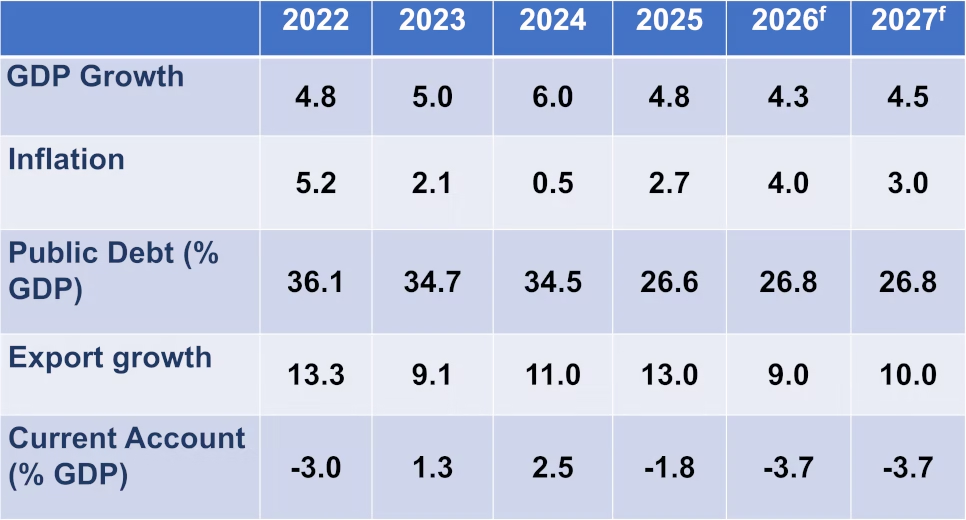
f – forecasts
Source: AMRO/IMF/World Bank/Asian Development Bank

Source: Worldbox
Useful Links
https://www.mekongstrategic.com/news-and-insights
https://www.transparency.org/en/cpi/2021
https://www.imf.org/en/Countries/KHM
https://www.adb.org/countries/cambodia/main
About Worldbox Business Intelligence
Worldbox provides trusted business information on more than 500 million companies across developed and emerging markets.
Access company profiles, credit risk reports, ownership and management details, legal status, financial information and other data to support onboarding, KYB, compliance and risk assessment.
Worldbox data is available through online search, API, Snowflake’s data platform, AWS Marketplace, and AI-ready access through AWS MCP Servers.
Need reliable information on a company or market? Contact Worldbox to discuss your requirements.

 |
 |
 |
 |
Copyright (C) 2026 Worldbox Business Intelligence. All rights reserved.
Our mailing address is:
Worldbox Business Intelligence
Breitackerstrasse 1
Zollikon
Zurich 8702
Switzerland