![[Aggregator] Downloaded image for imported item #95403](https://asiagategroup.com/wp-content/uploads/worldbox-brunei-slider-8-10-26.jpg "[Aggregator] Downloaded image for imported item #95403")
Worldbox Business Intelligence Risk Rating – August 2026
BRUNEI
Summary
Overall Risk Score
29/40 – Stable (Unchanged)
| Political risk: 8/10 – Stable (Unchanged)
Economic risk: 7/10 – Stable (Unchanged) Commercial risk: 7/10 – Stable (Unchanged) Technology risk: 7/10 – Stable (Unchanged) The risk assessment of a country is made up of four components, being Political, Economic, Commercial and Technological. Each component is scored out of 10 with 1 being the highest risk and 10 the lowest. |
ESG Risk: 8/10 – Stable (Unchanged)*
*Environmental, social and governance (ESG) issues are becoming increasingly important to companies, investors and consumers in Southeast Asia. That is why we are now preparing a separate ESG score and section with our quarterly country risk reports. We explain how each country rates, looking at the E, S and G individually, and outline recent developments. |
Political Risk August Update
Stable at 8
There is little obvious threat to Brunei’s political stability. There is no credible opposition, the government controls the media, and Sultan Hassanal Bolkiah, 80, remains popular. The sultan shows no sign of wishing to relinquish the throne, but the succession of Crown Prince Haji Al-Muhtadee Billah, when the sultan does step down, seems assured. That should ensure continuity of government economic and social policy.
Living standards remain very high on a global and regional basis, and there is no sign of any significant opposition to the status quo. Brunei has close military ties with the US, the UK and Australia, which continue to provide protection against any possible regional instability. It also maintains friendly ties with China.
In June, the Sultan reshuffled his cabinet. Key moves included the appointment of the Sultan’s son, Prince Abdul Mateen, as foreign minister. Mateen has never held a formal cabinet portfolio before. The appointment reflects the Sultan’s confidence in Mateen and his readiness to entrust him with one of the country’s most important portfolios. Another of the Sultan’s son, Prince Abdul Malik, joins the cabinet for the first time as minister in the Prime Minister’s Office.
While Crown Prince Haji Al-Muhtadee Billah, 52, the eldest son of the Sultan of Brunei, remains heir to the throne, Malik and Mateen are now being given valuable experience in government, “reinforcing perceptions that the next generation of the Bolkiah dynasty is being prepared to take on greater responsibilities”, according to the Diplomat publication. Crown Prince Al-Muhtadee Billah has retained his position as senior minister at the Prime Minister’s Office.
The Diplomat adds that the creation of three coordinating ministers, a move that has drawn comparisons with Singapore’s governance model, was another notable feature of the reshuffle. Brunei has close ties with Singapore as the Brunei dollar and the Singapore dollar are pegged at a 1:1 par value under the two nations’ longstanding Currency Interchangeability Agreement. The publication points out that in Singapore, coordinating ministers oversee policy areas that cut across multiple ministries and help ensure better coordination across government agencies. These appointments reflect a similar emphasis on policy integration as the country enters a crucial final decade in implementing Wawasan Brunei 2035.
Political Risk – Context
Brunei is the smallest country in Southeast Asia, with a population of 450,000. However, thanks to immense oil wealth, it is also one of the richest. Located on the island of Borneo and surrounded by Malaysia and the South China Sea, the country is politically stable. The Sultan of Brunei is both head of state and head of government, and exercises absolute power. Hassanal Bolkiah Muiz’zaddin Wad’daulah, 80, has reigned since 1967, and has also served as Prime Minister of Brunei since its independence from the British rule in 1984. He is among the world’s few remaining absolute monarchs.
There are no elected representatives at the national level, while freedom of the press and assembly are significantly restricted. A legislative council with 36 appointed members is limited to a consultative role. Brunei operates two legal systems: Common Law, which has its origins in the English system, and a Sharia Penal Code, running in parallel with the Common Law system. Around 80% of the population is Muslim. All senior judges are appointed by the sultan. However, according to Freedom House, the courts appear to act independently when handling civil matters.
There is little sign of dissent and the monarchy appears to enjoy popular support. The sultan has used the oil wealth to provide citizens with basic medical and dental services at no charge, as well as free education and heavy investment in infrastructure development. There is no personal income tax. Citizens also enjoy heavy subsidies on fuel, electricity, water, rice, sugar and other staple foods.
Crown Prince Haji Al-Muhtadee Billah, 52, the eldest son of the Sultan of Brunei, is heir to the throne. Brunei maintains close ties with the US, the UK (from which it gained independence in 1984), Malaysia and Australia. In December 2024, for example, Brunei renewed an agreement with the UK to have a permanent army garrison in the country. The Garrison Agreement is renewed every five years.
China is also increasingly influential and has become Brunei’s largest trading partner, foreign investor and source of tourists. China is the biggest investor in Brunei’s port and petrochemical refinery, the country’s two major infrastructure initiatives. Brunei has become an enthusiastic supporter of China’s Belt and Road initiative.
Economic Risk August Update
Stable at 7
The economy picked up steam over the course of 2025 growing by 4.5% in the fourth quarter of 2025 and Worldbox Business Intelligence believes growth should continue apace in 2026 given the boom in oil prices resulting from the Middle East conflict. That should considerably strengthen the government’s revenues. Brunei is one of the very few oil and gas exporters in Asia, allowing the government to provide fuel subsidies to keep pump prices among the lowest in Southeast Asia to shield consumers from spikes in prices.
Brunei has increased exports of crude oil, refined products and LNG since the war in the Middle East started in late February to capture the high prices on offer in Asia, the region most affected by the Straits of Hormuz closure. Brunei will benefit from increased export earnings, and the government coffers will reap a significant windfall. Brunei’s exports of crude oil were 2.74 million barrels in April, the most in three months and up 51% from the 1.81 million barrels in April 2025, according to data compiled by commodity analysts Kepler. The increased production is set to continue while oil prices remain high.
Headline inflation has been declining since 2023 and turned negative in 2024 reflecting lower prices in transport, communication, clothing, and footwear. The deflationary trend continued in 2025 and into 2026. Brunei’s consumer prices rose by just 0.1% year-on-year in April, marking the first positive reading since October 2025, rebounding from a slight 0.1% decline in the prior month.
In June, S&P Global forecast that Brunei’s real GDP will grow by 2.5%-3.0% annually in 2026-2029. The assumption reflects investments in expansion of downstream capacity, backed by stabilization of oil and gas production post-maintenance. The long-term outlook hinges on the successful commissioning of the Hengyi Phase 2 project, which will add substantial new capacity for downstream products, and the Kelidang gas field, which will offset long-term production declines and insulate the GDP from crude price volatility, concluded the ratings agency.
Economic Risk – Context
Oil and gas account for around 90% of Brunei’s total exports and just under two-thirds of the country’s GDP. Brunei has no sovereign debt, domestic or foreign. It has the second-highest GDP per capita in ASEAN, after Singapore, at around US$77,000 in 2024, according to the IMF.
The Brunei dollar is pegged to the Singapore dollar at a one-to-one ratio, and the Singapore dollar is legal tender in the sultanate. The peg has provided the country with prudent monetary policy management from the Monetary Authority of Singapore. Together with generous fuel and energy subsidies, this policy has helped keep inflation under control.
Brunei aims to diversify its economy in line with the authorities’ Vision 2035, focusing on sectors like downstream oil and gas, food, tourism, information and communications technology (ICT), and services. Vision 2035 draws heavily from Saudi Arabia’s Vision 2030 strategy to reduce oil dependency through vast changes across different sectors of its economy.
In an article published in the East Asia Forum by two members of the ASEAN+3 Macroeconomic Research Office, the authors argued that while Brunei’s traditional development model has delivered stability and high living standards, it is no longer sufficient in a more uncertain global environment. Slowing hydrocarbon revenues and structural constraints underscore the need for reform. It added that a strategy anchored in diversification, human capital and fiscal discipline will be critical to achieving the Vision 2035 goals.
The article added that Brunei’s economic growth is likely to remain modest in the near term as domestic and external headwinds persist. Over the medium to longer term, Brunei must recalibrate its development strategy towards one that prioritises diversification, resilience and sustainability. Such a strategy should rest on three key pillars:
- Brunei should strengthen private sector dynamism, said the authors. Policy efforts to reduce the disproportionate reliance on the state as the primary driver of growth are essential. This calls for a gradual reorientation of the government’s role from direct employer and producer, towards an enabler that crowds in private initiatives, supports commercial risk-taking and fosters broader-based private sector activity over time.
- The government should leverage strategic trade agreements and deepening collaboration with like-minded partners can facilitate the inflow of technology and capital, particularly into the non-hydrocarbon sector. This has the benefit of supporting the development of a more dynamic domestic entrepreneurial ecosystem.
- The government’s economic diversification agenda has already begun to yield results. Increases in non-hydrocarbon exports, including food products under the Brunei Halal brand, suggest that niche manufacturing and branding initiatives can contribute to domestic value addition and export diversification.
The article added that a second pillar involved sustained investment in human capital and innovation. While Brunei benefits from a young and well-educated population, graduate unemployment and widening skills mismatches present persistent challenges, say the authors. In the ‘new normal’ era, Brunei’s education-to-employment pipeline must be reimagined to better reflect evolving economic realities. A reassessment of the education system is necessary to ensure closer alignment with labour market needs, they conclude.
Finally, the authors argue that, against a backdrop of persistent fiscal deficits and reserve drawdowns, the evolution of Brunei’s macroeconomic policy framework is critical. While large fiscal reserves provide near-term flexibility, they should only be deployed to smooth temporary shocks, rather than address structural imbalances, write the authors.
In terms of tourism the country is focusing on quality, sustainability and niche offerings. The country is aiming to take advantage of the growth in ecotourism by offering rainforest trekking, diving, birdwatching and educational tourism. The government aims to boost visitor numbers, targeting 1 million tourist arrivals and US$1.2bn in receipts by 2035. The country is also developing a medical tourism sector.
A study by the ASEAN+3 Macroeconomic Research Office (AMRO), the results of which were published in January 2026, of over 3,200 job tasks highlights how AI could reshape Brunei’s workforce through automation and augmentation. The study argued that Brunei’s high-income economy is more exposed to GenAI than lower-income peers due to robust digital infrastructure and a concentration of cognitive jobs. Finance and insurance sectors are likely to see the most transformation, while education and transportation will experience more augmentation – AI supporting rather than replacing workers.
The report added that AI offers an opportunity for oil-dependent Brunei to accelerate diversification, unlocking growth in tech-enabled services, education and innovation-driven industries. The challenge is not to resist change, but to shape it. Managed well, the report says, AI can boost productivity and create better jobs without deepening inequality.
S&P Global believes the government’s large fiscal and external reserves will support economic resilience. It expects the country’s sovereign wealth fund’s investment income to far exceed any deficits, and that the government will continue to have substantial liquid assets. It adds that Brunei’s external position remains extremely strong, anchored by persistent current account surpluses and large external assets.
Commercial Risk August Update
Stable at 7
Brunei’s banking sector’s non-performing loan (NPL) ratio is relatively low, standing at approximately 1.7% as of December 2025, down from 1.9% in the previous quarter. The NPL ratio has significantly improved from higher levels in previous years, reflecting a stable, yet oil-price-sensitive, financial system overseen by the central bank. S&P Global reported in June that the strong financial profiles of banks in the country will help them navigate the challenging and volatile global environment. The ratings agency said that it expected banks’ asset quality indicators to stabilize after having improved over the past few years. It added large exposure to government-linked companies and customers, extensive social welfare schemes in the country, and stable lending rates will continue to temper risks from sector concentration and volatility in the economy.
Commercial Risk – Context
The US State Department’s 2025 Investment Climate Statement describes Brunei as having a well-educated, largely English-speaking population, excellent infrastructure, and a government intent on attracting foreign investment and projects. It adds that in parallel with Brunei’s efforts to attract foreign investment and create an open and transparent investment regime, the country has taken steps to streamline the process for entrepreneurs and investors to establish businesses.
Other advantages include the stable political climate and the fact that the country is generally sheltered from natural disasters. Brunei’s central location in Southeast Asia, with good telecommunications and airline connections, business tax credits in specified sectors, and the absence of income, sales or export taxes offers a welcoming climate for potential investors, adds the report.
The report highlights various sectors that offer opportunities to US (and presumably other foreign) companies. These are as follows:
- aerospace and defence
- agribusiness
- construction
- petrochemicals
- energy and mining
- environmental technologies
- food processing and packaging
- franchising
- health technologies
- information and communication
- digital finance
- and services
The report adds that in March 2025, Brunei introduced a five-year, multi-entry, long-term visa for foreigners with family, business, or professional ties to the country, including categories for business and high-demand professionals. The initiative aims to boost investment and integration alongside a new policy allowing foreign business owners and technical professionals to renew work permits up to age 65, raising the previous limit of 60.
Other important characteristics for foreign investors, according to the State Department, include:
- Brunei’s regulatory system has limited transparency, particularly in lawmaking processes and impact assessments.
- Brunei’s protection and enforcement regime for intellectual property rights is still in development but is increasingly strong and effective.
- US companies do not generally identify corruption as an obstacle to conducting business in Brunei. The level and extent of reported corruption in Brunei is generally low.
Brunei’s constitution does not specifically provide for judicial independence, but in practice, the court system operates without government interference.
The Heritage Foundation ranked Brunei’s economy as the 51st freest in its 2026 World Index. The country’s economic freedom score is higher than the world and regional averages. Brunei Darussalam’s economy is considered “moderately free” according to the 2026 Index.
The Heritage Foundation said that the economy maintains a relatively high degree of market openness that facilitates trade and investment. The legal system generally secures private property and macroeconomic stability. The investment environment is relatively efficient and transparent, although the regulatory framework needs to be more streamlined to enhance overall economic competitiveness.
Technology Risk August Update
Stable at 7
Universiti Brunei Darussalam has signed an agreement with Malaysia’s state-owned MIMOS International Venture Sdn Bhd (MIVSB), a strategic international commercialization and investment body, to strengthen Malaysia–Brunei collaboration in deep tech innovation and research commercialisation. Both sides will explore the development of a cross-border innovation ecosystem to support research, intellectual property and startups in reaching market readiness across Malaysia, Brunei and potentially wider ASEAN markets.
Technology Risk – Context
The Global Innovation Index (GII), from the World Intellectual Property Organization, is an important index used by countries and multinational companies to assess innovation ecosystems and aid in policymaking and investment decisions.
Brunei Darussalam ranked 88th among the 139 economies in the GII for 2025. The sultanate ranked 50th among high-income economies and 14th among 17 economies in Southeast Asia, East Asia and Oceania.
Brunei has the tenth-fastest 5G download speed in the Asia-Pacific region, at 149.6 megabits per second (Mbps), according to Opensignal. Around 92% of households in Brunei have access to a fibre-optic network, while 90% of the population is covered by 5G mobile services.
Government policies
Brunei has identified ICT as a key sector it wishes to expand to help reduce the dependence on oil and gas. Brunei’s Digital Economy Masterplan 2025, with multiple projects that will propel Brunei to become a smart nation through digitisation. The projects include:
- The National Information Hub – a platform for information integration among government agencies
- The Digital Identity – a single nationwide digital authentication key that provides access to multiple online services offered by the government
- The Digital Payment Hub – a flagship project consisting of a National QR Code and an Instant Payment System, allowing users to make immediate and cost-effective fund transfers.
The digital-payment and e-commerce segments have grown rapidly since the onset of the pandemic. Collaborations between domestic financial institutions and fintech companies have resulted in innovative payment solutions, including e-wallets such as BIBD QuickPay, Progresif Pay, DSTPay and Beep Digital Solutions.
However, despite the advances in digitisation in recent years, the ICT sector remains in its infancy, accounting for just over 2% of GDP.
Brunei has identified fintech as a key driver in increasing the contribution of the country’s financial sector to 8% of GDP by 2035 from 5.6% in 2020.
In January 2026, the government enacted the Personal Data Protection Order 2025, which it says marks a transformative era for Brunei’s digital landscape, providing a robust framework of trust, privacy and accountability to encourage digital innovation.
Infrastructure
Brunei has a modern advanced infrastructure system with a modern road network, two deep-sea ports. The government has invested heavily in developing a fibre-optic network (which now measures around 6000 kilometres in length) and in installing 5G.
In June 2025, the government unveiled its 12th National Development Plan (2024-2029), under which it plans to spend around US$3.1 billion on 305 projects aimed at boosting key sectors such as education, health, industrial growth, housing, infrastructure, digital transformation, and green technology.
The Ministry of Finance and Economy said that the plan aligns with Brunei’s long-term vision which focuses on six key strategic areas: enhancing education infrastructure, preparing future-ready talent, promoting sustainability, strengthening national resilience and citizens’ welfare, expanding non-oil and gas sectors, and improving public sector efficiency.
Environmental, Social and Governance (ESG) August Update
Stable at 8
The Brunei Sustainable Economy Forum 2026 took place in May and policymakers, industry leaders and partners reaffirmed their commitment to advancing a sustainable and diversified economy.
Environmental, Social and Governance (ESG) – Context
The Sustainable Development Report from Cambridge University Press assesses the progress of all 193 UN Member States on the Sustainable Development Goals (SDGs). It provides a useful means of ranking Southeast Asian countries on their ESG progress.
Brunei is ranked 92nd out of 167 in the 2025 report, with a score of 67.97.
Environment: Brunei, with its low-lying topography and flat coastal plain, is vulnerable to climate change. It experiences monsoons and heavy rains, and its entire northern border facing the South China Sea. Brunei has adopted a national climate change policy that aims to reduce carbon emissions, increase carbon sink and strengthen climate resilience nationwide. Brunei has one of the highest forest coverage rates in Southeast Asia, with forests spanning roughly 72% to 81% of its landmass. However, it is experiencing gradual tree cover loss, driven by permanent agriculture, logging, settlements, and natural disturbances.
The increase in these activities is being matched by a growth in illegal wildlife trade, as cleared forests provide easy access to more remote areas, according to the World Wildlife Fund.
Brunei generally enjoys excellent air quality, although crop burning in neighbouring countries causes air pollution, which reaches its highest levels during the southwest monsoon months of June to September, when smoke is blown from Indonesia and Malaysia.
Social – Brunei emerges well from the 2025 US State Department’s annual analysis of human rights. The latest report states that there are no reports of political prisoners or detainees, or of disappearances by or on behalf of government authorities. It adds that the government generally respects judicial independence, and there were no known instances of government interference with the judiciary. The report adds that government took credible steps to identify and punish officials who committed human rights abuses.
Governance – Responsible business conduct is a relatively new concept in Brunei, and there are no specific government programmes encouraging foreign and local enterprises to follow generally accepted corporate social responsibility (CSR) principles, according to the 2025 US State Department Investment Climate report. It adds, however, that there is broad awareness of CSR among producers and consumers, and individual private- and public-sector organisations have formalised CSR programs and policies. There are no reporting requirements and no independent NGOs in Brunei that promote or monitor CSR.
Latest economic data
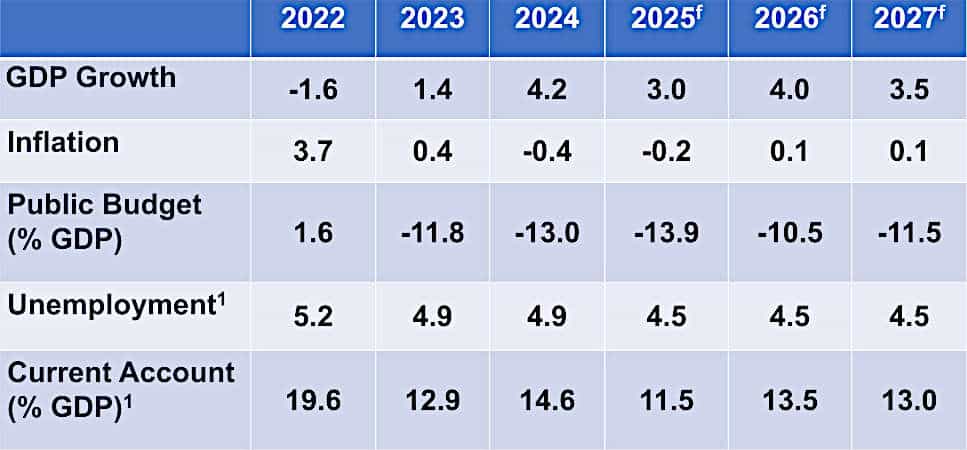
f – forecasts
1 – Trading Economics
Source: IMF/ADB, AMRO except where stated

Source: Worldbox
Useful links
https://www.transparency.org/en/cpi/2021
https://www.imf.org/en/Countries/BRN
https://www.state.gov/reports/2024-investment-climate-statements/brunei/
Global Business Information from Worldbox
Worldbox provides trusted business information on more than 500 million companies across developed and emerging markets.
Access company profiles, credit risk reports, ownership and management details, legal status, financial information and other data to support onboarding, KYB, compliance and risk assessment.
Worldbox data is available through online search, API, Snowflake’s data platform, AWS Marketplace, and AI-ready access through AWS MCP Servers.
Need reliable information on a company or market? Contact Worldbox to discuss your requirements.

 |
 |
 |
 |
Copyright (C) 2026 Worldbox Business Intelligence. All rights reserved.
Our mailing address is:
Worldbox Business Intelligence
Breitackerstrasse 1
Zollikon
Zurich 8702
Switzerland