Worldbox Country Risk Climate October 2025
MALAYSIA
Summary
| Overall Risk Score 24/40 (Stable)
Political risk: Stable 8/10 Economic risk: Stable 8/10 Commercial risk: Stable 8/10 Technology risk: Stable 8/10 The risk assessment of a country is made up of 3 components, being Political, Economic and Commercial. Each component is scored out of 10 with 1 being the highest risk and 10 the lowest. |
ESG Risk: 8/10 (Stable)*
*Environmental, social and governance (ESG) issues are becoming increasingly important to companies, investors and consumers in Southeast Asia. That is why we are now preparing a separate ESG score and section with our quarterly country risk reports. We explain how each country rates, looking at the E, S and G individually, and outline recent developments. |
Political Risk – Stable at 8
Malaysia consists of two regions, peninsular Malaysia and the states of Sabah and Sarawak, which lie on the island of Borneo. It is a multi-ethnic, multi-religious federation encompassing a majority ethnic Malay population in most of its states and an economically powerful Chinese community. Ethnic Indians are the next largest group in the country. Since 1971 Malays have benefited from positive discrimination in business, education and the civil service.
Malaysia appears to have finally entered calmer political waters after experiencing significant political turbulence since 2018. It is also on course to transition from entrenched dominant-party rule to a competitive, multi-party democracy. The United Malays National Organisation (UMNO) dominated the political environment from independence in 1957 until 2018, when it was ejected from office amid corruption scandals. Veteran politician Anwar Ibrahim became the country’s fifth prime minister in less than five years in November 2022.
In November 2024, Anwar completed his second year in power – longer than his three predecessors – with no immediate challenger in sight. The country’s recent political stability, strong economic recovery and growing importance as a hub for artificial intelligence (AI) infrastructure investments augur well for 2025. Moreover, Anwar will not face any significant elections until December 2025, when the Sabah legislative assembly election is due to take place.
Anwar’s government – formed of his progressive coalition, one-time rival UMNO, East Malaysian parties, and a number of smaller parties – appears to be maintaining its cohesion. Meanwhile, divisions within the opposition coalition Perikatan Nasional have widened substantially.
The long-standing rivalry between former prime minister Mahathir Mohamad and the current prime minister Anwar Ibrahim could become a key factor in Malaysian politics yet again. In 1998, after a clash over how to handle the Asian financial crisis and an ensuing power struggle, Anwar, the then deputy prime minister and a highly respected finance minister, was sacked over his calls for reform and an end to cronyism. On the orders of Mahathir, Mr Anwar was subsequently arrested and jailed on charges of corruption and sodomy. Anwar has always denied the charges and claimed he was a victim of a political conspiracy.
In 2016, the two settled their differences and re-united. Mahathir subsequently led a four-party coalition to victory in the 2018 election. Anwar’s wife, Wan Azizah Wan Ismail, served as the deputy prime Minister in Mahathir’s government.
However, in May 2023, Mahathir filed a RM150 million (S$45.9 million) lawsuit against Anwar over remarks suggesting Mahathir had accumulated wealth for personal benefit during his tenure as prime minister. In April 2025, Mahathir reportedly said he would proceed with legal action after Anwar failed to respond to a letter of demand for an apology over the statement.
Now there are reports that the Malaysian Anti-Corruption Commission (MACC) has widened its investigation into Mahathir Mohamad’s alleged overseas assets to include Switzerland. Mahathir remains a powerful force in Malaysia politics, and he and his allies could mount a significant challenge to Anwar. The next election is not due until 2028 but there is speculation that Anwar could call a vote as early as next year.
Economic Risk – Stable at 8
Once dependent on commodities, Malaysia has a diversified economy, with services accounting for around half of GDP and manufacturing another quarter. Agriculture and mining account for much of the remainder. Malaysia is also one of the most open economies in the world, with a trade-to-GDP ratio averaging over 130% since 2010. Openness to trade and investment has been instrumental in employment creation and income growth, with about 40% of jobs in Malaysia linked to export activities, according to the World Bank.
The economy performed strongly in 2024, with low and stable inflation, according to the IMF, which completed an Article IV Mission to Malaysia in December. In the event the economy grew by 5.1% as strong domestic demand and investment offset a downturn in the commodities sector. The IMF said that an uncertain global outlook, “including external risks from deeper geoeconomic fragmentation”, could cause growth to weaken in 2025. However, it added that the faster-than-envisaged implementation of large investment projects in Malaysia could accelerate growth.
Malaysia emerged as a surprise winner from the trade tensions between the US and China. The country aggressively courted American and Chinese firms with tax breaks and other incentives during Trump’s first term as president, attracting multi-billion-dollar investments from companies such as Texas Instruments and Lam Research of the US, and Alibaba and Geely of China.
The country is planning to turn its southern tip into a hub for multinational companies looking for a safe haven. It has signed an economic agreement with Singapore, which would see the establishment of a special Malaysian economic zone where companies will be given financial incentives to build factories.
Trump’s April 2025 decision to impose a tariff of 24% was subsequently reduced to 19% in August. Furthermore, the US is reportedly considering granting tariff exemptions to Malaysia for commodities not produced in the US, including cocoa and palm oil. Malaysia has also asked the US to consider imposing zero tariff rates on its exports of furniture, automotive and aerospace products.
Trump visited Malaysia in October and signed a reciprocal trade agreement. The fact that Malaysia has negotiated the tariffs down by five percentage points and concluded negotiations with the US at a relatively early stage augurs well for future trade relations between the two countries. It also helps allay concerns over the impact of the tariffs on FDI into Malaysia, which should continue at a robust pace.
Under the deal, Malaysia pledged to remove trade barriers and provide preferential market access to various US goods. The deal includes commitments in digital trade, services and investments and Kuala Lumpur pledged to protect labour rights and strengthen environmental protections. Trump also signed an agreement with Malaysia on critical minerals supply.
Malaysia attracted foreign direct investment (FDI) investments of 378.5bn ringgit ($85.8 billion) in 2024, a record figure and up by 14.9% from the previous year. The US was Malaysia’s top foreign investor with a combined 32.8 billion ringgit, followed by Germany 32.2 billion ringgit, China’s 28.2 billion ringgit and Singapore’s 27.3 billion ringgit. The services sector received 66.8% of the investments.
Commercial Risk – Stable at 9
Malaysia benefits from good infrastructure, an English-speaking business and consumer environment, and a well-established legal framework. However, the implementation of national policies varies from state to state, with Kuala Lumpur regarded as the easiest place in which to conduct business.
Corruption remains a challenge: Malaysia ranked 57th among 180 countries in Transparency International’s Corruption Perceptions Index (CPI) for 2024, the same rank as the previous year. Transparency International, the global anti-corruption coalition, argues that Malaysian politicians continually fail to combat corruption because influence and alliance-building trump accountability. Bribery is perceived as a standard business practice, while 71% of Malaysians believe officials are highly corrupt, according to a report by The Diplomat.
The Heritage Foundation ranked Malaysia as the 44th freest economy in its 2025 Index of Economic Freedom. The country scored 67.1, an increase of 1.4 points from last year. Malaysia is ranked 7th out of 39 countries in the Asia-Pacific region. The country’s economic freedom score is higher than the world and regional averages. Malaysia’s economy is considered “moderately free” according to the 2025 Index.
In its December 2024 Article IV assessment press release, the IMF said that the financial sector remains sound, adding that banks’ capital and liquidity positions are robust. Credit growth, corporate and household balance sheets, and real-estate markets would not pose systemic risks, explained the IMF. However, it said that continued vigilance was warranted against pockets of more highly leveraged borrowers, interlinkages between banks and non-bank financial institutions, and climate and cyber risks.
Technology Risk – Stable at 8
The Global Innovation Index (GII), from the World Intellectual Property Organization, is an important index used by countries and multinational companies to assess innovation ecosystems and aid in policymaking and investment decisions.
Malaysia ranked 33rd out of 133 countries in the 2024 GII – its highest achievement since 2016. Notably, it also ranked as the second-highest upper-middle-income country in 2024, after China.
Malaysia also ranked in 15th position globally and third in the ASEAN region in the 2023 ICT Development Index (IDI), published by the International Telecommunication Union (ITU). Malaysia has made rapid progress in recent years – it ranked 64th out of 167 economies in the 2015 ranking.
Government policies
The government is committed to the development of its digital infrastructure, including an expansion of broadband and 5G connectivity, and building up data centres for cloud computing and AI, to boost its competitiveness in the ASEAN region.
Initiatives include the Digital Ecosystem Acceleration (DESAC) initiative and the New Industrial Master Plan 2030 (NIMP 2030), which aim to encourage businesses to embrace digital transformation and develop the nation’s digital literacy and economy.
NIMP 2030 targets these key areas: digital and ICT services, global services, and professional services, as well as manufacturing-related services. In digital services, it aims to create 3000 smart factories by 2030 by integrating advanced technology, leveraging data for strategic insights, and delivering personalized services.
As a result of Malaysia’s development of its digital infrastructure, it is rapidly emerging as a regional tech powerhouse, with major companies choosing the country as a base for their cloud computing networks. The Silicon Valley giants Google, Microsoft, Amazon Web Services and Nvidia are pouring billions into the country, signalling a transformative era for Malaysia’s digital landscape.
Infrastructure
The World Bank ranks Malaysia 2nd in Southeast Asia for infrastructure quality. Investments – amounting to RMB 400bn (US 95bn) alone during the 2021-25 development plan – focus on transportation, utilities, and digital infrastructure, solidifying Malaysia’s position as a regional leader.
The 2026-30 plan also involves heavy investment in infrastructure including a RM43bn grid upgrade to add storage and smart control so the e1QQnergy system can support heavy industrial loads and rising data centre demand. The Plan also encompasses a National Semiconductor Strategy that aims for a cumulative investment of RMB 500bn with RMB25bn in public support across the phases.
Other key infrastructure projects covered by the plan include the completion of the Klang Valley MRT3 Line, expansion of interstate highways like the West Coast Expressway and Pan Island Link 1, and the East Coast Rail Link (ECRL) corridor development with associated industrial parks and the Johor Singapore Special Economic Zone.
Education and skilled staff
Over the past 20 years, the education system has focused on science, engineering and maths-related subjects. Malaysia now has one of the highest levels of STEM graduates in the world. Highly skilled expats are also moving to the country, lured by its low cost of living and low taxes. However, Malaysia is still failing to produce enough skilled workers to meet demand. The semiconductor industry, for example, currently faces a severe shortage of talent, with around 50,000 skilled engineers needed, while Malaysian universities are producing only about 5000 engineers annually.
As part of Malaysia’s labour-market reforms, the government launched the Academy in Industry programme in 2023, subsidising training for school leavers to meet industry needs. Universities and colleges are also working closely with tech companies to ensure that the curriculum aligns with industry requirements.
October Bulletin
Political Risk – Stable at 8
There are concerns that the country is becoming more divided on race and religious grounds. A number of outlets have reported recently on the growth of radical Islam in Malaysia. In July, for example, Deutsche Welle (DW) said that there has been a surge in support for conservative Islamic policies, particularly among younger and more religious Malay voters. It cited the rise of the opposition Perikatan Nasional (PN), or National Alliance, coalition — a five-party grouping that includes the Malaysian Islamic Party (Parti Islam Se Malaysia, or PAS) — that has been gaining popularity and electoral ground over the past decade.
In the 2023 state elections, for example, PN won 146 of the 245 contested seats, and formed governments in several states. The elections cemented PN’s control in the northern and east coast states and demonstrated its growing influence, especially among younger and more conservative Malay voters. DW added that rising public dissatisfaction with the ruling coalition’s perceived liberal agenda poses a significant challenge to Anwar’s hold on power.
In the states PAS governs, such as Kelantan, Terengganu, Kedah, and Perlis, DW reports that the party has been pushing for policies aligned with its conservative Islamic ideology, including efforts to implement Islamic criminal law, enforce stricter dress codes, and promote gender segregation in public spaces. Moreover, a majority of Malay-Muslim voters appear to support greater Islamization of society.
A 2023 Pew Research Centre survey, for example, found that 86% of Muslim Malaysians favoured making Sharia the official law, while 65% say the Quran should influence Malaysian law to a great deal.
DW quoted James Chin, professor of Asian Studies at the University of Tasmania and an expert on Southeast Asia, as saying that the rise of political Islam is the biggest challenge facing Malaysia, both now and for some years to come. China added that:
“The Islamists have devoted themselves to setting up a lot of Islamic religious schools to brainwash young Malays… basically teaching them Islam is the answer to everything.”
In terms of racial tensions, Nikkei Asia has reported that “incendiary remarks, often targeted at ethnic Chinese Malaysians, have been on the rise in recent months, stoking concerns over growing racial tensions and political instability in the Southeast Asian country.” The Japanese agency cited analysts as blaming opposition politicians for fanning ethno-religious sentiments in an attempt to undermine Prime Minister Anwar Ibrahim’s government.
Nikkei added that while friction between Malays and Chinese Malaysians has been a feature in Malaysia’s politics for decades, social media rhetoric has grown more heated over the past couple of years. It claimed that many young Malays are actively spreading hate speech over TikTok and Instagram.
Economic Risk – Stable at 8
Malaysia’s economy expanded 4.4% in the first half of the year, with growth being broad-based, according to the Ministry of Finance. Household spending remained resilient, supported by favourable labour market conditions, subdued inflation, strong domestic tourism, and continuing government measures to sustain consumer purchasing power.
The ministry also cited strong private and public sector activities through higher investment in the manufacturing and services sectors, as well as ongoing infrastructure developments, as key economic drivers amid persistent global uncertainties.
Malaysia’s GDP is projected to expand by between 4.0% and 4.8% in 2025 according to the central bank. In July, the IMF upgraded its growth forecasts for 2025 and 2026 to 4.5% and 4.0% respectively from 4.1 and 3.8% in April.
The country has consistently recorded current account surpluses for more than two decades. S&P forecast that the current account surplus will stabilise at around 2.1% of GDP over the next three years, driven by continued strong demand for Malaysian manufacturing exports. This indicates that Malaysia has sufficient reserve coverage, and S&P expects Malaysia’s deep capital markets to support financial stability.
Headline inflation rose slightly in August 2025 to 1.3%, up from 1.2% in July.
Core inflation, meanwhile, increased 2% in August as compared to 1.8% in the previous month. This marked the fastest reading in four months but still signalling mild underlying price pressures. Worldbox Business Intelligence expects the low inflationary environment to continue given the likelihood of slowing global growth and the strength of the ringgit, which by September 2025, had gained around 5.8% against the dollar over the course of the year.
The central bank lowered the overnight policy rate for the first time in five years in July in a pre-emptive move to support growth. Borrowing costs fell to 2.75% from the 3% level they had been at since May 2023. Given the relatively buoyant economy,
Worldbox Business Intelligence does not expect borrowing costs to fall again this year.
Commercial Risk – Stable at 8
In September 2025, S&P reaffirmed Malaysia’s sovereign credit ratings at ‘A-’ with a “Stable” outlook. According to S&P, the rating affirmation was supported by Malaysia’s well-diversified economy, continued political stability, steady growth momentum, balanced external position, as well as narrowing fiscal deficits. The Ministry of Finance said the review served as a vote of confidence in Malaysia’s macroeconomic management, resulting in better growth prospects than most other sovereigns at similar income levels.
Technology Risk – Stable at 8
In September, Malaysia was reportedly exploring the use of 5G Broadcast technology, with the Malaysian Communications and Multimedia Commission (MCMC) conducting test-bed sessions to assess its potential. Communications Minister Datuk Fahmi Fadzil said the sessions focused on broadcasting services, emergency alert warning systems and public announcements.5G Broadcast allows TV and radio content to be delivered directly to devices without the need for a SIM card, mobile data plan or WiFi, enabling access to live content without interruptions in crowded cities or remote areas.
Environmental, Social and Governance (ESG) – Stable at 8
The United Nations’ Sustainable Development Goals (SDGs) are recognized as a beneficial framework for responsible investment. The Sustainable Development Report from Cambridge University Press assesses the progress of all UN Member States on the SDGs. It provides a useful means of ranking Southeast Asian countries on their ESG progress.
Malaysia is ranked 84 out of 167 in the 2025 report, with a score of 69.5.
Environment: Malaysia faces a number of environmental challenges, including air and water pollution, deforestation and flooding. Malaysia has established a network of protected areas, including national parks and conservation corridors, designed to safeguard remaining primary forests and endangered species habitats. The country has also committed to reaching net-zero carbon emissions by 2050, backed by a 45% reduction in emissions intensity by 2030 and the introduction of a carbon tax in 2026. Parts of Peninsular Malaysia suffer from serious air pollution. The problem is exacerbated by the seasonable burning of crops in Indonesia. Indonesia’s 2025 fire season was one of the worst in recent memory, with a sharp spike in hotspots and toxic haze choking parts of Malaysia.
Social: The US State Department’s 2024 report on Malaysia says that “there were no reports the government or its agents committed arbitrary or unlawful killings, including extrajudicial killings, during the year”.
However, it added that the government regularly restricted freedom of expression for members of the public, nongovernmental organizations (NGOs), and media, citing reasons such as upholding Islam and the special status of ethnic Malays, protecting royalty or national security, maintaining public order, and preserving friendly relations with other countries.
In September 2025, the government introduced the world’s first comprehensive protection bill directly targeting gig workers. It will impact over 1.2 million workers in Malaysia. The new law contains provisions concerning service contracts, the rights of gig workers including just cause for dismissal, provisions concerning dispute resolution and tribunals, and requirements concerning councils governing areas such as minimum remuneration, and social security/health and safety.
Governance: Malaysian public-listed companies are faring well in ESG factors among their ASEAN peers based on leading ESG indicators including disclosure and commitments to sustainability practices, according to an April 2022 report by PwC.
October Bulletin
Environmental, Social and Governance (ESG) – Stable at 8
Malaysia’s real estate sector is undergoing an ESG-driven transformation, aligning with 2050 net-zero goals through new legislation and sustainable initiatives, according to a new report from real estate specialists JLL. It added that three developments in 2025 are driving changes. These include:
- The Energy Efficiency and Conservation Act (EECA), effective January 2025, which sets new building energy efficiency standards.
- BURSA Malaysia’s new Sustainability Reporting Requirements increase transparency and accountability in ESG reporting for listed companies, including real estate corporate occupiers.
- The Corporate Renewable Energy Supply Scheme supports the growth of solar PV capacity by enabling green electricity sourcing.
Latest economic data
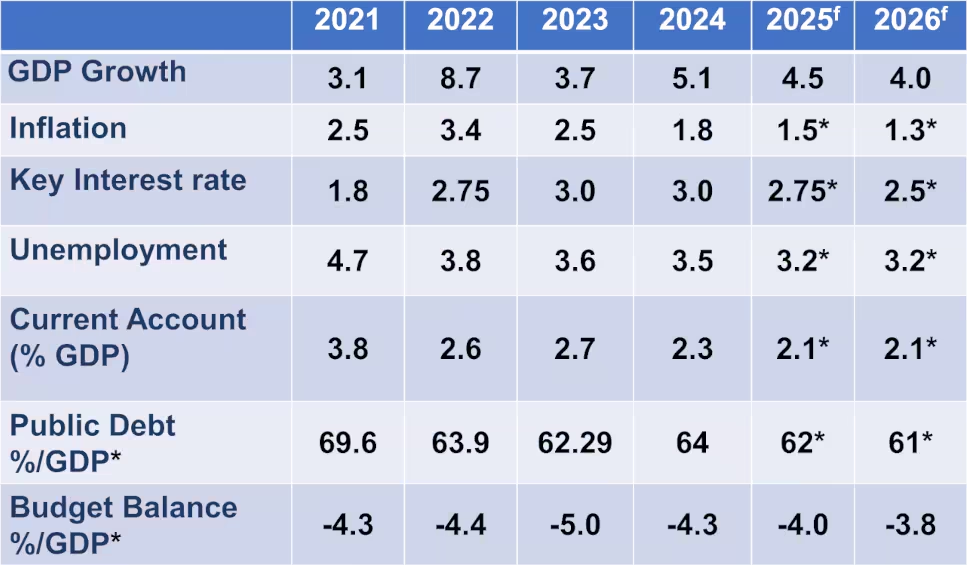
f forecasts
* Worldbox Business Intelligence forecast
Source: International Monetary Fund, official figures, except where stated

Source: Worldbox
Useful Links
https://www.imf.org/en/Countries/MYS
https://www.freemalaysiatoday.com/
About Worldbox Business Intelligence
Switzerland-based Worldbox Business Intelligence is a global leader in business data and intelligence. With over 400 million companies across all major and emerging markets, our solutions support real-time onboarding, KYB, and compliance verification through the delivery of credit reports, profiles, ownership and management, legal status and history details as well as financial and other business information.
Accessible via API, online search, and the AWS MCP Server, Worldbox enables organizations to search, evaluate, and acquire company data with transparent pricing and seamless AI integration.
With its global network and Swiss precision, Worldbox empowers smarter, more efficient business decision-making.
“Worldbox Business Intelligence – Bringing Swiss Precision To Data”
Copyright (C) 2025 Worldbox Business Intelligence. All rights reserved.
Our mailing address is:
Worldbox Business Intelligence
Breitackerstrasse 1
Zollikon
Zurich 8702
Switzerland