Worldbox Country Risk Climate – October 2025
LAOS
Summary
| Overall Risk Score 20/40 (Stable)
Political risk: Stable 7/10 Economic risk: Stable 5/10 Commercial risk: Stable 4/10 Technology risk: Stable 4/10 The risk assessment of a country is made up of 3 components, being Political, Economic and Commercial. Each component is scored out of 10 with 1 being the highest risk and 10 the lowest. |
ESG Risk: 4/10 (Stable)*
*Environmental, social and governance (ESG) issues are becoming increasingly important to companies, investors and consumers in Southeast Asia. That is why we are now preparing a separate ESG score and section with our quarterly country risk reports. We explain how each country rates, looking at the E, S and G individually, and outline recent developments. |
Political Risk – Stable at 7
The Lao People’s Democratic Republic, as Laos is officially known, has been a one-party state since its foundation in 1975 at the end of the Indochina war. The only legal party is the Lao People’s Revolutionary Party (LPRP). There is no organized opposition and no truly independent civil society. A 61-member Central Committee of the LPRP, under the leadership of the 11-member Politburo, makes all major decisions. National Assembly elections are held every five years but are not free or fair, while protests are banned.
The LPRP is now facing perhaps the most challenging period since independence. It oversaw strong economic growth after liberalizing the economy in the late 1980s and early 1990s. During the decade up until 2019, the economy grew by an average of 7% per annum and Laotians enjoyed rising living standards and improved access to electricity and healthcare.
However, the Covid-19 pandemic exposed the country’s economic vulnerabilities. Economic growth fell sharply and inflation surged as the currency depreciated significantly. Many Laotians left the country, while millions more suffered extreme hardship. This background would prove a severe threat to many governments, but in Laos there is no credible alternative to the LPRP, which is why Worldbox Business Intelligence believes the country will remain politically stable.
In July 2025, the government carried out one of its most sweeping restructurings seen in decades. It merged major ministries to cut costs, reducing the number of ministries from 17 to 13. Nikkei Asia quotes the government as saying the goal is that administration becomes “lean, streamlined, efficient and robust,” and described the changes as an “urgent necessity.”
The Ministry of Finance is absorbing the Ministry of Planning and Investment, which has been involved in most foreign-backed infrastructure projects. The Ministry of Industry and Commerce is merging with the Ministry of Energy and Mines, and Ministry of Natural Resources and Environment will merge with the Ministry of Agriculture and Forestry and be renamed the Ministry of Agriculture and Environment. Finally, LPRP’s personnel committee will absorb the Ministry of Home Affairs that has been responsible for civil servant management.
The restructuring highlights the seriousness of the debt crisis facing Laos according to various analysts, including Ian Baird, a professor of geography and Southeast Asian studies at the University of Wisconsin-Madison. Nikkei Asia quoted the academic as saying that “such a sweeping shift, with so many ministries involved, would not have happened if there wasn’t a serious issue with debt and low salaries.”
Economic Risk – Stable at 5
Despite rapid economic growth over much of the past two decades, Laos remains one of the poorest countries in the world. About two-thirds of the population live in rural areas, with many working in agriculture. Yet agriculture contributes only 15% to GDP. Therefore, earnings and farm incomes remain low, and many Laotians lack access to enough safe and nutritious food to meet their dietary needs, according to the World Bank.
Laos was also badly affected by Covid-19. The pandemic severely impacted micro, small and medium enterprises (which make up the vast majority of firms) and businesses owned by women. The tourism and handicrafts sectors were among the worst-affected areas. Meanwhile, the Ukraine war resulted in a surge in inflation that hit the poorest sections of society hardest.
In April 2025, the Lowy Institute published a gloomy assessment of the country’s prospects. Its main finding is that Laos is trapped in a severe debt crisis with no resolution in sight, threatening a decade of economic and social malaise. The Australian think tank added that exiting the crisis will require China to provide substantial debt relief. However, the politics appear unfavourable, as neither side wants to admit failure and accept the consequences.
The ASEAN+3 Macroeconomic Research Office (AMRO) says that public debt remains at unsustainable levels, despite falling to an estimated 99% of GDP in 2024. Laos started paying interest payments in full in 2024, while deferrals of principal to key creditors continued. AMRO adds that external debt in foreign currencies exposes Laos to exchange rate risks, while fiscal risks from contingent liabilities associated with state-owned enterprises and public-private partnerships remain a concern.
The agency forecasts that debt repayments will peak in 2025, elevating financing needs and limiting the room for essential public spending. Revenue collection is projected to strengthen, supported by the reinstatement of fuel excise rates and improvement in tax administration.
Commercial Risk – Stable at 4
Corruption is a significant challenge. Laos ranks 114th out of 180 countries in Transparency International’s (TI) 2024 Corruption Perceptions Index, moving dramatically up from its 2023 place of 136th. In the ASEAN region, Laos is placed level with the Philippines and ahead of Myanmar and Cambodia.
In March 2025, the authorities said they were investigating officials responsible for a hydropower dam that is a decade behind schedule. State funds for construction of Nam Him Boun dam were reportedly embezzled.
The US State Department’s mid-2024 Investment Climate Statement reports that Laos’ government is increasingly tying its fortunes to the economic integration of ASEAN and export-led development, and has prioritized the digital economy, logistics, green growth, and more sustainable development, in addition to continuing to develop agriculture and resource extraction.
The report adds that corruption, policy and regulatory ambiguity, and the uneven application of laws are disincentives to further foreign investment. The multiple ministries, laws and regulations affecting foreign investment in Laos create confusion and require potential investors to engage either local partners or law firms to navigate an opaque and cumbersome bureaucracy.
However, the report notes that the government’s efforts have borne fruit, citing the streamlining of application processes that means it now takes less than 17 days to obtain a business licence, compared with 174 days on average a few years ago.
Technology Risk – Stable at 4
The Global Innovation Index (GII), from the World Intellectual Property Organization, is an important index used by countries and multinational companies to assess innovation ecosystems and aid in policymaking and investment decisions.
Laos ranked 111th out of 133 countries in the 2024 GII – moving up from 113th place in 2020.
Government policies
The government is keen to drive the digitization of the economy and society. However, despite investments in digital infrastructure, Laos lags in digital adoption compared with the rest of East and Southeast Asia. Around 62% of the population had access to the internet in 2023, up from 43% in 2020, while 85% of the population are now mobile-phone users.
The Ministry of Education and Sports (MoES), in partnership with UNICEF and the European Union, has an ambitious digital transformation strategy that includes digital access, digital skills, digital learning, digital information and online safety. The strategy focuses on providing high-quality, accessible educational content in both digital and offline formats. This approach is particularly significant in remote areas, where internet connectivity remains a challenge.
Digitization is also being used to increase financial inclusion. Around 70% of the population of just over 7 million do not have a bank account, and the government is focusing on fintech solutions such as mobile payments and cross-border systems to boost financial inclusion and economic growth. In 2023, it introduced a digital kip, which allows people to pay or transfer money through a QR code regardless of whether they have a bank account.
Infrastructure
Much of Vientiane can access 5G and Lao Telecom has plans to extend that network nationwide. 4G and 3G coverage extends to all major population centres as well as many towns and villages along highways, but coverage in rural and mountainous areas remains patchy.
Average mobile internet speeds in Laos have improved substantially in recent years, thanks to the adoption of newer network technologies such as 4G. According to data from Ookla’s Speedtest Global Index, Laos ranks 86th globally for average mobile internet speeds.
Education and skilled staff
According to UNICEF, Laos still has some of the poorest education indicators in Southeast Asia. Approximately 70% of 5-year-old children are not enrolled in Early Childhood Education programmes, with those in hard-to-reach areas and from poor families being the most excluded. Many of them do not speak the Lao language, which is the official language of instruction. Moreover, only 81.9% of enrolled children complete primary education, and, according to UNICEF, learning outcomes are low, leaving children without essential knowledge and skills. Meanwhile, thousands of students drop out of higher education, vocational education and teacher training, according to the MoES. In many cases, this is due to financial hardship.
Unsurprisingly, against this background, Lao employers report that they cannot find the skilled workers they need to grow their businesses. Information and communication technology is among the worst-affected sectors. The shortages are being exacerbated by the country’s economic problems, which are motivating the most skilled staff to move abroad.
October Bulletin
Political Risk – Stable at 7
Russia is trying to embroil Laos in its war in the Ukraine, according to a report by Poland’s TVP World. It cited Ukrainian military intelligence as saying that Moscow is using humanitarian cover as a pretence to deploy Laotian troops.
The agency said Russia’s military planners had arranged for 50 engineers from the Lao People’s Armed Forces to travel to the southwestern Kursk region of the Ukraine, ostensibly for de-mining activity. Laos is also said to have offered free rehabilitation services for injured Russian troops.
Laos and Russia have long been close allies with Moscow backing the Pathet Lao communist guerrillas during the war against the royalist government that took power after Laos gained independence from France in 1953. Thongloun Sisoulith—now president of Laos and general secretary of the ruling party – was one of the many Laotians sent to university in Moscow. However, backing Russia in its war against Ukraine carries risks for Laos. Other Russian allies, such as North Korea, Iran, Syria, Myanmar, have been subject to sweeping international sanctions for backing Moscow.
Laos is already attracting the attention of Washington. In June, Laos was among 12 countries that had partial travel bans imposed on their citizens. The White House said these “common sense restrictions” would “protect Americans from dangerous foreign actors”. The US has not given any explicit reasons as to why Laos has had a travel ban imposed on it but the country’s close ties to China may have influenced the Trump administration.
Economic Risk – Stable at 5
The Laotian economy expanded by 4.1% in 2024, driven by strong performance in services, electricity, mining, agriculture, and manufacturing, according to the World Bank’s Lao Economic Monitor published in May 2025. It added that tourism was a key driver of growth with foreign tourist arrivals climbing by 21% while domestic travel also increased.
It added that improved connectivity – presumably a reference to the new high speed rail link to China – supported exports and tourism. Industry grew moderately, despite persistent labour shortages. Agriculture remained resilient, bolstered by export demand for non-rice crops and livestock. Challenges persist, however. However, the World Bank added that “double-digit inflation continued to erode household purchasing power, dampen consumption, and increase business costs, while the shortage of workers poses a risk to sustained growth”.
However, conditions appear to have improved in 2025, according to the ASEAN+3 Macroeconomic Research Office (AMRO) following its Annual Consultation Visit to Lao PDR from July 16 to 30, 2025.
AMRO reported that inflation had moderated to single-digit levels, and the kip had stabilized following recent policy reforms. These improvements, AMRO said, reflected the government’s efforts in monetary tightening, fiscal consolidation, and foreign exchange regulation enforcement.
AMRO expects growth of 4.4% in 2025 and 4.2% in 2026, led by robust electricity generation and continued expansion of the services sector. The agency added that a record-high fiscal surplus was posted in 2024, with another surplus projected for 2025, in line with the government’s five-year consolidation goals. These fiscal improvements have contributed to a decline in the public debt-to-GDP ratio from its peak in 2023.
In terms of President Trump’s tariffs, Laos has not won the reprieve negotiated by neighbouring countries. While the likes of Thailand and Vietnam have negotiated down their tariffs to 19% from 36% and 20% from 46% respectively, Laos faces a tariff of 40%. Again, this may reflect Laos’ close ties to China.
Fortunately, exports to the US are relatively minor with China, Thailand, and Vietnam together accounting for over 80% of Lao exports. However, Laos will be affected by any slowdown in global growth.
Laos main exports to the US include footwear, wood furniture, textiles, and electronics components all of which are likely to be hit hard by the new tariff. Small and medium-sized enterprises (SMEs), which make up the backbone of Laos’s economy, are particularly vulnerable, according to the Laotian Times. Many of these businesses, the publication says, have invested in expanding their operations to meet US demand. The US move is likely to increase Laos’ dependency on China.
In January, the US also suspended all aid to Laos, including that aimed at defusing unexploded ordnance (UXO). In a secret war conducted between 1964 and 1973, the US Air Force targeted communist guerrillas and their supply lines in Laos, dropping nearly 2 million tons of explosives and chemical weapons. Around 30% of the bombs failed to explode, and a combined 20,000 Laotians have been killed by UXO since the end of the war.
The US tariffs, aid cuts and the travel ban appear to signal Washington’s acceptance that Laos is now fully in China’s orbit. While other Western countries are continuing with their aid efforts, it is China that is making the most significant contribution.
Commercial Risk – Stable at 4
The financial sector continues to face vulnerabilities, with interest receivables rising for some banks, and bank performance uneven, according to AMRO. The growing dependence on domestic financing risks further raising interest rates. Dollarization remains high, with foreign currency deposits accounting for 69% of broad money. Asset quality risks are emerging as special measures brought in during COVID-19 are phased out.
Technology Risk – Stable at 4
In September, the Faculty of Natural Sciences at the National University of Laos signed an agreement with SX Group to jointly research and develop a Lao Large Language Model that can be incorporated in artificial intelligence. The project also includes the creation of the Lao Corpus, a comprehensive and standardized database of the Lao language. The AI model will enable more accurate understanding and processing of Lao, while the Lao Corpus will serve as the essential data source for training the system.
Environmental, Social and Governance (ESG) – Stable at 4
The United Nations’ Sustainable Development Goals (SDGs) are recognized as a beneficial framework for responsible investment. The Sustainable Development Report from Cambridge University Press assesses the progress of UN Member States on the SDGs. It provides a useful means of ranking Southeast Asian countries on their ESG progress.
Laos is ranked 121 out of 167 in the 2025 report, with a score of 62.55.
Environment – Laos faces a number of environmental challenges. These include seasonal air pollution, mainly due to farmers burning fields to prepare for the next planting cycle. In March 2025, for example, the government reported that air pollution caused by agricultural burning was affecting all parts of the country. Outdoor air pollution is four times higher than global guidelines for human health and peaks during the crop-burning season in March and April. Other major sources of air pollution include vehicle emissions in urban areas and industrial plants using unclean forms of energy. Indoor air pollution, largely caused by using solid fuels for cooking, is another serious hazard. It is estimated to cause 7000 deaths annually.
Forest loss and degradation is also a serious challenge. According to Global Forest Watch, Laos lost 24% of its total tree cover from 2002 to 2023. The pace of deforestation may also be gathering pace as a result of the high-speed rail link to China. It has enabled faster fruit exports from Laos to China, attracting more investment in large-scale plantations, created by clearing forest.
Social – Laos scores very lowly in this area. According to the US State Department, key concerns include credible reports of: arbitrary detention; political prisoners; serious problems with the independence of the judiciary; serious restrictions on free expression and media, including censorship and the use of criminal defamation laws; serious restrictions on internet freedom; substantial interference with the freedom of peaceful assembly and freedom of association; and the inability of citizens to change their government peacefully through free and fair elections.
Governance – Laos also rates very poorly in terms of governance with high levels of corruption and very weak rule of law as outlined in the commercial risk section.
October Bulletin
Environmental, Social and Governance (ESG) – Stable at 4
In September, the government formally recognized the success of the Xayabouly Hydroelectric Power Plant as a regional model of international best practices in sustainable clean energy. The Xayabouly Hydroelectric Power Plant is a run-of-river facility on the Mekong River, generating electricity by harnessing its natural flow without requiring a large storage reservoir.
Latest economic data
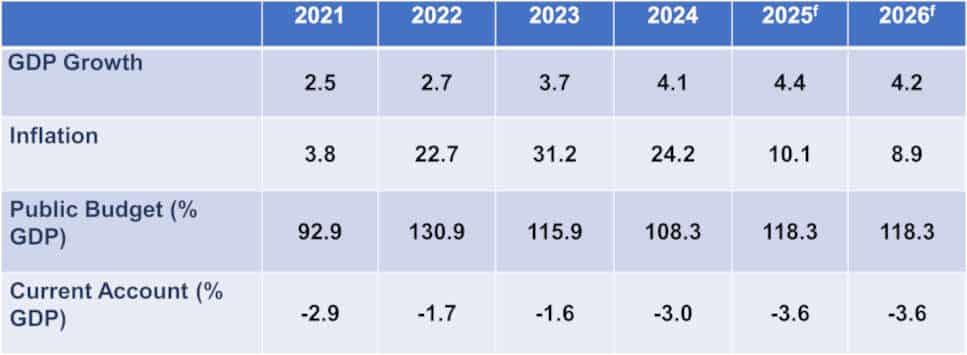
f – forecasts
Source: Worldbox Business Intelligence, AMRO.

Source: Worldbox
Useful Links
https://www.transparency.org/en/cpi/2021
https://www.imf.org/en/Countries/LAO
https://www.adb.org/countries/lao-pdr/main
About Worldbox Business Intelligence
Worldbox Business Intelligence, headquartered in Switzerland, is a Global API data solution provider of business intelligence and used in data analytics.
With the Global API solution Worldbox Business Intelligence enables clients and partners a frictionless real time onboarding, KYC and compliance verification, while rapid global investigations are provided, if needed.
Worldbox Business Intelligence provides global data in a standardised structure on more than 320 Million companies worldwide. It’s global network of subsidiaries, branches and desks allows the precise and efficient collection of data on key target territories for clients and partners.”
“Worldbox Business Intelligence – Bringing Swiss Precision To Data”
Copyright (C) 2025 Worldbox Business Intelligence. All rights reserved.
Our mailing address is:
Worldbox Business Intelligence
Breitackerstrasse 1
Zollikon
Zurich 8702
Switzerland