![[Aggregator] Downloaded image for imported item #115484](https://asiagategroup.com/wp-content/uploads/worldbox-laos-slider-9-14-26.jpg "[Aggregator] Downloaded image for imported item #115484")
Worldbox Country Risk Climate – August 2026
LAOS
Summary
Overall Risk Score
20/40 – Stable (Minor Change)
| Political risk: 7/10 – Stable (Unchanged)
Economic risk: 5/10 – Stable Commercial risk: 4/10 – Elevated (Unchanged) Technology risk: 4/10 – Elevated (Unchanged) A country’s risk rating is based on four areas: political, economic, commercial and technological risk. Each area is scored from 1 to 10, where 1 is the highest risk and 10 is the lowest. |
ESG Risk: 4/10 – Elevated (Unchanged)
Environmental, social and governance (ESG) risk is increasingly important to companies, investors and consumers across Southeast Asia. Our quarterly country risk reports therefore include a separate ESG score and analysis of each country’s environmental, social and governance performance, along with recent developments. |
Political Risk August Update
Stable at 7
The parliamentary elections held on 22 February 2026 were as strictly controlled as ever. All 243 candidates contesting 175 seats were pre-selected by the ruling communist party. However, there are some signs of change with people taking social media to voice criticism of the political environment. In particular, the removal of one of the few lawmakers willing to call out corruption from the candidate list provoked a wave of dissent. AFP reported that the outspoken MP Valy Vetsaphong announced she had removed herself from the ballot, ending her decade-long career in parliament. However, there is scepticism about whether she left of her own accord or was pushed. The AFP added that news of her departure led to some social media users openly expressing support for her online, while others voiced discontent over her exit. AFP quoted a development worker as saying the criticism plus more online discussion about politics and younger candidates on the ballot compared to previous elections pointed to signs of change.
Political Risk – Context
The Lao People’s Democratic Republic, as Laos is officially known, has been a one-party state since its foundation in 1975 at the end of the Indochina war. The only legal party is the Lao People’s Revolutionary Party (LPRP). There is no organized opposition and no truly independent civil society. A 61-member Central Committee of the LPRP, under the leadership of the 11-member Politburo, makes all major decisions. National Assembly elections are held every five years but are not free or fair, while protests are banned.
Just when it appeared that the economic crisis triggered by the Covid-19 outbreak was coming to an end, Laos now faces a fresh challenge from the fallout from the conflict in the Middle East, which has triggered a sharp increase in energy costs and fuel shortages. Overall inflation jumped to double figures in April 2026 heaping further pressure on a population whose living standards have fallen sharply over the past five years.
The government has responded to slumping growth by carrying out significant reforms including merging major ministries to cut costs. According to a November 2025 article in East Asia Forum, a highly-respected Australian publication, the reforms laid the groundwork for “a generational shift towards a more technocratic style of government.” The article argued that leading elites such as those from and close to President Sisoulith, Prime Minister Siphandone and Phomvihane (Kaysone Phomvihane was one of the first leaders of the LPRP) families remain at the core of the Party and hold executive control. But it added that Laos’s emerging technocratic elite appears poised to play a more prominent role in economic management.
East Asia Forum believes two scenarios are possible. In the first, revolutionary veterans retain their hold on power for another five-year term but are likely to give more authority to technocrat cadres in party and government positions. In the second, revolutionary veterans retire, and a cohort of technocrat cadres fill key positions with expanded mandates.
Events at the three-day 12th National Congress of the LPRP in January do appear to indicate that a transition is underway. The Diplomat reported that the Congress marked a partial generational transition within the party, inducting five new Politburo members, who replaced revolutionary veterans born in the late 1940s and early 1950s. General Secretary Thongloun Sisoulith was re-elected and, according to the Diplomat, his vision of an independent, self-reliant economy will shape policy and strategic priorities for 2026 and beyond. This vision reflects concerns about the country’s dependence on China and its reliance on hydropower and resource exports. The government wants to diversify the economy by developing manufacturing, modernising agriculture and promoting tourism.
Overall, however, Worldbox Business Intelligence does not believe that Laos’ political stability is at risk even as living standards remain under pressure. There is no organised or credible opposition. Hundreds of thousands of Laotians have already left the country and Worldbox Business Intelligence believes this exodus will continue, acting as a safety value, and also meaning that street protests are unlikely.
Economic Risk August Update
Stable at 5
The Asian Development Bank has revised down its growth forecast for Laos due to the impact of the Middle East conflict. Economic growth in Laos is now projected to slow to 4% in 2026, down from 4.4% in 2025, before rebounding to 4.5% in 2027. The ADB says that services, power generation, construction and expanding regional connectivity, despite heightened external uncertainties, will be the key drivers of growth. The ADB warned that vulnerabilities linked to external conditions, high public debt servicing obligations and structural constraints are expected to weigh on Laos’ medium-term growth outlook.
Inflation, which fell sharply to 7.7% in 2025 following fiscal and monetary tightening, is forecast to rise to 9.8% in 2026, reflecting higher global oil prices, rising transport costs, and the pass-through effects on food and other imported goods. Additional upward pressure is expected from electricity tariff adjustments and wage increases. There has been some easing of inflationary pressure in recent months. The annual inflation rate declined to 7.4% in June, down from 9.0% in May, according to the Ministry of Finance. However, given the continued instability in the Middle East, it is difficult to assume that the downward trend will continue.
The ADB says that the services sector is expected to benefit from tourism, transport and logistics, particularly as regional connectivity improves through cross-border links such as the Laos-China railway. Foreign visitor arrivals had nearly returned to pre-pandemic levels and are anticipated to stabilise. However, much will depend on how long the Middle East conflict lasts, as air fares surge and airlines cut flights.
Laos is heavily dependent on fuel imports from the Middle East. Around 97% of its fuel and diesel flow in from Thailand, which sources the energy from The Middle East. Thailand has been suffering severe fuel shortages and a sharp rise in the price of diesel but has continued to supply fuel to Laos. Imports of oil into Thailand have surged as Thai refiners seek to diversify supplies, so Laos is unlikely to suffer from fuel shortages but the price of the energy to the end user is likely to surge further unless oil prices fall sharply.
Even if a lasting peace deal is reached between Iran and the USA, oil prices are unlikely to fall sharply in the near future because repairing damaged energy infrastructure in the Gulf region and rebuilding depleted fuel inventories could take several months, possibly longer.
The government has taken measures to stabilise the fuel supply, buying fuel from Vietnam as well as another undisclosed country. It has also unveiled cuts to fuel excise taxes, reducing that tax on petrol to 15% from 25%, and on diesel from 10% zero. The Prime Minister’s Office has also instructed ministries to reduce fuel consumption by rotating staff, increasing remote meetings, and limiting unnecessary travel, according to the Diplomat.
One major concern is that slumping growth and rising inflation will trigger another sharp deprecation in the value of the KIP. Laos external debt is denominated in US dollars, so any depreciation against the dollar would increase debt servicing costs, pushing the country into a vicious downward spiral.
Economic Risk – Context
Despite rapid economic growth over much of the past two decades, Laos remains one of the poorest countries in the world. About two-thirds of the population live in rural areas, with many working in agriculture. Yet agriculture contributes only 15% to GDP. Therefore, earnings and farm incomes remain low, and many Laotians lack access to enough safe and nutritious food to meet their dietary needs, according to the World Bank.
The country has experienced extreme economic distress over the past few years, with many Laotians seeing their incomes under pressure from rising inflation, due to a sharply devaluing currency, rising public debt and unemployment.
The US State Department’s 2025 Investment Climate report says that the China-Lao high speed railway project is having a positive impact on economic growth. It explains that some businesses and investors are beginning to use Laos as a low-cost export base to sell goods within the region and to the United States and Europe. The report adds that the emergence of light manufacturing has begun to help Laos integrate into regional supply chains, and improving infrastructure should facilitate this process, making Laos a potential locale for regional manufacturers seeking to diversify from existing production bases in Thailand, Vietnam, and China. New special economic zones (SEZs) in Vientiane and Savannakhet have attracted manufacturers from Europe, North America, and Japan, while Chinese and Thai interests also have plans for additional SEZ projects.
However, it also warns that growth remains hampered by a shortage of workers with technical skills and education, weak health care systems, and poor transportation infrastructure.
Laos’ increasing dependence on China is highlighted by Beijing’s early offer of help for a plan to build a highway linking Vientiane to the Vietnamese border in northern Laos. The US$6.1 billion, 688-kilometre project should cut cross-border transit times by half and provide a much faster link to Thailand, which lies across the Mekong River from Vientiane. It could turn Laos into a trade gateway.
Unfortunately, the outlook for Laos has deteriorated sharply as a result of the Middle East conflict.
Commercial Risk August Update
Elevated at 4
The World Bank says that the Laos banking sector remains fundamentally adequately capitalized. However, the sector faces critical vulnerabilities driven by currency depreciation, high inflation, and heavy exposure to public debt. While institutional measures have improved, the sector continues to grapple with liquidity constraints and non-performing loans.
Commercial Risk – Context
Corruption is a significant challenge. Laos ranks 109th out of 182 countries in Transparency International’s (TI) 2025 Corruption Perceptions Index, moving dramatically up from its 2023 place of 136th. In the ASEAN region, Laos is placed ahead of Thailand, the Philippines and ahead of Myanmar and Cambodia.
The US State Department’s mid-2025 Investment Climate Statement reports that Laos’ government is increasingly tying its fortunes to the economic integration of ASEAN and export-led development, and has prioritised the digital economy, logistics, green growth, and more sustainable development, in addition to continuing to develop agriculture and resource extraction.
However, it adds that corruption, policy and regulatory ambiguity, and uneven application of laws are disincentives to further foreign investment. The multiple ministries, laws, and regulations affecting foreign investment in Laos create confusion and require potential investors to engage either local partners or law firms to navigate an opaque and cumbersome bureaucracy. The government has attempted to streamline business registration using a one-stop shop model. While businesses acknowledge that this is an improvement, they add that several additional steps must still be taken outside of the single stop. Businesses also complain that there are often different registration requirements at the central and provincial levels.
Technology Risk August Update
Elevated at 4
Laos has launched its first and largest wind farm and the first cross-border renewable energy project in the ASEAN area. The $950m project was developed by Monsoon Wind Power, which was established by a group of companies including Mitsubishi through its subsidiary Diamond Generating Asia, ACEN Renewables International, Impact Electron Siam, STP&I, BCPG and SMP Consultation.
Technology Risk – Context
The Global Innovation Index (GII), from the World Intellectual Property Organisation, is an important index used by countries and multinational companies to assess innovation ecosystems and aid in policymaking and investment decisions.
Laos ranked 109th out of 139 countries in the 2025 GII – moving up from 113th place in 2020. Lao PDR ranks 22nd among the 37 lower middle income group economies. It ranks 16th among the 17 economies in Southeast Asia, East Asia, and Oceania.
Government policies
In January 2026, the government reaffirmed its commitment to advancing digital transformation as a key driver of national development, continuing efforts to enhance e-government services, develop a digitally skilled workforce, and promote overall digital growth. Around 63% of the population now has access to the internet, up from 43% in 2020, while the national fibre-optic network has expanded to over 36,000 kilometres, with 4G coverage reaching 76% of villages. In addition, 5G services have been launched in 59 districts.
Progress has also been made in digital government, with the government intranet network connecting all ministries and provinces. To support business and innovation, the ministry has strengthened legislation and strategic plans covering e-government services, cybersecurity, and startup promotion.
Digitisation is also being used to increase financial inclusion. Around 70% of the population of just over 7 million do not have a bank account, and the government is focusing on fintech solutions such as mobile payments and cross-border systems to boost financial inclusion and economic growth. In 2023, it introduced a digital KIP, which allows people to pay or transfer money through a QR code regardless of whether they have a bank account.
Infrastructure
Laos has benefited from major upgrades to its infrastructure in recent years. The country’s 2026–2030 national development plan aims to continue this trend and transition the country from a landlocked state to a connected regional hub. Major Transport Projects include:
- Construction has begun on a US$6.6 billion, 562-kilometer international railway linking Vientiane to the Vung Ang deep-water port in Vietnam.
- Work has also begun on the US$1.9 billion Vientiane-Hanoi expressway. Laos aims to complete the project by 2029.
- Part of the US$7.1 billion Laos-China Expressway, a 440 km route connecting Vientiane to Boten at the Chinese border has already been built.
Much of Vientiane can access 5G and Lao Telecom has plans to extend that network nationwide. 4G and 3G coverage extends to all major population centres as well as many towns and villages along highways, but coverage in rural and mountainous areas remains patchy.
Average mobile internet speeds in Laos have improved substantially in recent years, thanks to the adoption of newer network technologies such as 4G. According to data from Ookla’s Speedtest Global Index, Laos ranked 85th in the world for mobile speeds and 105th for fixed broadband speeds during February 2026.
Education and skilled staff
According to UNICEF, Laos still has some of the poorest education indicators in Southeast Asia. Approximately 70% of 5-year-old children are not enrolled in Early Childhood Education programmes, with those in hard-to-reach areas and from poor families being the most excluded. Many of them do not speak the Lao language, which is the official language of instruction. Moreover, only 81.9% of enrolled children complete primary education, and, according to UNICEF, learning outcomes are low, leaving children without essential knowledge and skills. Meanwhile, thousands of students drop out of higher education, vocational education and teacher training, according to the MoES. In many cases, this is due to financial hardship.
Unsurprisingly, against this background, Lao employers report that they cannot find the skilled workers they need to grow their businesses. Information and communication technology is among the worst-affected sectors. The shortages are being exacerbated by the country’s economic problems, which are motivating the most skilled staff to move abroad.
Environmental, Social and Governance (ESG) August Update
Elevated at 4
Laos has designated June 5th as a nationwide observance of World Environment Day and National Environment Day and has called on all citizens, businesses, and international partners to unite in discussing ways to mitigate the effects of climate change.
Environmental, Social and Governance (ESG) – Context
The United Nations’ Sustainable Development Goals (SDGs) are recognized as a beneficial framework for responsible investment. The Sustainable Development Report from Cambridge University Press assesses the progress of UN Member States on the SDGs. It provides a useful means of ranking Southeast Asian countries on their ESG progress.
Laos is ranked 121 out of 167 in the 2025 report, with a score of 62.55.
Environment – Laos is amongst the most vulnerable countries to projected climate change trends, facing significant climate-related hazards that are exacerbated by poverty, malnourishment, and high exposure of poor and marginalized communities. Floods and droughts are among the most significant threats.
Illegal mining is another issue. Satellite analysis recently identified 517 suspected riverbank mines in Laos, many likely illegal, with clusters along key Mekong tributaries, raising fears of widespread, unmonitored contamination.
Social – Laos scores very lowly in this area. According to the US State Department, key concerns include credible reports of: arbitrary detention; political prisoners; serious problems with the independence of the judiciary; serious restrictions on free expression and media, including censorship and the use of criminal defamation laws; serious restrictions on internet freedom; substantial interference with the freedom of peaceful assembly and freedom of association; and the inability of citizens to change their government peacefully through free and fair elections.
Governance – Laos also rates very poorly in terms of governance with high levels of corruption and very weak rule of law as outlined in the commercial risk section.
Latest economic data
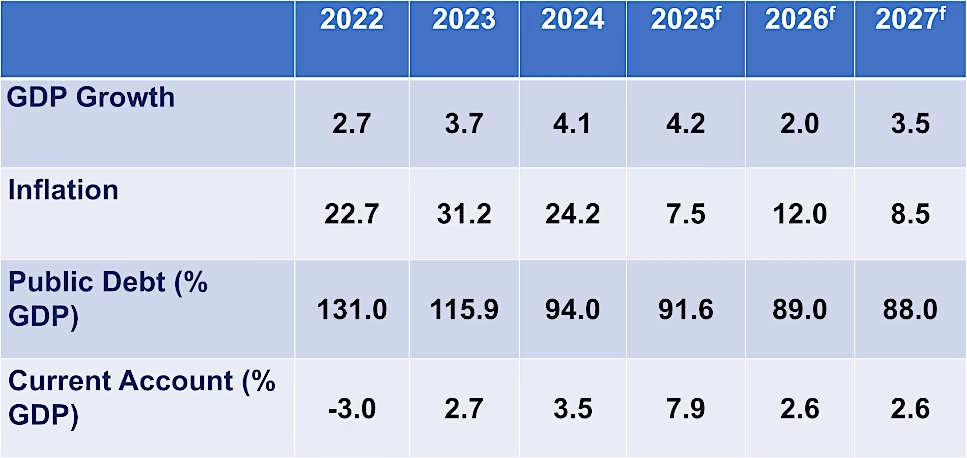
f – forecasts
Source: Worldbox Business Intelligence, /AMRO.
Useful Links
https://www.transparency.org/en/cpi/2021
https://www.imf.org/en/Countries/LAO
https://www.adb.org/countries/lao-pdr/main

Source: Worldbox
Global Business Information from Worldbox
Worldbox provides trusted business information on more than 500 million companies across developed and emerging markets.
Access company profiles, credit risk reports, ownership and management details, legal status, financial information and other data to support onboarding, KYB, compliance and risk assessment.
Worldbox data is available through online search, API, Snowflake’s data platform, AWS Marketplace, and AI-ready access through AWS MCP Servers.
Need reliable information on a company or market? Contact Worldbox to discuss your requirements.

 |
 |
 |
 |
Copyright (C) 2026 Worldbox Business Intelligence. All rights reserved.
Our mailing address is:
Worldbox Business Intelligence
Breitackerstrasse 1
Zollikon
Zurich 8702
Switzerland