Worldbox Country Risk Climate August 2025
MALAYSIA
NEW – Technology is an increasingly important driver of economic success, and we are now including a separate Technology sector in our quarterly country risk reports and integrating the core into our overall score.
Summary
| Overall Risk Score 32/40 (Stable)
Political risk: Stable 8/10 Economic risk: Stable 8/10 Commercial risk: Stable 8/10 Technology risk: Stable 8/10 The risk assessment of a country is made up of 3 components, being Political, Economic and Commercial. Each component is scored out of 10 with 1 being the highest risk and 10 the lowest. |
ESG Risk: 8/10 (Stable)*
*Environmental, social and governance (ESG) issues are becoming increasingly important to companies, investors and consumers in Southeast Asia. That is why we are now preparing a separate ESG score and section with our quarterly country risk reports. We explain how each country rates, looking at the E, S and G individually, and outline recent developments. |
Political Risk – Stable at 8
Malaysia consists of two regions, peninsular Malaysia and the states of Sabah and Sarawak, which lie on the island of Borneo. It is a multi-ethnic, multi-religious federation encompassing a majority ethnic Malay population in most of its states and an economically powerful Chinese community. Ethnic Indians are the next largest group in the country. Since 1971 Malays have benefited from positive discrimination in business, education and the civil service.
Malaysia appears to have finally entered calmer political waters after experiencing significant political turbulence since 2018. It is also on course to transition from entrenched dominant-party rule to a competitive, multi-party democracy. The United Malays National Organisation (UMNO) dominated the political environment from independence in 1957 until 2018, when it was ejected from office amid corruption scandals. Veteran politician Anwar Ibrahim became the country’s fifth prime minister in less than five years in November 2022.
In November 2024, Anwar completed his second year in power – longer than his three predecessors – with no immediate challenger in sight. The country’s recent political stability, strong economic recovery and growing importance as a hub for artificial intelligence (AI) infrastructure investments augur well for 2025. Moreover, Anwar will not face any significant elections until December 2025, when the Sabah legislative assembly election is due to take place.
Anwar’s government – formed of his progressive coalition, one-time rival UMNO, East Malaysian parties, and a number of smaller parties – appears to be maintaining its cohesion. Meanwhile, divisions within the opposition coalition Perikatan Nasional have widened substantially.
In March, Anwar ordered the cabinet to study a two-term limit for the prime minister after agreeing to the proposal from the Democratic Action Party (DAP), the coalition government’s largest party, which relies on support from ethnic Chinese and Indian Malaysians.
The Malaysian Islamic Party (PAS), the largest party in parliament and the opposition bloc’s dominant partner, has countered saying that there should not be a limit and that the prime minister should be a Muslim. PAS is clearly trying to shore up support in its heartlands.
Economic Risk – Stable at 8
Once dependent on commodities, Malaysia has a diversified economy, with services accounting for around half of GDP and manufacturing another quarter. Agriculture and mining account for much of the remainder. Malaysia is also one of the most open economies in the world, with a trade-to-GDP ratio averaging over 130% since 2010. Openness to trade and investment has been instrumental in employment creation and income growth, with about 40% of jobs in Malaysia linked to export activities, according to the World Bank.
The economy performed strongly in 2024, with low and stable inflation, according to the IMF, which completed an Article IV Mission to Malaysia in December. It estimated growth at around 5%. The IMF said that an uncertain global outlook, “including external risks from deeper geoeconomic fragmentation”, could cause growth to weaken in 2025. However, it added that the faster-than-envisaged implementation of large investment projects in Malaysia could accelerate growth.
Malaysia emerged as a surprise winner from the trade tensions between the US and China. The country aggressively courted American and Chinese firms with tax breaks and other incentives during Trump’s first term as president, attracting multi-billion-dollar investments from companies such as Texas Instruments and Lam Research of the US, and Alibaba and Geely of China.
The country is planning to turn its southern tip into a hub for multinational companies looking for a safe haven. It has signed an economic agreement with Singapore, which would see the establishment of a special Malaysian economic zone where companies will be given financial incentives to build factories.
There are some concerns that Trump’s August 2025 decision to impose a tariff of 19% – could slow investment according to the Penang state government’s investment arm, InvestPenang. The body warned that export-oriented companies are exploring supply chain realignments, including shifting production to countries with lower tariff exposure and relocating segments of operations to the US.
Malaysia attracted foreign direct investment (FDI) investments of 378.5bn ringgit ($85.8 billion) in 2024, a record figure and up by 14.9% from the previous year. The US was Malaysia’s top foreign investor with a combined 32.8 billion ringgit, followed by Germany 32.2 billion ringgit, China’s 28.2 billion ringgit and Singapore’s 27.3 billion ringgit. The services sector received 66.8% of the investments.
Commercial Risk – Stable at 8
Malaysia benefits from good infrastructure, an English-speaking business and consumer environment, and a well-established legal framework. However, the implementation of national policies varies from state to state, with Kuala Lumpur regarded as the easiest place in which to conduct business.
Corruption remains a challenge: Malaysia ranked 57th among 180 countries in Transparency International’s Corruption Perceptions Index (CPI) for 2024, the same rank as the previous year. Transparency International, the global anti-corruption coalition, argues that Malaysian politicians continually fail to combat corruption because influence and alliance-building trump accountability. Bribery is perceived as a standard business practice, while 71% of Malaysians believe officials are highly corrupt, according to a report by The Diplomat.
The Heritage Foundation ranked Malaysia as the 44th freest economy in its 2025 Index of Economic Freedom. The country scored 67.1, an increase of 1.4 points from last year. Malaysia is ranked 7th out of 39 countries in the Asia-Pacific region. The country’s economic freedom score is higher than the world and regional averages. Malaysia’s economy is considered “moderately free” according to the 2025 Index.
In its December 2024 Article IV assessment press release, the IMF said that the financial sector remains sound, adding that banks’ capital and liquidity positions are robust. Credit growth, corporate and household balance sheets, and real-estate markets would not pose systemic risks, explained the IMF. However, it said that continued vigilance was warranted against pockets of more highly leveraged borrowers, interlinkages between banks and non-bank financial institutions, and climate and cyber risks.
NEW
Technology Risk – Stable at 8
The Global Innovation Index (GII), from the World Intellectual Property Organization, is an important index used by countries and multinational companies to assess innovation ecosystems and aid in policymaking and investment decisions.
Malaysia ranked 33rd out of 133 countries in the 2024 GII – its highest achievement since 2016. Notably, it also ranked as the second-highest upper-middle-income country in 2024, after China.
Malaysia also ranked in 15th position globally and third in the ASEAN region in the 2023 ICT Development Index (IDI), published by the International Telecommunication Union (ITU). Malaysia has made rapid progress in recent years – it ranked 64th out of 167 economies in the 2015 ranking.
Government policies
The government is committed to the development of its digital infrastructure, including an expansion of broadband and 5G connectivity, and building up data centres for cloud computing and AI, to boost its competitiveness in the ASEAN region.
Initiatives include the Digital Ecosystem Acceleration (DESAC) initiative and the New Industrial Master Plan 2030 (NIMP 2030), which aim to encourage businesses to embrace digital transformation and develop the nation’s digital literacy and economy.
NIMP 2030 targets these key areas: digital and ICT services, global services, and professional services, as well as manufacturing-related services. In digital services, it aims to create 3000 smart factories by 2030 by integrating advanced technology, leveraging data for strategic insights, and delivering personalized services.
As a result of Malaysia’s development of its digital infrastructure, it is rapidly emerging as a regional tech powerhouse, with major companies choosing the country as a base for their cloud computing networks. The Silicon Valley giants Google, Microsoft, Amazon Web Services and Nvidia are pouring billions into the country, signalling a transformative era for Malaysia’s digital landscape.
Infrastructure
The country benefits from stable mobile internet connections, improved transmission speeds, and fixed internet stability. The IDI 2023 report found that Malaysia had achieved near-universal coverage of 4G or LTE mobile networks, high mobile-broadband subscriptions, and affordable prices for mobile and fixed broadband services, as well as high rates of internet usage, mobile-phone ownership and internet traffic.
Education and skilled staff
Over the past 20 years, the education system has focused on science, engineering and maths-related subjects. Malaysia now has one of the highest levels of STEM graduates in the world. Highly skilled expats are also moving to the country, lured by its low cost of living and low taxes. However, Malaysia is still failing to produce enough skilled workers to meet demand. The semiconductor industry, for example, currently faces a severe shortage of talent, with around 50,000 skilled engineers needed, while Malaysian universities are producing only about 5000 engineers annually.
As part of Malaysia’s labour-market reforms, the government launched the Academy in Industry programme in 2023, subsidising training for school leavers to meet industry needs. Universities and colleges are also working closely with tech companies to ensure that the curriculum aligns with industry requirements.
August Bulletin
Political Risk – Stable at 8
As part of China’s efforts to offset the impact of the US-Sino trade war on the economy, Beijing is seeking closer economic ties with Malaysia and the rest of Southeast Asia. Indeed, China is keen to sign a free trade deal with ASEAN. As part of China’s diplomatic efforts in the region, President Xi Jinping visited Malaysia and several other countries in the region in April.
The Singapore Straits Times quoted Malaysian officials as hoping for deeper economic engagement with China to cushion the effect of the tariff imposed on the Malaysia by President Trump. However, the Malaysians – and other Southeast Asian governments – are concerned that signing a free trade deal with China could result in a flood of cheap imports that could destroy swathes of industry.
Investment House CGS International believes the visit could lead to developments beyond trade, particularly in key areas such as infrastructure, industrial parks, technology, and commodities. The Chinese could, for example, be interested in playing a role in the Kuala Lumpur–Singapore High-Speed Rail. CGS also sees potential collaboration or investments from China the semiconductor ecosystem and data centre sector.
Given the new US administration’s foreign policy goal is to focus on the Indo-Pacific and contain China, Washington presumably did not expect the tariffs to result in an expanding Chinese presence in Southeast Asia.
Economic Risk – Stable at 8
Malaysia is unlikely to be significantly impacted by the 19% tariff rate on exports to the US that is due to come into effect in August, according to the central bank. That reflects the diversified nature of the economy with the service sector accounting for 60% of GDP. Moreover, while the US is one of Malaysia’s key trading partners, it accounted for just 11.3% of total trade in 2024.
The government is also ramping up efforts to protect the economy. It is, for example, enforcing anti-dumping duties, countervailing taxes and other safeguards to shield domestic industries from redirected exports stemming from global trade tensions. The government is also intensifying market diversification and targeting the exports of electronics, petroleum products, palm oil and processed foods to new and emerging markets, particularly those in the now-10-member BRICS grouping, as well as those in South America and Africa.
However, Worldbox Business Intelligence has lowered its growth forecast to 4.5% this year and believe growth could slow even further as a result of the US tariffs. The government has forecast growth of 4.5% to 5.5% this year, but is reviewing that figure due to the US tariffs.
Inflation is projected to average between 2% and 3.5% in 2025, according to figures from Malaysia’s central bank, Bank Negara Malaysia. Borrowing costs were last changed in March 2025, staying at the 3% level they have been at since May 2023. The central bank may lower rates in the second half of the year depending on the impact of the US tariffs on the economy.
Commercial Risk – Stable at 8
In January 2025, Moody’s Ratings affirmed Malaysia’s sovereign rating at A3 with a stable outlook, citing strong medium-term growth prospects and effective policymaking institutions. However, it warned that Malaysia’s fiscal metrics remain weak due to the relatively high debt and weak debt affordability amid a narrow revenue base. Malaysia is aiming to reduce the fiscal deficit as a percentage of economic output to 3.8% this year from 4.3% in 2024, leading to a reduction in the debt burden to around 63% of gross domestic product. Given the strong economic background, one might have expected a much larger degree of fiscal consolidation to be taking place.
Technology Risk – Stable at 8
In April, Malaysia proposed a technology safeguard agreement to the US authorities and companies. In response to a question about US tariffs, Investment, Trade and Industry Minister Tengku Datuk Seri Zafrul Abdul Aziz said that many US companies based in Malaysia are exporting to the US, “so, we are working closely with the US companies that will be affected if semiconductors are also on the list of tariffs that will be imposed.” The minister said that 30% of Malaysia’s exports to the US are semiconductors, while another 30% are composed of electrical and electronics products.
Environmental, Social and Governance (ESG) – Stable at 8
The United Nations’ Sustainable Development Goals (SDGs) are recognized as a beneficial framework for responsible investment. The Sustainable Development Report from Cambridge University Press assesses the progress of all UN Member States on the SDGs. It provides a useful means of ranking Southeast Asian countries on their ESG progress.
Malaysia is ranked 79 out of 166 in the 2024 report, with a score of 69.3.
Environment: Malaysia faces a number of environmental challenges, including air and water pollution, deforestation and flooding. The country is committed to keeping 50% of its land area under forest – currently the figure is 54%. High levels of air pollution reach crisis levels every year during the dry season as smoke from fires to clear land for palm oil and pulp and paper plantations in Indonesia blankets much of Malaysia.
In August, Malaysia scrapped a plan to send orangutans overseas in an emulation of China’s “panda diplomacy”. The U-turn won praise from environmentalist organizations, including the World Wide Fund for Nature, which said the decision was “not just a win for wildlife conservation but also a crucial step towards balancing economic growth with environmental sustainability”.
Social: The US State Department’s 2023 report on Malaysia says that, unlike in previous years, “there were no reports the government or its agents committed arbitrary or unlawful killings, including extrajudicial killings, during the year”.
Governance: Malaysian public-listed companies are faring well in ESG factors among their ASEAN peers based on leading ESG indicators including disclosure and commitments to sustainability practices, according to an April 2022 report by PwC.
August Bulletin
Environmental, Social and Governance (ESG) – Stable at 8
Malaysia’s National Sustainable Development Goal Council has approved a National Environmental, Social and Governance (ESG) Strategic Plan. It aims to bring business entities toward ESG compliance and reporting, and even to a level beyond compliance, thus creating a competitive advantage and sustainable development for the country, according to the prime minister.
Latest economic data
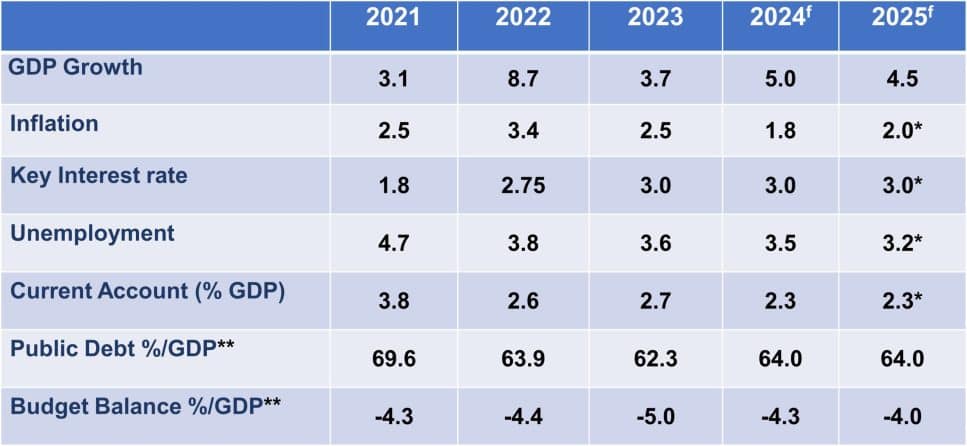
f forecasts
* Worldbox Business Intelligence forecast
** Statista
Source: International Monetary Fund, official figures, except where stated
Source: Worldbox
Useful Links
https://www.imf.org/en/Countries/MYS
https://www.freemalaysiatoday.com/
About Worldbox Business Intelligence
Worldbox Business Intelligence, headquartered in Switzerland, is a Global API data solution provider of business intelligence and used in data analytics.
With the Global API solution Worldbox Business Intelligence enables clients and partners a frictionless real time onboarding, KYC and compliance verification, while rapid global investigations are provided, if needed.
Worldbox Business Intelligence provides global data in a standardised structure on more than 340 Million companies worldwide. It’s global network of subsidiaries, branches and desks allows the precise and efficient collection of data on key target territories for clients and partners.”
“Worldbox Business Intelligence – Bringing Swiss Precision To Data”
Copyright (C) 2025 Worldbox Business Intelligence. All rights reserved.
Our mailing address is:
Worldbox Business Intelligence
Breitackerstrasse 1
Zollikon
Zurich 8702
Switzerland