
Southeast Asia is emerging as a global manufacturing hub, attracting huge inflows of foreign direct investment as multinationals seek to diversify their supply chains and contain costs. Adrian Ashurst, CEO of Worldbox Business Intelligence, highlights developments in key economies.
The small US software supplier Epicor, with a turnover of under a billion dollars, provides an excellent barometer of the rise of manufacturing in Southeast Asia. The Texas-based provider of enterprise resource planning (ERP) software to makers of industrial machinery, automotive parts and electronic components has seen revenues in the region grow by several hundred per cent in the past seven years. It expects Southeast Asia to continue to outperform North Asia as Chinese manufacturers and others relocate production to the likes of Vietnam, Indonesia and Thailand in the face of continuing Sino–US tensions.
Other drivers include: the realisation among global manufacturers, sparked by COVID-19 supply issues, of the need to diversify their global logistics chain; and rising wages in China. According to the management consultants Roland Berger:
“Since 2013, Chinese manufacturing wages have doubled to an average of US$8.27 per hour. This rise stands in stark contrast to hourly manufacturing wages in Vietnam, Thailand or Malaysia which remain below US$3.”
Higher US tariffs are exacerbating China’s competitiveness problems. At the same time, adds Roland Berger, Southeast Asia can draw on an impressive number of people aged between 25 and 54 with a tertiary education.
Surging foreign direct investment (FDI) is driving the region’s rise. For the first time in a decade, Southeast Asia attracted more FDI than China in 2023. Southeast Asia’s FDI amounted to US$206 billion, while China received just US$43 billion. 1
Vietnam and Indonesia lead the charge
McKinsey says Indonesia and Vietnam “are currently leading the manufacturing and trade flow shifts, as indicated by tangible metrics such as FDI and export volumes” 2
The consulting firm adds that:
“In 2023, Indonesia received about $33 billion in greenfield manufacturing FDI and Vietnam about $16 billion, while their exports reached $290 billion and $440 billion, respectively. China, which is expected to remain the key leader in production, is helping drive the production shifts in the region as its manufacturers are increasingly moving their base into Southeast Asia.”
Indonesia’s manufacturing sector focuses on electronics, automotive and textiles, employs around 19 million people, and contributes 19.8% to GDP, while Vietnam’s productive sector is concentrated around textiles, electronics and furniture, employs around 11.96 million people, and contributes 16.4% to GDP 3.
McKinsey says Indonesia and Vietnam’s increasingly strong export performance reflects this growth.
Figure 1: Indonesia and Vietnam’s export growth is outstripping the rest of Southeast Asia
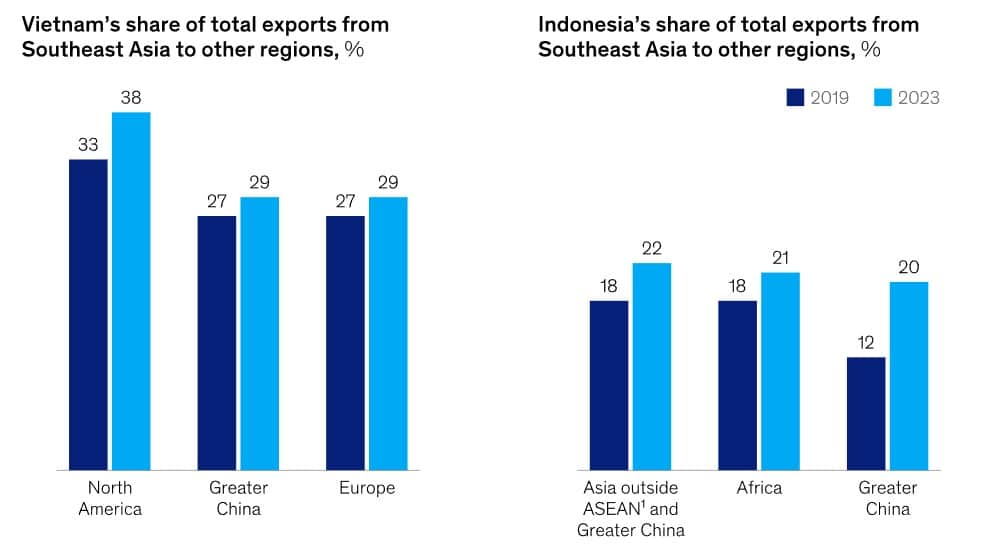
‘The Association of Southeast Asian Nations (ASEAN) is a regional intergovernmental organization comprising 10 countries: Brunei, Cambodia, Indonesia, Laos, Malaysia, Myanmar, the Philippines, Singapore, Thailand, and Vietnam.
Source: IHS Markit
McKinsey & Company
Investment gushes into the region
Vietnam is now the largest exporter in Southeast Asia, with exports rising from US$320 billion in 2019 to US$440 billion in 2023, a compound annual growth rate of over 8%. McKinsey credits substantial FDI in the manufacturing sector, particularly in electronics, as driving this export growth. FDI surged by 7% in the first eight months of the year, reaching US$20.52 billion, with manufacturing accounting for nearly 70% of the inflows.
Indonesia’s magnetic appeal for electric-vehicle makers
Meanwhile, Indonesia’s attempts to attract foreign manufacturers, especially those that hold the promise of skills transfers or raising the country’s technological wherewithal, are also meeting with significant success. FDI in the manufacturing sector increased from less than US$2 billion in 2011 to more than US$20 billion last year.
Electric-vehicle (EV) production has been a key growth area. The country has one of the largest deposits globally of nickel, a key mineral in the production of batteries for EVs. Jakarta has also launched many incentives to achieve its ambition of becoming a major global player in the EV supply chain.
Recent examples of FDI into the EV sector include the Chinese carmaker BYD announcing plans to direct US$1.3 billion into a car plant, with plans to build 150,000 autos a year. The Chinese EV manufacturer Neta Auto also agreed to make Indonesia its production base for right-hand-drive cars for export. And in September, GAC Aion New Energy Automobile, the main EV manufacturing unit of the Chinese state-owned automaker GAC Group, announced that it planned to begin vehicle production in Indonesia from early 2025.
Indonesia certainly does not lack ambition in the manufacturing area, with Rachmat Kaimuddin, Indonesia’s deputy coordinating minister for investment and maritime affairs, being quoted as saying “It took 40 or 50 years to industrialize China. We may have to be faster.” Industrialisation is a key plank in Indonesia’s plans to reach developed-economy status by 2045.
Malaysia bets on the semiconductor industry
Malaysia is also benefiting from huge FDI inflows. Its semiconductor industry, focused on the Penang state, has grown strongly and now accounts for 20.5% of the country’s total manufacturing output. Intel, Texas Instruments and Infineon, among others, have all announced major expansion plans in the country in recent years.
In May, Prime Minister Anwar Ibrahim said that Malaysia is targeting at least 500 billion ringgit (US$107 billion) in investment for its semiconductor industry, as it looks to position itself as a global manufacturing hub. Anwar said the investment would be for integrated-circuit design, advanced packaging and manufacturing equipment for semiconductor chips. The country also wants to set up at least 10 local companies in design and advanced packaging for semiconductor chips, with revenues between US$210 million and US$1 billion.
China drives into Thailand
Recent years have seen a slew of investments in Thailand by Chinese automotive manufacturers, lured by government incentives, with Thailand emerging as a key manufacturing base for EVs and advanced battery technologies. In March, the Thai government said it expected to garner at least US$15 billion in FDI in the next three years, as Prime Minister Srettha Thavisin embarks on a global mission to attract more EV makers and global tech firms.
Recent developments in terms of EV FDI include:
- China’s BYD opened a factory in Rayong in July, after investing around US$900 million. BYD believes the facility will play a crucial role in its international expansion, particularly in Southeast Asia.
- The Chinese battery manufacturer SVOLT, which emerged from the car manufacturer Great Wall, started making battery packs in Thailand in December. Neta of China also started producing SUV EVs in the country during the same month.
- The Chinese EV makers Changan, GAC, Great Wall Motor, Hozon New Energy Automobile, and SAIC Motor are already making or plan to produce EVs in Thailand.
- Meanwhile, Japan’s Toyota, Isuzu and Honda, South Korea’s Hyuandai, and the German auto giants Mercedes-Benz and BMW all have considerable ambitions in the country.
Thailand received investment applications worth 850 billion baht (US$26 billion) in 2023, the highest level in nine years, with FDI applications growing by 72% from a year earlier. Applications in 2024 are expected to total no less than 800 billion baht (US$24.7 billion).
In conclusion, huge inflows of FDI are helping the region to expand beyond traditional industries into sectors such as manufacturing as well as services. That should ensure Southeast Asian economies become much more diversified and are able to rise up the value chain. Certainly, FDI appears if anything to be speeding up, with the region potentially embarking on a growth spree that could last for many years.
Footnotes:
1. https://asianews.network/southeast-asia-set-to-overtake-china-in-growth-and-fdi-says-report/
3. https://www.aseanbriefing.com/news/southeast-asia-manufacturing-tracker/
Source: Worldbox Press Release October 2024
About Worldbox Business Intelligence
Worldbox Business Intelligence, headquartered in Switzerland, is a Global API data solution provider of business intelligence and used in data analytics.
With the Global API solution Worldbox Business Intelligence enables clients and partners also a frictionless real time onboarding, KYC and compliance verification while rapid global investigations are provided, if needed.
Worldbox Business Intelligence provides global data in a standardised structure to more than 200 Million companies worldwide. The global network of subsidiaries, branches and desks allows to precisely and efficiently collect data and target key territories for clients and partners.”
“Worldbox Business Intelligence – Bringing Swiss Precision To Data”
Copyright (C) 2024 Worldbox Business Intelligence. All rights reserved.
Our mailing address is:
Worldbox Business Intelligence
Breitackerstrasse 1
Zollikon
Zurich 8702
Switzerland