

The 3Q 2024 RAM-CTOS Business Confidence Index (BCI) survey indicated that businesses remain firmly optimistic about their prospects for the next three months. The overall index jumped to 58.9 in 3Q 2024 (2Q 2024: 54.0), staying above the neutral threshold of 50 for the third consecutive quarter. This also marks the highest index reading since 2Q 2022 (65.0), as business sentiment continues to improve over the last three surveys. The easing of main challenges, such as rising costs and weak demand, likely underpinned the strong positive sentiment this survey, which polled 109 firms.
Figure 1: Overall index rises for the third successive quarter in 3Q 2024

* The RAM-CTOS sub-index commenced in 1Q 2022. Data points prior to this are derived from the main RAM BCI. The threshold that indicates positive sentiment is 50. Sources: RAM BCI and RAM-CTOS BCI.
MCO = Movement Control Order
All sub-indices, save for capacity utilisation, recorded higher sentiment readings this quarter. The biggest improvements were seen in the sales (+8.3 points q-o-q to 64.7) and profitability sub-indices (+6.4 points to 56.9). Consistent with this observation, the share of firms that view weak economy and rising cost of doing business as major challenges fell further to around 55% and 75%, respectively, from about 65% and 80% in the previous quarter.

Commenting on the improved sentiment, Chris W.K. Lee, Group CEO and Executive Director of RAM Holdings Berhad said, “The continued rise in business optimism is a good sign that the Malaysian economy is on a healthy and sustained growth trajectory, in line with recent improvements in macroeconomic and trade data. This aligns with RAM’s 2024 GDP growth projection of 4.5%-5.5%, an acceleration from the relatively weak 3.6% last year.”
 Erick Hamburger, Group CEO of CTOS Digital Berhad said, “The increasing business resilience is certainly commendable, yet we are mindful that it must be accompanied by robust financial dexterity and data analytics so that businesses are well-positioned to capture the vast opportunities ahead. Our continuous enhancement in digital solutions, including credit scores and risk management, aims to equip and support businesses in both planning and managing future expansion to sustain growth.”
E-invoice implementation still challenging for smaller MSMEs
In this quarter’s thematic query on Malaysia’s e-invoicing rollout, about a quarter of firms surveyed indicated that they are not ready to adopt the system, with smaller micro, small and medium enterprises (MSME) respondents being particularly unprepared. Close to 30% of SMEs and around 65% of micro firms reported that they are not ready, compared to just 13% of corporates. Surveyed firms, especially among MSMEs, cited technical difficulties, lack of training and knowledge as well as cost of implementation as some of the greatest challenges to adopting e-invoicing. These challenges may be attributed to smaller firms’ limited resources and lack of economies of scale.
Figure 2: Technical difficulties among key challenges in e-invoicing adoption
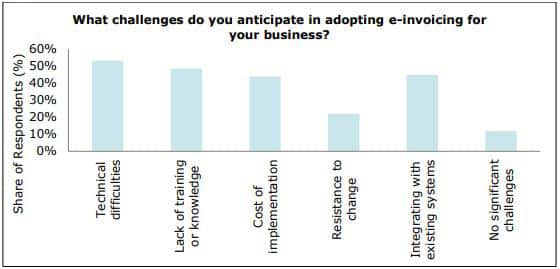
* Percentages sum to more than 100% as firms are allowed to pick more than one response.
Source: RAM-CTOS BCI
Firms want lower tax bills in Budget 2025
Firms surveyed expressed a neutral to slightly optimistic view towards the upcoming Budget 2025. While 45% of respondents carried a neutral sentiment, a notable 38% were positive that the anticipated fiscal policies will support their business, far outweighing the 17% that carried negative sentiment. Tax incentives and reductions top the list of areas that firms hope to see prioritised in Budget 2025, with approximately 73% of firms indicating this as a key focus. This is followed by the need for better access to financing and grants (47%) and support for technology and digital adoption (42%).
Of the policies targeted at MSMEs from Budget 2024, accessing to micro- or lowinterest-financing and automation and digitalisation grants are top policies MSMEs hope to see continue in Budget 2025.
Figure 3: Beyond lowering tax, businesses want more financing options and technology adoption support in the upcoming Budget 2025
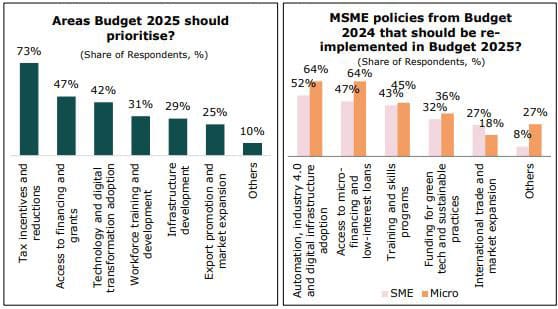
* Percentages sum to more than 100% as firms are allowed to pick more than one response.
Source: RAM-CTOS BCI
About RAM Holdings Berhad
 RAM Holdings is a leading provider of independent credit research and advisory services. RAM Holdings (formerly known as Rating Agency Malaysia Berhad) was established in November 1990 as a catalyst for the domestic debt capital market and as the nation’s first credit rating agency. Its shareholders comprise both local and foreign financial institutions. On 1 July 2007, the rating operations were novated to a newly formed subsidiary, RAM Rating Services Berhad (or RAM Ratings). Today, RAM Holdings spearheads the cultivation of new businesses and continues to provide training as well as economic research that promotes financial and credit expertise, in addition to soft skills. For more information, log on to www.ram.com.my.
About CTOS
 CTOS is Malaysia’s leading registered Credit Reporting Agency (CRA), regulated by the Ministry of Finance under the Credit Reporting Agencies Act 2010. Established in 1990, CTOS facilitates credit extensions by empowering individuals and businesses with access to crucial information at greater ease and speed. CTOS delivers a complete portfolio of credit risk management solutions and services and is widely used by the country’s banking and financial institutions, insurance companies, telecommunication companies, large corporations, SMEs, legal firms and state bodies. For more information, visit our website at www.ctoscredit.com.my.
Source: CTOS
