
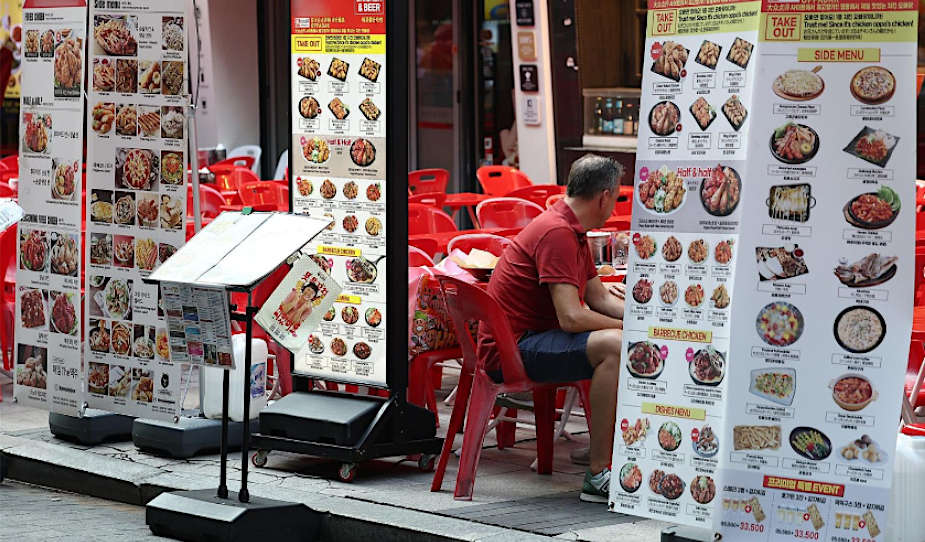
📷 A man sits outside a restaurant in Seoul, July 24. Yonhap.
Debt relief urged for small biz owners, fairness flagged as key concern
The number of self-employed individuals unable to repay their loans on time has surged to three times the level seen four years ago, amid the prolonged economic downturn, an opposition party lawmaker said Sunday.
The increase was especially sharp among those aged 60 and above, who recorded nearly a fivefold jump, making them more vulnerable.
 Rep. Park Sung-hoon of the main opposition People Power Party, a member of the National Assembly’s Strategy and Finance Committee, cited data provided by NICE Information Service, a company offering personal credit information.
The data showed that 161,198 self-employed borrowers were in loan delinquency as of the end of July this year, compared with 51,045 at the end of 2020.
Self-employed borrowers include self-employed workers and small business owners who have taken out business loans under their personal names. Loan delinquents are defined as borrowers who have been overdue on repayments for three months or longer.
The number of self-employed borrowers falling behind on loan repayments grew steadily from 51,045 in 2020 to 63,031 in 2022, then surged sharply to 114,856 in 2023 and 155,060 in 2024.
This sharp increase is believed to reflect the impact of rising interest rates after the end of the COVID-19 pandemic, which made it harder for business owners, who had borrowed at historically low rates during the pandemic, to meet their principal and interest payments.
Consequently, the proportion of delinquent loans within total lending climbed significantly, rising from 1.1 percent in 2020 to 2.7 percent in 2024 and reaching 3.2 percent by the end of July this year.
 Citizens and tourists are seen on the streets of Myeong-dong in Seoul, Aug. 29. Yonhap.
The decline in credit quality was particularly notable among older borrowers.
For borrowers aged 60 and above, the number of delinquents rose fivefold, from 7,191 in 2020 to 35,755 in July, marking the highest growth rate among all age groups. Their average loan amount was also the largest at 298 million won ($214,000).
In its June report, the Bank of Korea also warned that loan delinquency rates among self-employed borrowers remain elevated above the long-term average.
“Their financial liabilities exceed financial assets, while the burden of principal and interest payments is high relative to income,” the report said. “Slow income recovery, resulting from weak performance in the service sector and other factors, may hinder self-employed households’ ability to strengthen their debt repayment capacity.”
Park emphasized that the surge in delinquencies among self-employed individuals is not just a personal issue but also a serious warning for the broader economy.
“The government and financial authorities must act promptly, implementing effective, customized debt relief and recovery support measures,” he said.
 Since his inauguration on June 4, President Lee Jae Myung has also placed particular emphasis on financial policies for self-employed workers and small business owners.
The new administration has been rolling out multiple large-scale support programs to ease their financial burdens, including low-interest refinancing loans, interest reimbursement schemes and the bad bank initiative.
 Kim Dae-jong, a professor at Sejong University’s School of Business, noted that while expanded financial support can aid economic recovery and stabilize employment, policies that lack fairness could trigger backlash.
“Careful planning of both eligibility and implementation methods is crucial,” he said.

Source: koreatimes.co.kr
