![[Aggregator] Downloaded image for imported item #34781](https://asiagategroup.com/wp-content/uploads/worldbox-thailand-slider-5-18-26.jpg "[Aggregator] Downloaded image for imported item #34781")
Worldbox Business Intelligence Risk Rating – May 2026
THAILAND
Summary
| Overall Risk Score 24/40 (Stable)
Political risk: Stable 5/10 Economic risk: Stable 6/10 Commercial risk: Stable 6/10 Technology risk: Stable 7/10 The risk assessment of a country is made up of four components, being Political, Economic, Commercial and Technological. Each component is scored out of 10 with 1 being the highest risk and 10 the lowest. |
ESG Risk: 6/10 (Stable)*
*Environmental, social and governance (ESG) issues are becoming increasingly important to companies, investors and consumers in Southeast Asia. That is why we are now preparing a separate ESG score and section with our quarterly country risk reports. We explain how each country rates, looking at the E, S and G individually, and outline recent developments. |
Political Risk – Stable at 5
Thailand is a constitutional monarchy. The legislature is bicameral, consisting of a directly-elected House of Representatives with 500 seats and an upper house, the Senate, all of whose members are appointed by the Royal Thai Military, under the new Constitution adopted in April 2017, to serve five-year terms.
The King is the Chief of State and the Monarchy is hereditary. Traditionally, he has little direct power but has been able to exert considerable influence over political affairs. In the case of the late King Bhumibol Adulyadej, who reigned from 1946 until his death in 2016, that reflected popular respect. Thailand also has one of the harshest lèse-majesté laws in the world, under which people can be charged for posting, sharing or liking social media posts that are deemed offensive to the monarchy.
The royal family and military usually work in tandem, often using the lèse-majesté laws to suppress political dissent. They were used, for example, to justify the arrests of pro-democracy protesters by the government of former prime minister Prayuth Chan-ocha, who led a military coup in 2014 and remained the country’s leader until August 2023. The 2014 power grab marked Thailand’s 13th successful coup since it became a constitutional monarchy in 1932.
As we forecast in our September 2025 report, the Thai-Cambodian border dispute re-escalated in December. Renewed fighting between the two neighbouring countries had killed at least 32 people, including soldiers and civilians, and displaced around 800,000, by mid-December. Each side has blamed the other for instigating the clashes, claiming self-defence and trading accusations of attacks on civilians. The conflict stems from a territorial dispute over the colonial-era demarcation of their 800km border. Five days of fighting in July killed dozens of people before a truce was brokered by the United States, China and Malaysia.
Thailand and Cambodia signed a fresh ceasefire agreement in late December but a few days after the new pact was signed, Thailand accused Cambodia of breaking the deal.
Shortly after the renewed outbreak of fighting, Prime Minister Anutin Charnvirakul dissolved parliament and called for fresh elections, which were held on 8th February. Anutin capitalised on a nationalist wave whipped up by the border conflict with Cambodia. Anutin’s Bhumjaithai Party (BJT) won around 194 seats in the 500-member House of Representatives, up from 71 seats in the 2023 poll. Meanwhile, the Progressive People’s Party (PP), which led most of the political opinion polls in the run up to the vote, suffered a steep decline – taking just 116 seats, down from the 151 seats won by its predecessor Move Forward in 2023. The Shinanwatra family were the biggest losers, however. Their Pheu Thai (PT), came third with just 76 seats, down from 141 in 2023 – underlining the party’s declining electoral power. The result was seen as a victory for stability over change, and for nationalism over reform.
Anutin has constructed a 15-party coalition commanding roughly 290 seats –comfortably above the 251 needed for a simple majority. Cabinet posts are dominated by Bhumjaithai figures, with several portfolios allocated to key coalition partner Pheu Thac. Critically, lawmakers selected Sophon Zaram, a senior figure in the BJT, as speaker of the 500-member House of Representatives. The speaker plays a pivotal role in parliament, setting the legislative agendas and scheduling key votes for the lower house.
Sixty per cent of voters on 8 February also endorsed a referendum on amending the 2017 constitution crafted by the then military junta. The BJT will try to limit key goals of the reformers such as changes to the unelected Senate and limits to the monarchy’s political prerogatives.
Economic Risk – Stable at 6
Thailand has been one of Southeast Asia’s most dynamic and successful tiger economies. The World Bank points out that over the past four decades, Thailand has made remarkable progress in social and economic development, moving from a low-income to an upper-middle-income country in less than a generation. The economy grew by an annual average of 7.5% during 1960–96 and by 5% during 1999–2005, following the Asian Financial Crisis.
However, Thailand’s growth rate has slumped over the past two decades and it is now one of the weakest performers in Southeast Asia.. As the OECD explains in a December 2025 report, “economic growth is weakening in the face of several long-term challenges. Catch-up in GDP per capita has slowed, and the pace of poverty reduction has diminished.”
Thailand faces a number of challenges that successive governments have failed to address. These include elevated household debt, an ageing population and low productivity. US tariffs, although reduced from the initially announced 36 to 19%, present a significant shock for the economy, while foreign tourist numbers have declined. The war with Cambodia and uncertainty about the long-term political outlook for the country are further problems.
The government has taken measures to address some of these challenges. In October, for example, the government said it would spend 10 billion baht (US$307 million) to buy bad debt. Thailand’s stubbornly high levels of household debt have shackled the economy for several years, with the ratio of household debt to GDP standing at 86.8% by the end of June, among the highest levels in Asia.
However, in November 2025 the IMF urged the government to do more. It called for “urgent structural reforms to strengthen resilience and improve growth potential. Key priorities include deepening trade and financial integration, reinvigorating structural transformation to boost labor productivity, and advancing export sophistication, alongside efforts to enhance social protection, governance, and climate resilience. Together, these policies would support stronger and more inclusive growth and facilitate external rebalancing.”
The OECD, in a December 2025 report, also called for further regulatory reforms, including easing restrictions on foreign direct investment and removing barriers to competition, to boost productivity. It added that creating a level playing field by reducing the dominant role of state-owned enterprises is also key to strengthening productivity in Thailand.
In February 2026, the East Asia Forum has blamed short-term planning and political instability for Thailand’s economic malaise. It explained that:
“Successive Thai governments have inadequately prioritised productivity-raising economic reforms. A succession of short-term crises and domestic political turmoil has diverted attention from the country’s crucial long-term issues in favour of ineffective short-term measures, especially economic stimulus packages. Low productivity, not unemployment, is Thailand’s enduring problem. The continuing policy emphasis on economic stimulus ignores that essential fact.”
Commercial Risk – Stable at 6
Thailand ranked 116th out of 182 countries in Transparency International’s 2025 Corruption Perceptions Index, falling from 107th place in 2024. It has fallen dramatically since 2015 when it was ranked in 38th place. Regionally, it now lies ahead of only the Philippines, Cambodia and Myanmar.
Transparency International made the following recommendations:
-
Establish a justice system and judicial institutions that are independent, transparent and accessible, protected from political or economic interference.
-
Address undue influence over political decision-making by ensuring transparency in political funding.
-
Ensure that those affected by corruption can access justice.
-
Promote civic space and anti-corruption reporting, which are fundamental freedoms, including media freedom and the right to access information.
-
Enhance transparency and oversight in public services and national budget management.
-
Prevent, detect and punish corruption and large-scale illicit financial flows.
Thailand ranks 85th in terms of economic freedom, according to the Heritage Foundation’s 2025 index, down from 42nd in 2021. The Foundation says that Thailand’s economic fundamentals remain relatively solid, but economic freedom still faces challenges that include the need to advance institutional reform. It cites persistent political instability, which undermines the country’s investment climate and economic potential, as a major concern. It adds that the judicial system remains inefficient and vulnerable to political interference, and corruption persists.
The US State Department’s 2025 Investment Climate Statement advises US entities (and the warning is applicable to all foreign entities) planning to invest in Thailand to obtain qualified legal advice. It explains that Thai business regulations are governed predominantly by criminal rather than civil law. It adds that while foreigners are rarely jailed for improper business activities, yet violations of business regulations can carry heavy criminal penalties.
Technology Risk – Stable at 7
The Global Innovation Index (GII), from the World Intellectual Property Organization, is an important index used by countries and multinational companies to assess innovation ecosystems and aid in policymaking and investment decisions.
Thailand ranked 45th out of 139 countries in the 2025 GII. Thailand ranks 10th among the 17 economies in Southeast Asia, East Asia, and Oceania. It ranks 4th among the 36 Upper middle-income group economies.
The 2025 World Digital Competitiveness Ranking highlights Thailand’s decline in digital competitiveness. Thailand dropped one rank to 38th place, with technology being the main drag on its competitiveness, reflecting poor progress in several sub-factors, including regulatory frameworks, capital, and technological framework. A key weakness is the lack of private investment in AI, despite strong potential in this area.
Government policies
Thailand Digital Economy and Society Development Plan (2018–2037) is the country’s main plan for developing its digital economy and society which drives cross-sector collaboration as one of the driving mechanisms. The Plan aims to:
- Develop high-efficiency digital infrastructure nationwide.
- Drive the economy with digital technology.
- Build a society with thorough and equal quality with digital technology.
- Transform the public sector into digital government.
- Develop and prepare manpower for the era of digital economy and society.
- Build confidence in digital technology usage.
The National Board of Digital Economy and Society forecasts that Thailand’s digital economy will expand by 4.2% in 2026, slowing slightly from the 5.0% growth expected in 2025 but still growing twice as fast as the overall economy, which the Ministry of Finance projects to expand by only 2.0%. The digital economy is expected to reach a value of 5.6 trillion baht in 2026. The digital economy should benefit from the upturn in the global electronics cycle, increased investment in advanced technologies, and strong growth in data centre businesses and AI adoption across industries — all key pillars of Thailand’s new digital infrastructure.
Infrastructure
Thailand is investing heavily in infrastructure, much of it focused on building its Eastern Economic Corridor (EEC). There are three key megaprojects at the core of these infrastructure plans:
-
A high-speed rail linking Bangkok’s international airports at Don Mueang and Suvarnabhumi, with the emerging aerospace hub at U-Tapao International Airport. The project is scheduled to begin construction soon. When completed, this will seamlessly link Bangkok with the future “Aerotropolis” at U-Tapao.
- The Laem Cha Bang deep seaport (Phase 3) upgrade seeks to increase its total cargo capacity to 18.1 million 20-foot equivalent units (TEU) per year using the automated system and advanced full-scale services. This project has an estimated cost of CAD 4.2 billion. Construction is ongoing, with phased completion expected by 2027.
- Development of the U-Tapao International Airport and its “Aerotropolis”, promoting investments in aerospace and aviation-related industries. The Thai government has been in discussions with major international aerospace firms to develop aircraft maintenance and related facilities. The project will support the country’s vision of becoming an ASEAN technological, manufacturing and service hub with strong connectivity to its neighbours, the ASEAN region, and beyond.
In addition, Thailand aims to transform Thailand’s Eastern Economic Corridor into a digital powerhouse, focusing on telecom infrastructure and smart city development. The plan will focus on enhancing the digital infrastructure and services to be modern, efficient, and capable of supporting future technological investments. The overall goal is to improve the quality of life for the people in the area and develop the EEC into a smart city of international standards.
Thailand is also experiencing huge investment in data centres with around 70 projects planned or underway, driven by global demand for AI and supported by government tax incentives. These projects are concentrated in the country’s EEC. In April 2026, for example, Microsoft announced plans to invest more than US$1 bn in cloud and AI data centre infrastructure and operations in Thailand over the next two years. Google launched a new “cloud region” in Bangkok in January, saying its data centres would contribute more than US$40bn in economic value to Thailand over five years. The country aims to have 1 gigawatt of data centre capacity by 2027, up from roughly 0.35 GW in 2024, driven by growing AI demand abroad and at home.
Education and skilled staff
Thailand faces a shortage of both quantity and quality in STEM workers, with its education system not yet able to produce a workforce that matches the needs of the modern labour market. An ageing work force is exacerbating the skills gap. Many experienced engineers are approaching retirement, leaving a gap that younger professionals are not yet equipped to fill. The lack of specialised training in robotics, artificial intelligence, and smart manufacturing further exacerbates the issue, as employers struggle to find candidates with the necessary skills. Thailand can address this problem by reforming its education system and encouraging students into STEM subjects. It could also ease work permit regulations, making Thailand an attractive destination for international engineers and other STEM specialists.
May Bulletin
Political Risk – Stable at 5
The new government faces a number of key challenges, the most critical of which is kickstarting Thailand’s economic growth, a challenge made even harder by the conflict in the Middle East, which will have a dramatic impact on Thai living standards and employment. Thailand is reliant on oil and gas imports, and is already suffering from a spike in fuel prices. Anutin’s first task will be to deal with surging inflation and the cost of living. Fuel shortages have already led to long lines at fuel stations, with people rushing to fill up amid fears of rising prices as government subsidies end. Farmers, especially rice growers, face disruptions during critical planting and harvesting periods, being unable enough diesel for machinery and water pumps.
In late March, Thailand agreed a deal with Iran to allow its vessels and tankers to traverse the Strait of Hormuz, potentially alleviating the country’s energy supply crunch. However, given the possibility of the conflict escalating there is no guarantee that the deal will last.
The BJT has pledged to fix the long-term problems facing the economy through a mix of consumer subsidies, cheap credit, business-friendly technocrats and promoting a “green economy.” Its campaign platform included support for community solar projects and measures to lower household electricity bills. However, these measures alone will do little to address the problems of an ageing population, low productivity, and high household debt.
Economic Risk – Stable at 6
The economy grew by 2.2% in 2025, well below Thailand’s peers in the region and the outlook for 2026 is even worse, according to the Bank of Thailand and the Thai Ministry of Finance. Much will depend on how long the conflict in the Middle East lasts. Thailand currently imports around 50% of of its crude oil from the Gulf and net oil imports are equivalent to 4.7% of GDP, the highest share in the region. High oil costs will impact the economy in a number of ways. High levels of debt are already constraining consumer spending and higher energy costs will leave Thais with even less disposable income, placing further pressure on private consumption. High energy costs will also impact manufacturing, which is already under pressure from Chinese imports, and the service economy.
The rising cost of jet fuel is likely to slow further the recovery of Thailand’s tourism sector, following a disappointing 2025 when the country recorded its first annual decline in international arrivals in a decade, excluding the Covid-19 pandemic years. International arrivals fell 7.23% year-on-year to 32.9 million visitors in 2025. The decline was most pronounced in short-haul markets, traditionally Thailand’s strongest feeder base. Chinese arrivals were projected to plunge 33%, while visitor numbers from Hong Kong fell 29%, South Korea 16% and Taiwan 11%. A combination of factors undermined the market. These include the Thai-Cambodian conflict, kidnapping concerns and an unexpected earthquake to severe flooding in Hat Yai in southern Thailand which disrupted transport with Malaysia. Tourism accounted for around 20% of GDP before the pandemic in 2019 and created employment for millions of often low-skilled Thais.
The Bank of Thailand forecasts the economy will grow by just 1.5% and 2.3% respectively in 2026 and 2027, reflecting weak exports, high household debt, and reduced consumption. The global economy could also fare poorly in 2026 depending on how long the Middle East conflict lasts, given high oil prices act like a hefty tax, depressing global economic activity.
The Bank of Thailand cut its policy rate by 25 basis points to 1.00% in February to help offset the impact of US tariff uncertainty and a strong baht. Further cuts are possible this year if the economy continues to slow. Inflation remains subdued with the consumer price index falling 0.88% in February from a year earlier, marking the 11th straight month of negative headline rate. However, the energy price shock could quickly lift prices. Energy and food together account for roughly 70% of the consumer price basket. Over the past year, softer energy prices have kept overall inflation below the Bank of Thailand’s target range of 1%-3%.
Commercial Risk – Stable at 6
Fitch said in February that the coalition’s stability would determine whether Thailand can reduce entrenched political uncertainty and deliver predictable fiscal policy. It pointed to Thailand’s long history of political unrest, noting that since the May 2023 election the country has seen three prime ministers and three acting prime ministers.
Thai banks fear that NPLs could rise as oil prices climb following the outbreak of the Middle East conflict, with SMEs in tourism, transport and energy facing mounting repayment pressure. Higher oil prices are feeding through to transport costs, electricity bills and overall living expenses, weighing on consumer purchasing power and weakening borrowers’ repayment capacity. Mortgage lending remains subdued and is unlikely to worsen significantly, while auto loans may see a shift in demand towards electric vehicles, reflecting changing consumer behaviour, according to the Nation newspaper. The publication added that banks are also adopting a more cautious stance, with a “wait-and-see” approach to investment. Measures include reviewing budgets, delaying unclear projects and encouraging remote working to reduce costs.
Technology Risk – Stable at 7
Thailand is experiencing a surge in foreign investment, much of it technology-related, with applications up nearly 70% in 2025, as the country strives to become a regional technology hub focused on data centres, semiconductors, and electric vehicles. The main investors are Singapore, much of it involving production base expansion by parent companies from China, followed by the United States, Hong Kong and China, respectively. Data centres and semiconductors, particularly printed circuit boards, have seen particularly heavy investment with many major global manufacturers setting up production bases in Thailand.
Environmental, Social and Governance (ESG) – Stable at 6
The United Nations’ Sustainable Development Goals (SDGs) are recognized as a beneficial framework for responsible investment. The Sustainable Development Report from Cambridge University Press assesses the progress of all UN Member States on the SDGs. It provides a useful means of ranking Southeast Asian countries on their ESG progress.
Thailand is ranked 43 out of 167 in the 2025 report, with a score of 75.34.
The US State Department’s 2025 Investment Climate Statement says that Thailand values the importance of environmental, social, and governance (ESG) disclosures, with both the SEC and the Bank of Thailand focused on this issue. SEC regulations on Sustainable and Responsible Investing fund disclosure requirements came into effect in April 2022, and the SEC, as the stock exchange regulator, mandates ESG reporting for listed companies in the 56-1 One Report annual public filing. The Stock Exchange of Thailand (SET) also provides resources, guidelines, and training to help companies with sustainability disclosures follow global reporting standards, including the Global Reporting Initiative (GRI) standards. In addition, SET annually announces Thailand Sustainability Investment (THSI), a list of Thai-listed companies with outstanding sustainability performance.
Environment – Thailand faces some severe environmental issues. Air pollution is among the most serious, particularly during “the burning season”, when farmers in Thailand and surrounding countries burn off stubble. The season lasts from December to May. In March 2026, the northern city of Chiang Mai was ranked the worst polluted among major global cities.
The issue of deforestation is more severe in Thailand than in many other Southeast Asian countries, primarily due to the rapid clearance of forests to accommodate agricultural expansion necessitated by population growth and the country’s focus on exporting agricultural products. The government is seeking to curb deforestation, but challenges persist, with incidences of illicit tree cutting and conversion of forested land into agricultural use continuing to pose threats to conservation efforts.
There are growing concerns about the impact of the growth of data centres in the country on the environment. Data centres require large volumes of water for cooling and major electricity supply, raising concerns about wastewater contamination and increased burning of fossil fuels.
Social – The law provides for the right of workers in certain private-sector and state-owned enterprises to form and join independent trade unions, while Thais also enjoy the right to universal healthcare and a pension. There is a minimum wage law, although it does not cover some areas, such as government officers, state enterprise employees, domestic workers, maritime workers and agricultural workers.
Governance – Thailand ranked ninth on the Asian Corporate Governance Association’s recent report card on 12 Asia-Pacific markets in 2023, down from eighth place in 2020. Thailand’s fall was due in particular to lower scores for listed companies, investor participation and public governance. In 2024, the SEC and Stock Exchange of Thailand introduced new rules to flag or suspend the stock of troubled companies and escalate investigations.
May Bulletin
Environmental, Social and Governance (ESG) – Stable at 6
Among Asian nations, Thailand is one of a few leading the way in ESG initiatives, sustainability reporting, and sustainable finance, according to a January 2026 report from Deloitte. It added that the Thai authorities have been setting ESG disclosure standards and a common reference standard for classifying and categorizing Thailand’s green economic activities (Thailand Taxonomy) and introducing tax incentives for investments in sustainable finance. The report notes various risks that affect ESG initiatives in different sectors. For example, in consumer and industrial goods, pollution and waste are major challenges.
Latest economic data
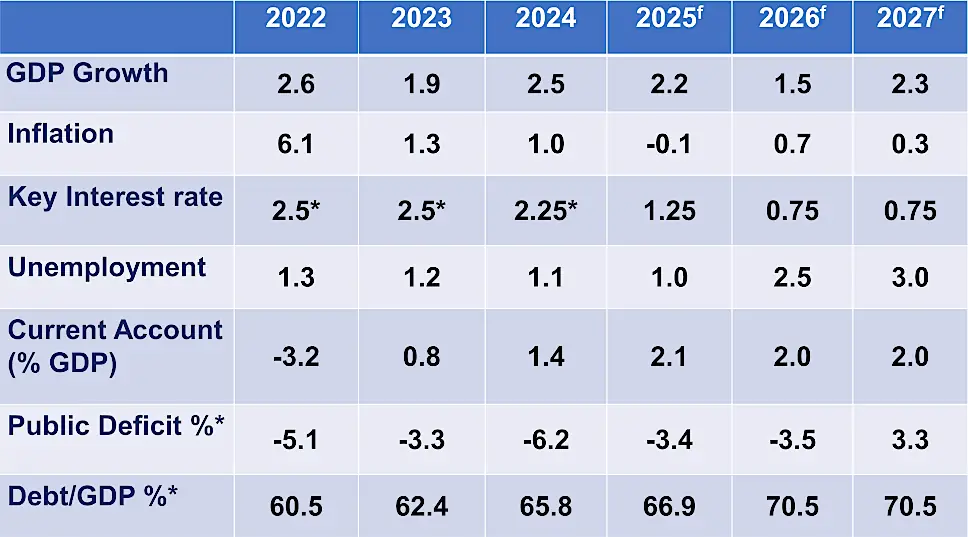
f forecasts
* Worldbox Business Intelligence
Source: IMF November 2025, World Bank except where stated
Source: Worldbox
Useful links
https://www.bangkokpost.com/news
https://www.nationthailand.com/
https://www.imf.org/en/countries/tha
https://www.adb.org/where-we-work/thailand
About Worldbox Business Intelligence
Switzerland-based Worldbox Business Intelligence is a global leader in business data and intelligence. With over 400 million companies across all major and emerging markets, our solutions support real-time onboarding, KYB, and compliance verification through the delivery of credit reports, profiles, ownership and management, legal status and history details as well as financial and other business information.
Accessible via API, online search, and the AWS MCP Servers, available over AWS marketplace, Worldbox enables organizations to search, evaluate, and acquire company data with transparent pricing and seamless AI integration.
With its global network and Swiss precision, Worldbox empowers smarter, more efficient business decision-making.
“Worldbox Business Intelligence – Bringing Swiss Precision To Data”
 |
 |
 |
 |
Copyright (C) 2026 Worldbox Business Intelligence. All rights reserved.
Our mailing address is:
Worldbox Business Intelligence
Breitackerstrasse 1
Zollikon
Zurich 8702
Switzerland